Riddles of the Week
למודי משה | February 20, 2026
Print This Article
View Original PDF

Riddles of the Week

למודי משה | February 15, 2026

Riddles of the Week

(For answers see above)

  1. In this week’s parsha we learn that Klal Yisrael were commanded to give donations towards the Mishkan. The halachah is (Yoreh Deah 248:4) that when receiving tzedokah from a woman, one is only allowed to receive a small amount, as if it is a large amount she may be giving it without her husband’s knowledge and contrary to his wishes. When the women donated towards the Mishkan, were they only allowed to donate a small amount, or was it okay for them to give large donations?
  2. If a woman becomes ill when she sees another Jew suffering due to lack of money, may she give large amounts of tzedokah without her husbands consent?
  3. The Gemara in a number of places (Shabbos 90, Erachin 6, and Menachos 107) mentions that on top of the Beis HaMikdash there was something called כליא עורב . Rashi in Menachos explains that this was spikes to scare away the ravens and to stop them from sitting on top of the Beis HaMikdash. The question is, the Gemara in Succah (28a) relates that when Yonason Ben Uziel would learn Torah, any bird that would fly overhead would immediately get burnt up, if so, surely the Beis HaMikdash which was more kadosh, should have also burnt up any birds that flew overhead, so why did they need spikes to deter the birds?
  4. As gold is more valuable than wood, why was the aron made of wood instead of gold, which would give more honor to the Torah housed therein?
  5. Which eight parts of the body are mentioned in the description of the Mishkan and its vessels in Parshas Terumah?
  6. The name of which person from the Megillah (although with different nekudos) is found in this week’s parsha?
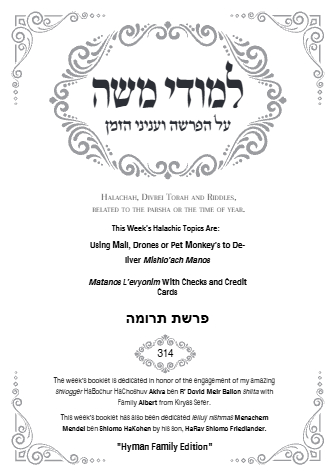
Riddles of the Week

(For answers see above)

  1. In this week’s parsha we learn that Klal Yisrael were commanded to give donations towards the Mishkan. The halachah is (Yoreh Deah 248:4) that when receiving tzedokah from a woman, one is only allowed to receive a small amount, as if it is a large amount she may be giving it without her husband’s knowledge and contrary to his wishes. When the women donated towards the Mishkan, were they only allowed to donate a small amount, or was it okay for them to give large donations?
  2. If a woman becomes ill when she sees another Jew suffering due to lack of money, may she give large amounts of tzedokah without her husbands consent?
  3. The Gemara in a number of places (Shabbos 90, Erachin 6, and Menachos 107) mentions that on top of the Beis HaMikdash there was something called כליא עורב . Rashi in Menachos explains that this was spikes to scare away the ravens and to stop them from sitting on top of the Beis HaMikdash. The question is, the Gemara in Succah (28a) relates that when Yonason Ben Uziel would learn Torah, any bird that would fly overhead would immediately get burnt up, if so, surely the Beis HaMikdash which was more kadosh, should have also burnt up any birds that flew overhead, so why did they need spikes to deter the birds?
  4. As gold is more valuable than wood, why was the aron made of wood instead of gold, which would give more honor to the Torah housed therein?
  5. Which eight parts of the body are mentioned in the description of the Mishkan and its vessels in Parshas Terumah?
  6. The name of which person from the Megillah (although with different nekudos) is found in this week’s parsha?
PDF Preview



