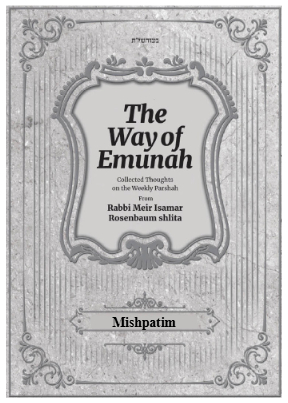
The Way Of Emunah
The Way of Emunah | February 08, 2026
Print This Article
View Original PDF

The Way Of Emunah

The Way of Emunah | February 08, 2026

greatness. A short while later, he was appointed Rov of the large city of Ostroha, where he established a yeshiva and taught Torah to many students. This also gave him the ability to publish his Sefer Turei Zahav and to write teshuvos to halachic shailohs that were sent to him from around the country.

He once wrote in a teshuva that whiskey has the halachic status of “chamar medinah” (a national beverage), and it, therefore, can be used for Kiddush on Shabbos morning. He wrote that this applies to all cities, with the exception of Posna, where the residents cannot tolerate whiskey. In his humility, he thought the reason he had been sent away from that city was because the people there had an aversion to whiskey, so he ruled that it cannot be “chamar medinah” for them.

When this teshuva was publicized, it caused great consternation in Posna. They were especially upset about the fact that other communities were mocking them for being singled out as prohibited from making Kiddush on whiskey.

They sent some of the distinguished members of their community to Ostroha to ask forgiveness from the Taz. He greeted the guests with a smile and had delicacies served to them. After they were seated, they asked why he hadn’t placed any whiskey on the table for a “l’chaim”, as is customary.

He told them, “I know that you don’t like whiskey. After all, you evicted me from your city because I drank whiskey...”

They then understood everything and explained that they had nothing against whiskey per se, but they had suspected that he was a drunkard. They didn’t realize that he only drank a little bit to keep warm. They asked him mechillah for suspecting him and, of course, he forgave them. He then issued a proclamation that the residents of Posna may also use whiskey for Kiddush on Shabbos morning.

This story is written in the pinkus (communal notebook) of the city of Posna as a lesson to future generations to be careful to maintain the honor of Chochomim.

Even a Tzadik Must Help

כִּי תִרְאֶה חֲמוֹר שׂנַאֲךָ וגו' עָזֹב תַּעֲזֹב עִמּוֹ (כג, ה)
When you see the donkey of your enemy... you shall surely unload with him. (23:5)

The Torah is teaching us that every Yid, even a Gadol Hador, is obligated to help his friend in his time of need.

Sefer Toldos HaGra relates that when the Vilna Gaon zy”a was a young man, he went into a self-imposed exile, wandering from place to place in anonymity. He once was traveling on the road when he met a wagon driver who was on his way to a nearby town. The driver was sitting alone in his wagon, and he asked the Gaon where he was headed. When the Gaon said that he was headed to the same town the driver was going to, the waggoneer offered him a ride, and the Gaon boarded the wagon.

This story took place during the summer, when it was very hot and sunny. The Gaon took off his overcoat and sat on the wagon in his talis and tefillin, immersed in Torah and tefillah. After an hour of travel, the wagon driver turned to him and said, “I am very tired. I have to take a short nap. Can you please take the reins and lead the horses for a little while? The horse knows the way very well, so it should be very easy.”

The Gaon was very happy to have been given an opportunity to perform the mitzvah of “azov ta’azov”. He took the driver’s place, while the driver went to sleep in the back. As they entered the city, a certain individual who happened to have once been in Vilna and knew what the Gaon looked like, recognized him. He thought to himself, “If the Vilna Gaon is the wagon driver, the person sitting in the wagon must be Moshiach!”

He began running in the streets, screaming, “Rabosai, Moshiach is here!”

All the men, women and children came running from their houses, asking where Moshiach was. The man told them, “I saw with my own eyes a wagon being driven by the Vilna Gaon himself. Moshiach must be in that wagon!”

The entire crowd stood and waited to greet Moshiach, but when the wagon reached them, they found only a simple waggoneer sleeping in the back.

Healed by Bread and Water

וַעֲבַדְתֶּם אֵת ה' אֱלֹקֵיכֶם וּבֵרַךְ אֶת לַחְמְךָ וְאֶת מֵימֶיךָ וַהֲסִרֹתִי מַחֲלָה וגו' (כג, כה)
And you shall serve Hashem, your G-d, and your bread and water will be blessed, and I will remove sickness... (23:25)

Rav Eliezer of Zhikov zy”a explains that sicknesses can sometimes be healed by local doctors, using medicines and treatments that are available locally. A person who contracts such an illness can be healed easily. Other times, the remedy is not available locally, and one must travel a long distance to get medicine and treatment. Usually, only a man of means can afford the cost of travel and being treated by the top doctors who specialize in his ailment. So what does a poor man who finds himself in such a situation do? His only course of action is to place his trust in Hashem and to daven to Him.

Thus, the Torah states that if one serves Hashem, He will bless his bread and water and remove sickness from his midst. In other words, Hashem will make it that all the medicine he needs to be healthy is found in his bread and water, and he will be unaffected by illnesses that would require travel or top specialists.

The Main Thing is for the Head to be There

וַיֹּאמֶר ה' אֶל מֹשֶׁה עֲלֵה אֵלַי הָהָרָה וֶהְיֵה שָׁם וגו' (כד, יב)
And Hashem said to Moshe, “Come up to Me to the mountain and be there...” (24:12)

Why did Hashem tell Moshe to “be there”? Isn’t it obvious that if he goes up the mountain that he will be there?

The Kotzker Rebbe zy”a explains that even if someone climbs to the top of a mountain, it is possible that he isn’t really there. While his body may be atop the mountain, his mind may be elsewhere. The Torah is teaching us that the main thing is not ascending the mountain to be close to Hashem. Rather, the main thing is for one’s head to be with Hashem!

Rectifying all the Days of Shovavim

In most years, this Shabbos is the last one of Shovavim. Rav Tzadok of Lublin zy”a (Sefer Pri Tzadik) writes that even if someone failed to rectify himself during the previous days if Shovavim, he can do so on this Shabbos. He writes that “if the end is good, it is all good“.

For this reason, this Parshah (Mishpatim) is situated right after the Aseres Hadibros (Parshas Yisro). This teaches us that a person should never despair. Even if he transgressed the entire Torah, he can still fix himself on this Parshah. Just like Shemittah and Yovel (which are discussed in this Parshah) represent freedom and redemption, one can free himself from the yeitzer hara and become a true servant of Hashem.

Saved in the Merit of Future Mitzvos

The Gemara (Megillah 13B) states: “It was known and revealed to Hashem that Haman would one day gather shekalim to use against Klal Yisroel. Therefore, He put our shekalim before his shekalim. This is as is stated that on the first day of Adar they announce the shekalim“.

Sefer Tiferes Shmuel asks how the shekalim protected the Jews at the time of Mordechai and Esther if the Bais Hamikdosh did not exist then and no one was giving shekalim.

He answers by quoting what is written in Sefarim Hakedoshim about the great place Klal Yisroel has before Hashem. Whenever any nation is at war with another country and needs assistance, Hashem takes out their record book to see if they possess any merit that makes them worthy of being saved. If He does not find a zechus, He does not help them. However, if Klal Yisroel needs assistance, even if they do not possess any merit that would make them worthy of a miracle, He counts the zechusim of mitzvos they will do in the future and saves them in that merit because we have a history of doing mitzvos and He knows that we will do it.

This even occurred when the world was first created. Despite the fact that KIal Yisroel had yet to do any mitzvos, Hashem still credited them for the mitzvos they would do in the future.

Chazal say that Hashem actually created the world in the merit of these future mitzvos. They say (see Rashi, Bereishis 1:1): “Bereishis bara. In the beginning, He created. In the merit of Yisroel that are called ‘the first.’”

We find the same idea at the time of the exodus from Mitzrayim (see Rashi, Shemos 13:11-12). Moshe Rabenu asked Hashem in what merit Klal Yisroel was being taken out of Mitzrayim and Hashem answered that He was saving them in the zechus of the mitzvos they would do in the future, after they receive the Torah.

We can now explain the Medrash that says that Hashem put Klal Yisroel’s shekalim before Haman’s This means that Hashem put the zechus of our shekalim that we would give in the future in order to counteract the shekalim of Haman, even though those shekalim would not be given until the Bais Hamikdosh was rebuilt.

This is also the meaning of the Gemara’s words that “on the first of Adar they announced the shekalim.” This means that Hashem announces in shomayim that the zechus of the shekalim that will be given in the future is already enough to help Klal Yisroel.

The same applies today. When we need Hashem’s help, we ask Him to have mercy on us in the merit of the mitzvos that we will do after He saves us from our enemies.

We also recite this in the piyyut: “The light of the general and personal geulah should shine upon us in the merit of the shekalim that we will give in the Bais Hamikdosh in the future.”

The Tefilas Mussaf of the Belzer Rebbe

Rav Eliezer Dovid Friedman zt”l (Sefer M’Pi Sefarim V’Sofrim, Chelek 1, page 281) relates that Rav Shalom of Kaminka zy”a once spent Shabbos with the Sar Shalom of Belz zy”a. When he returned home, he was shown a sefer written by an early source that discussed matters of emunah and was made up of “chakiros” (philosophical questions on the Torah.)

He said, “If the author of this sefer had ever heard the Belzer Rov davening Tefillas Mussaf of Parshas Shekalim, he wouldn’t need to engage in such chakiros in order to have emunah in Hashem Yisborach!”

Finding His Sister

The following story was related by Rav Nosson Gestetner zt”l (quoted in Chodesh B’Chadsho 5766, page 1):

In the years of “Tach V’Tat” (5408-5409) many pogroms took place against the Jews and the Shach had to flee from the marauding bands of murderers. The Shach’s sister also fled from her father’s home, and she made her way to the home of a wealthy man who took her in as a servant in his house. When the Shach came to this city, he also stayed in this man’s home, without knowing that sister was there, and he sat and learned all day in a loud voice, as he was accustomed to do.

As he learned, the wealthy man heard the servant girl crying in a neighboring room. When he asked her what was wrong, she said that her brother, Rav Shabsi, had learned in her parents’ home, learning with a sweet voice. When she heard this masmid learning, it reminded her of her brother, and how she had no idea what happened to him. After she described her brother to her boss, he realized that he was, in fact, the masmid learning in his house. At that time, the Shach blessed his sister to merit a family of offspring that would be great in Torah and mitzvos and who would light up the world with their Torah. Several years later, she married Rav Yitzchok zt”l, and her sons included Rav Meir Eisenstadt zy”a, author of Shu”t Panim Me’iros.

The Debate With the Magen Avrohom

Sefer Sar Torah relates the following story:

The Shach once came to the city of Kalish, where he delivered a drasha in the bais medrash. The Magen Avrohom zy”a was in attendance and had a question on the Shach’s words. When the Shach returned to his lodgings, the Magen Avrohom sent his student to ask his question. He told the student, “I assume that when you ask this question, he will offer such-and-such answer. If he says this, ask him such-and-such question...”

When the student met the Shach, he spoke with clarity and wisdom, as he had been instructed. After they finished discussing the drasha, the Shach began speaking to him about other Torah topics. He saw that the student was not as fluent in them as he seemed to be on the topic of the drasha and realized that he must have been sent by someone else. He demanded that the student tell him who sent him and, with no other choice, the student revealed that it was the Magen Avrohom.

The Shach told him to return to his teacher and to tell him that he wished to speak to him in person. When the Magen Avrohom arrived, he began speaking in learning with the Shach and their discussion became very heated, developing into a full-blown debate.

In the midst of the learned debate, there was a man in the house who he had come for a din Torah and had fallen ill. The other people in the house saw that the man was near death and told the Shach that he must hurry and leave the house because he was a kohen.

The Shach banged on the table with his cane and said, “I command him to wait.”

He added, “As long as we are here, he will not die. So I am permitted to stay here.”

And so it was. As long as the Shach was arguing in learning with the Magen Avrohom, the man remained alive. But as soon as he walked out the door of the house, the man died.

One Can Only Get What is Decreed for Him

The Ibn Ezra was extremely poor. He was destitute throughout his entire life. His good friend, the Rambam, wanted to help him financially, but the Ibn Ezra vehemently refused to accept monetary support from anyone.

The Rambam tried to think of a way to help him and he came up with an idea. He knew that the Ibn Ezra davened Shacharis every day in the bais knesses near his house and that he crossed a bridge to get there. He decided to put some money on the bridge. According to halacha, if one finds loose money with no identifying marks, it belongs to the finder. Therefore, the Ibn Ezra would be able to keep the money without having to take tzedakah.

The Rambam left the money on the bridge the next morning, right before the Ibn Ezra came along. He then hid behind a tree and saw the Ibn Ezra coming. However, he was shocked to see his friend walking with his eyes firmly closed, and he didn’t even notice the money.

The Rambam ran over to the Ibn Ezra and asked him, “Why are you walking with your eyes closed?”

The Ibn Ezra answered, “I cross this bridge every day. Today, I wanted to see if I knew it so well that I could cross it with my eyes closed, and I discovered that I could!”

The Rambam then told the Ibn Ezra about his plan to leave money on the bridge and the Ibn Ezra said, “There is a fundamental rule that a person only receives what he is meant to have. If one is not meant to have something, there is no way for him to get it. Even if someone gets ahold of something not meant for him, he will somehow lose it.”

May their memories be a blessing for all of Klal Yisroel.
greatness. A short while later, he was appointed Rov of the large city of Ostroha, where he established a yeshiva and taught Torah to many students. This also gave him the ability to publish his Sefer Turei Zahav and to write teshuvos to halachic shailohs that were sent to him from around the country.

He once wrote in a teshuva that whiskey has the halachic status of “chamar medinah” (a national beverage), and it, therefore, can be used for Kiddush on Shabbos morning. He wrote that this applies to all cities, with the exception of Posna, where the residents cannot tolerate whiskey. In his humility, he thought the reason he had been sent away from that city was because the people there had an aversion to whiskey, so he ruled that it cannot be “chamar medinah” for them.

When this teshuva was publicized, it caused great consternation in Posna. They were especially upset about the fact that other communities were mocking them for being singled out as prohibited from making Kiddush on whiskey.

They sent some of the distinguished members of their community to Ostroha to ask forgiveness from the Taz. He greeted the guests with a smile and had delicacies served to them. After they were seated, they asked why he hadn’t placed any whiskey on the table for a “l’chaim”, as is customary.

He told them, “I know that you don’t like whiskey. After all, you evicted me from your city because I drank whiskey...”

They then understood everything and explained that they had nothing against whiskey per se, but they had suspected that he was a drunkard. They didn’t realize that he only drank a little bit to keep warm. They asked him mechillah for suspecting him and, of course, he forgave them. He then issued a proclamation that the residents of Posna may also use whiskey for Kiddush on Shabbos morning.

This story is written in the pinkus (communal notebook) of the city of Posna as a lesson to future generations to be careful to maintain the honor of Chochomim.

Even a Tzadik Must Help

כִּי תִרְאֶה חֲמוֹר שׂנַאֲךָ וגו' עָזֹב תַּעֲזֹב עִמּוֹ (כג, ה)
When you see the donkey of your enemy... you shall surely unload with him. (23:5)

The Torah is teaching us that every Yid, even a Gadol Hador, is obligated to help his friend in his time of need.

Sefer Toldos HaGra relates that when the Vilna Gaon zy”a was a young man, he went into a self-imposed exile, wandering from place to place in anonymity. He once was traveling on the road when he met a wagon driver who was on his way to a nearby town. The driver was sitting alone in his wagon, and he asked the Gaon where he was headed. When the Gaon said that he was headed to the same town the driver was going to, the waggoneer offered him a ride, and the Gaon boarded the wagon.

This story took place during the summer, when it was very hot and sunny. The Gaon took off his overcoat and sat on the wagon in his talis and tefillin, immersed in Torah and tefillah. After an hour of travel, the wagon driver turned to him and said, “I am very tired. I have to take a short nap. Can you please take the reins and lead the horses for a little while? The horse knows the way very well, so it should be very easy.”

The Gaon was very happy to have been given an opportunity to perform the mitzvah of “azov ta’azov”. He took the driver’s place, while the driver went to sleep in the back. As they entered the city, a certain individual who happened to have once been in Vilna and knew what the Gaon looked like, recognized him. He thought to himself, “If the Vilna Gaon is the wagon driver, the person sitting in the wagon must be Moshiach!”

He began running in the streets, screaming, “Rabosai, Moshiach is here!”

All the men, women and children came running from their houses, asking where Moshiach was. The man told them, “I saw with my own eyes a wagon being driven by the Vilna Gaon himself. Moshiach must be in that wagon!”

The entire crowd stood and waited to greet Moshiach, but when the wagon reached them, they found only a simple waggoneer sleeping in the back.

Healed by Bread and Water

וַעֲבַדְתֶּם אֵת ה' אֱלֹקֵיכֶם וּבֵרַךְ אֶת לַחְמְךָ וְאֶת מֵימֶיךָ וַהֲסִרֹתִי מַחֲלָה וגו' (כג, כה)
And you shall serve Hashem, your G-d, and your bread and water will be blessed, and I will remove sickness... (23:25)

Rav Eliezer of Zhikov zy”a explains that sicknesses can sometimes be healed by local doctors, using medicines and treatments that are available locally. A person who contracts such an illness can be healed easily. Other times, the remedy is not available locally, and one must travel a long distance to get medicine and treatment. Usually, only a man of means can afford the cost of travel and being treated by the top doctors who specialize in his ailment. So what does a poor man who finds himself in such a situation do? His only course of action is to place his trust in Hashem and to daven to Him.

Thus, the Torah states that if one serves Hashem, He will bless his bread and water and remove sickness from his midst. In other words, Hashem will make it that all the medicine he needs to be healthy is found in his bread and water, and he will be unaffected by illnesses that would require travel or top specialists.

The Main Thing is for the Head to be There

וַיֹּאמֶר ה' אֶל מֹשֶׁה עֲלֵה אֵלַי הָהָרָה וֶהְיֵה שָׁם וגו' (כד, יב)
And Hashem said to Moshe, “Come up to Me to the mountain and be there...” (24:12)

Why did Hashem tell Moshe to “be there”? Isn’t it obvious that if he goes up the mountain that he will be there?

The Kotzker Rebbe zy”a explains that even if someone climbs to the top of a mountain, it is possible that he isn’t really there. While his body may be atop the mountain, his mind may be elsewhere. The Torah is teaching us that the main thing is not ascending the mountain to be close to Hashem. Rather, the main thing is for one’s head to be with Hashem!

Rectifying all the Days of Shovavim

In most years, this Shabbos is the last one of Shovavim. Rav Tzadok of Lublin zy”a (Sefer Pri Tzadik) writes that even if someone failed to rectify himself during the previous days if Shovavim, he can do so on this Shabbos. He writes that “if the end is good, it is all good“.

For this reason, this Parshah (Mishpatim) is situated right after the Aseres Hadibros (Parshas Yisro). This teaches us that a person should never despair. Even if he transgressed the entire Torah, he can still fix himself on this Parshah. Just like Shemittah and Yovel (which are discussed in this Parshah) represent freedom and redemption, one can free himself from the yeitzer hara and become a true servant of Hashem.

Saved in the Merit of Future Mitzvos

The Gemara (Megillah 13B) states: “It was known and revealed to Hashem that Haman would one day gather shekalim to use against Klal Yisroel. Therefore, He put our shekalim before his shekalim. This is as is stated that on the first day of Adar they announce the shekalim“.

Sefer Tiferes Shmuel asks how the shekalim protected the Jews at the time of Mordechai and Esther if the Bais Hamikdosh did not exist then and no one was giving shekalim.

He answers by quoting what is written in Sefarim Hakedoshim about the great place Klal Yisroel has before Hashem. Whenever any nation is at war with another country and needs assistance, Hashem takes out their record book to see if they possess any merit that makes them worthy of being saved. If He does not find a zechus, He does not help them. However, if Klal Yisroel needs assistance, even if they do not possess any merit that would make them worthy of a miracle, He counts the zechusim of mitzvos they will do in the future and saves them in that merit because we have a history of doing mitzvos and He knows that we will do it.

This even occurred when the world was first created. Despite the fact that KIal Yisroel had yet to do any mitzvos, Hashem still credited them for the mitzvos they would do in the future.

Chazal say that Hashem actually created the world in the merit of these future mitzvos. They say (see Rashi, Bereishis 1:1): “Bereishis bara. In the beginning, He created. In the merit of Yisroel that are called ‘the first.’”

We find the same idea at the time of the exodus from Mitzrayim (see Rashi, Shemos 13:11-12). Moshe Rabenu asked Hashem in what merit Klal Yisroel was being taken out of Mitzrayim and Hashem answered that He was saving them in the zechus of the mitzvos they would do in the future, after they receive the Torah.

We can now explain the Medrash that says that Hashem put Klal Yisroel’s shekalim before Haman’s This means that Hashem put the zechus of our shekalim that we would give in the future in order to counteract the shekalim of Haman, even though those shekalim would not be given until the Bais Hamikdosh was rebuilt.

This is also the meaning of the Gemara’s words that “on the first of Adar they announced the shekalim.” This means that Hashem announces in shomayim that the zechus of the shekalim that will be given in the future is already enough to help Klal Yisroel.

The same applies today. When we need Hashem’s help, we ask Him to have mercy on us in the merit of the mitzvos that we will do after He saves us from our enemies.

We also recite this in the piyyut: “The light of the general and personal geulah should shine upon us in the merit of the shekalim that we will give in the Bais Hamikdosh in the future.”

The Tefilas Mussaf of the Belzer Rebbe

Rav Eliezer Dovid Friedman zt”l (Sefer M’Pi Sefarim V’Sofrim, Chelek 1, page 281) relates that Rav Shalom of Kaminka zy”a once spent Shabbos with the Sar Shalom of Belz zy”a. When he returned home, he was shown a sefer written by an early source that discussed matters of emunah and was made up of “chakiros” (philosophical questions on the Torah.)

He said, “If the author of this sefer had ever heard the Belzer Rov davening Tefillas Mussaf of Parshas Shekalim, he wouldn’t need to engage in such chakiros in order to have emunah in Hashem Yisborach!”

Finding His Sister

The following story was related by Rav Nosson Gestetner zt”l (quoted in Chodesh B’Chadsho 5766, page 1):

In the years of “Tach V’Tat” (5408-5409) many pogroms took place against the Jews and the Shach had to flee from the marauding bands of murderers. The Shach’s sister also fled from her father’s home, and she made her way to the home of a wealthy man who took her in as a servant in his house. When the Shach came to this city, he also stayed in this man’s home, without knowing that sister was there, and he sat and learned all day in a loud voice, as he was accustomed to do.

As he learned, the wealthy man heard the servant girl crying in a neighboring room. When he asked her what was wrong, she said that her brother, Rav Shabsi, had learned in her parents’ home, learning with a sweet voice. When she heard this masmid learning, it reminded her of her brother, and how she had no idea what happened to him. After she described her brother to her boss, he realized that he was, in fact, the masmid learning in his house. At that time, the Shach blessed his sister to merit a family of offspring that would be great in Torah and mitzvos and who would light up the world with their Torah. Several years later, she married Rav Yitzchok zt”l, and her sons included Rav Meir Eisenstadt zy”a, author of Shu”t Panim Me’iros.

The Debate With the Magen Avrohom

Sefer Sar Torah relates the following story:

The Shach once came to the city of Kalish, where he delivered a drasha in the bais medrash. The Magen Avrohom zy”a was in attendance and had a question on the Shach’s words. When the Shach returned to his lodgings, the Magen Avrohom sent his student to ask his question. He told the student, “I assume that when you ask this question, he will offer such-and-such answer. If he says this, ask him such-and-such question...”

When the student met the Shach, he spoke with clarity and wisdom, as he had been instructed. After they finished discussing the drasha, the Shach began speaking to him about other Torah topics. He saw that the student was not as fluent in them as he seemed to be on the topic of the drasha and realized that he must have been sent by someone else. He demanded that the student tell him who sent him and, with no other choice, the student revealed that it was the Magen Avrohom.

The Shach told him to return to his teacher and to tell him that he wished to speak to him in person. When the Magen Avrohom arrived, he began speaking in learning with the Shach and their discussion became very heated, developing into a full-blown debate.

In the midst of the learned debate, there was a man in the house who he had come for a din Torah and had fallen ill. The other people in the house saw that the man was near death and told the Shach that he must hurry and leave the house because he was a kohen.

The Shach banged on the table with his cane and said, “I command him to wait.”

He added, “As long as we are here, he will not die. So I am permitted to stay here.”

And so it was. As long as the Shach was arguing in learning with the Magen Avrohom, the man remained alive. But as soon as he walked out the door of the house, the man died.

One Can Only Get What is Decreed for Him

The Ibn Ezra was extremely poor. He was destitute throughout his entire life. His good friend, the Rambam, wanted to help him financially, but the Ibn Ezra vehemently refused to accept monetary support from anyone.

The Rambam tried to think of a way to help him and he came up with an idea. He knew that the Ibn Ezra davened Shacharis every day in the bais knesses near his house and that he crossed a bridge to get there. He decided to put some money on the bridge. According to halacha, if one finds loose money with no identifying marks, it belongs to the finder. Therefore, the Ibn Ezra would be able to keep the money without having to take tzedakah.

The Rambam left the money on the bridge the next morning, right before the Ibn Ezra came along. He then hid behind a tree and saw the Ibn Ezra coming. However, he was shocked to see his friend walking with his eyes firmly closed, and he didn’t even notice the money.

The Rambam ran over to the Ibn Ezra and asked him, “Why are you walking with your eyes closed?”

The Ibn Ezra answered, “I cross this bridge every day. Today, I wanted to see if I knew it so well that I could cross it with my eyes closed, and I discovered that I could!”

The Rambam then told the Ibn Ezra about his plan to leave money on the bridge and the Ibn Ezra said, “There is a fundamental rule that a person only receives what he is meant to have. If one is not meant to have something, there is no way for him to get it. Even if someone gets ahold of something not meant for him, he will somehow lose it.”

May their memories be a blessing for all of Klal Yisroel.

PDF Preview



