Halochos of the 9 days
חוקי חיים | July 15, 2026
Print This Article
View Original PDF

Halochos of the 9 days

חוקי חיים | July 12, 2026

Laundry

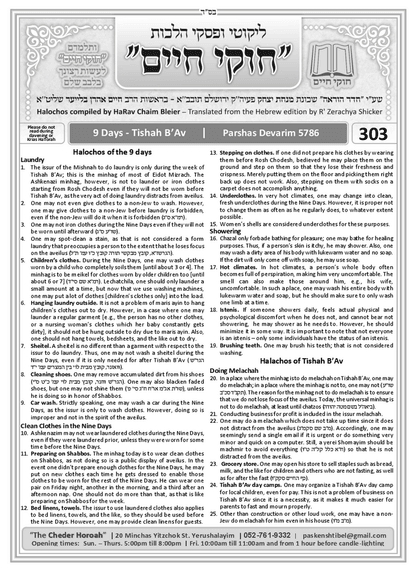
1. The issur of the Mishnah to do laundry is only during the week of Tishah B’Av; this is the minhag of most of Eidot Mizrach. The Ashkenazi minhag, however, is not to launder or iron clothes starting from Rosh Chodesh even if they will not be worn before Tishah B’Av, as the very act of doing laundry distracts from aveilus.

2. One may not even give clothes to a non-Jew to wash. However, one may give clothes to a non-Jew before laundry is forbidden, even if the non-Jew will do it when it is forbidden.

3. One may not iron clothes during the Nine Days even if they will not be worn until afterward.

4. One may spot-clean a stain, as that is not considered a form laundry that preoccupies a person to the extent that he loses focus on the aveilus.

5. Children’s clothes. During the Nine Days, one may wash clothes worn by a child who completely soils them [until about 3 or 4]. The minhag is to be meikel for clothes worn by older children too [until about 6 or 7]. Lechatchila, one should only launder a small amount at a time, but now that we use washing machines, one may put a lot of clothes [children’s clothes only] into the load.

6. Hanging laundry outside. It is not a problem of maris ayin to hang children’s clothes out to dry. However, in a case where one may launder a regular garment [e.g., the person has no other clothes, or a nursing woman’s clothes which her baby constantly gets dirty], it should not be hung outside to dry due to maris ayin. Also, one should not hang towels, bedsheets, and the like out to dry.

7. Sheitel. A sheitel is no different than a garment with respect to the issur to do laundry. Thus, one may not wash a sheitel during the Nine Days, even if it is only needed for after Tishah B’Av.

8. Cleaning shoes. One may remove accumulated dirt from his shoes. One may also blacken faded shoes, but one may not shine them, unless he is doing so in honor of Shabbos.

9. Car wash. Strictly speaking, one may wash a car during the Nine Days, as the issur is only to wash clothes. However, doing so is improper and not in the spirit of the aveilus.

Clean Clothes in the Nine Days

10. Ashkenazim may not wear laundered clothes during the Nine Days, even if they were laundered prior, unless they were worn for some time before the Nine Days.

11. Preparing on Shabbos. The minhag today is to wear clean clothes on Shabbos, as not doing so is a public display of aveilus. In the event one didn’t prepare enough clothes for the Nine Days, he may put on new clothes each time he gets dressed to enable those clothes to be worn for the rest of the Nine Days. He can wear one pair on Friday night, another in the morning, and a third after an afternoon nap. One should not do more than that, as that is like preparing on Shabbos for the week.

12. Bed linens, towels. The issur to use laundered clothes also applies to bed linens, towels, and the like, so they should be used before the Nine Days. However, one may provide clean linens for guests.

13. Stepping on clothes. If one did not prepare his clothes by wearing them before Rosh Chodesh, bedieved he may place them on the ground and step on them so that they lose their freshness and crispness. Merely putting them on the floor and picking them right back up does not work. Also, stepping on them with socks on a carpet does not accomplish anything.

14. Underclothes. In very hot climates, one may change into clean, fresh underclothes during the Nine Days. However, it is proper not to change them as often as he regularly does, to whatever extent possible.

15. Women’s shells are considered underclothes for these purposes.

Showering

16. Chazal only forbade bathing for pleasure; one may bathe for healing purposes. Thus, if a person’s skin is itchy, he may shower. Also, one may wash a dirty area of his body with lukewarm water and no soap. If the dirt will only come off with soap, he may use soap.

17. Hot climates. In hot climates, a person’s whole body often becomes full of perspiration, making him very uncomfortable. The smell can also make those around him, e.g., his wife, uncomfortable. In such a place, one may wash his entire body with lukewarm water and soap, but he should make sure to only wash one limb at a time.

18. Istenis. If someone showers daily, feels actual physical and psychological discomfort when he does not, and cannot bear not showering, he may shower as he needs to. However, he should minimize it in some way. It is important to note that not everyone is an istenis – only some individuals have the status of an istenis.

19. Brushing teeth. One may brush his teeth; that is not considered washing.
Laundry

1. The issur of the Mishnah to do laundry is only during the week of Tishah B’Av; this is the minhag of most of Eidot Mizrach. The Ashkenazi minhag, however, is not to launder or iron clothes starting from Rosh Chodesh even if they will not be worn before Tishah B’Av, as the very act of doing laundry distracts from aveilus.

2. One may not even give clothes to a non-Jew to wash. However, one may give clothes to a non-Jew before laundry is forbidden, even if the non-Jew will do it when it is forbidden.

3. One may not iron clothes during the Nine Days even if they will not be worn until afterward.

4. One may spot-clean a stain, as that is not considered a form laundry that preoccupies a person to the extent that he loses focus on the aveilus.

5. Children’s clothes. During the Nine Days, one may wash clothes worn by a child who completely soils them [until about 3 or 4]. The minhag is to be meikel for clothes worn by older children too [until about 6 or 7]. Lechatchila, one should only launder a small amount at a time, but now that we use washing machines, one may put a lot of clothes [children’s clothes only] into the load.

6. Hanging laundry outside. It is not a problem of maris ayin to hang children’s clothes out to dry. However, in a case where one may launder a regular garment [e.g., the person has no other clothes, or a nursing woman’s clothes which her baby constantly gets dirty], it should not be hung outside to dry due to maris ayin. Also, one should not hang towels, bedsheets, and the like out to dry.

7. Sheitel. A sheitel is no different than a garment with respect to the issur to do laundry. Thus, one may not wash a sheitel during the Nine Days, even if it is only needed for after Tishah B’Av.

8. Cleaning shoes. One may remove accumulated dirt from his shoes. One may also blacken faded shoes, but one may not shine them, unless he is doing so in honor of Shabbos.

9. Car wash. Strictly speaking, one may wash a car during the Nine Days, as the issur is only to wash clothes. However, doing so is improper and not in the spirit of the aveilus.

Clean Clothes in the Nine Days

10. Ashkenazim may not wear laundered clothes during the Nine Days, even if they were laundered prior, unless they were worn for some time before the Nine Days.

11. Preparing on Shabbos. The minhag today is to wear clean clothes on Shabbos, as not doing so is a public display of aveilus. In the event one didn’t prepare enough clothes for the Nine Days, he may put on new clothes each time he gets dressed to enable those clothes to be worn for the rest of the Nine Days. He can wear one pair on Friday night, another in the morning, and a third after an afternoon nap. One should not do more than that, as that is like preparing on Shabbos for the week.

12. Bed linens, towels. The issur to use laundered clothes also applies to bed linens, towels, and the like, so they should be used before the Nine Days. However, one may provide clean linens for guests.

13. Stepping on clothes. If one did not prepare his clothes by wearing them before Rosh Chodesh, bedieved he may place them on the ground and step on them so that they lose their freshness and crispness. Merely putting them on the floor and picking them right back up does not work. Also, stepping on them with socks on a carpet does not accomplish anything.

14. Underclothes. In very hot climates, one may change into clean, fresh underclothes during the Nine Days. However, it is proper not to change them as often as he regularly does, to whatever extent possible.

15. Women’s shells are considered underclothes for these purposes.

Showering

16. Chazal only forbade bathing for pleasure; one may bathe for healing purposes. Thus, if a person’s skin is itchy, he may shower. Also, one may wash a dirty area of his body with lukewarm water and no soap. If the dirt will only come off with soap, he may use soap.

17. Hot climates. In hot climates, a person’s whole body often becomes full of perspiration, making him very uncomfortable. The smell can also make those around him, e.g., his wife, uncomfortable. In such a place, one may wash his entire body with lukewarm water and soap, but he should make sure to only wash one limb at a time.

18. Istenis. If someone showers daily, feels actual physical and psychological discomfort when he does not, and cannot bear not showering, he may shower as he needs to. However, he should minimize it in some way. It is important to note that not everyone is an istenis – only some individuals have the status of an istenis.

19. Brushing teeth. One may brush his teeth; that is not considered washing.

PDF Preview