ABSTRACT לקוטי שיחות פ' אחרי
הוראה
Everyone needs to set personal restrictions with regards to permissible matters
ענין
A double guarding, the source for the precautionary measures instituted by the Rabbis (in additional to the Torah); by upholding all their decrees one fulfills the Will of HaShem
פסוק
ושמרתם את משמרתי יח, ל
חלק
א
הוראה
Whenever one has a spiritual awakening, one must harness it to the normal, every-day life
ענין
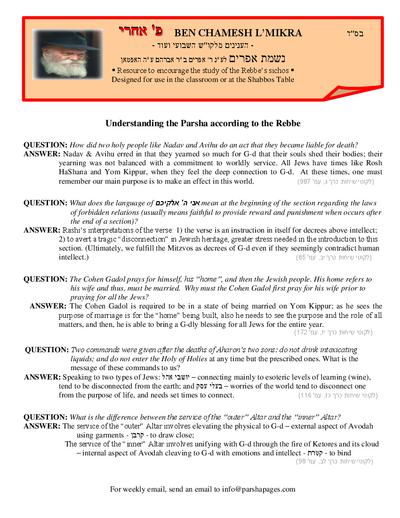
Nadav & Avihu erred in that they yearned for G-d so much that their souls shed their bodies; their yearning was not balanced with a commitment to worldly service
פסוק
אחרי מות טז, א
חלק
ג
הוראה
Through connections to Moshe one can both desire to be out of this world and still be in this world
ענין
Aharon was “love-sick” for G-d and needed a warning not to be tempted; his sons inherited this desire from their father
פסוק
*אחרי מות טז, א
חלק
זא
הוראה
Praise of Aharon – wore special clothing for Yom Kippur, not for his own greatness but due to a decree of the King; this action happened on the first Yom Kippur but was only noted by others at the 2nd Yom Kippur
פסוק
*ויעש טז, לד
חלק
זב
הוראה
Ultimately, we fulfill the Mitzvos as decrees of G-d even if they seemingly contradict human intellect
ענין
Rashi’s two interpretations of the verse:
1. Instruction in itself for decrees above intellect
2. To avert a tragic “disconnection” in Jewish heritage, greater stress needed in the introduction to this section
פסוק
*אני ה"א יח, ב
חלק
יב
הוראה
Even if a Jew doesn’t have the time to regret all his aveiros, just the most worrisome, HaShem helps him do Teshuvah on all
ענין
The Cohen Gadol is required to be in a state of being married on Yom Kippur; as he sees the purpose of marriage is for the “home” being built, also he needs to see the purpose and the role of all matters, and then, he is able to bring a G-dly blessing for all Jews for the entire year
פסוק
וכיפר בעדו ובעד ביתו טז, ו סיום מס' יומא
חלק
יזא
הוראה
Difficulties are really an opportunity for growth
ענין
How does teshuvah out of love transform one’s sins into Mitzvos?
פסוק
סיום מס' יומא
חלק
יזב
הוראה
In the Mitzvah of Teshuvah kaparah is a goal but not pivotal; the main avodah of the neshama is done with the body; then even the upper neshama is elevated
ענין
Three levels of kaparah are a part of Teshuvah (only part of life) that result in a “cleansing”
Four levels of kaparah (when viewed on its own) are kaparah of the soul (which includes after death)
פסוק
והתודה טז, כא
חלק
יזג
הוראה
To bring another Jew close to HaShem, one must enter inside one’s soul, by removing one’s “golden garments” (not feeling one’s own honor) and dress in plain white linen
ענין
Rashi’s views on the Cohen Gadol’s clothes on Yom Kippur:
White garments associated with the location of the service – Holy of Holies
Gold garments not worn there since has negative connotations
פסוק
*כתונת בד אז, ד
חלק
כבא
הוראה
The essence of G-d is connected with the inner aspects of the Jews
ענין
אני – above the world but connected through Mitzvos – decrees of the King
'ה - brings into existence - faithful to reward
אלקיכם - level of G-dliness in the creation – Judge that punishes
פסוק
*אני ה' אלקיכם יח, ל
חלק
כבב
הוראה
Speaking to 2 types of Jews:
יושבי אהל – mainly connecting to esoteric levels of learning (wine), tend to be disconnected from the earth
בעלי עסק – worries of the world tend to disconnect one from the purpose of life
ענין
Two commands connected to concept of entering the Holy place (given after the deaths of Aharon’s two sons):
Do not drink intoxicating liquids
Do not enter the Holy of Holies at any time but the prescribed ones
פסוק
ואל יבא טז, ב
חלק
כזא
הוראה
Day of Yom Kippur reveals the strong connection between the Jew and his Creator without limits and boundaries
ענין
Every sin has two aspects – effect on the person & the existence of the sin itself
Day of Yom Kippur atones for the person; the Scapegoat eliminates the existence of the sin
This is the dispute of רבי ורבנן, if the day of Yom Kippur itself atones
פסוק
רמב"ם
חלק
כזב
ענין
By most Mitzvos one transgresses the Mitzvah to save a life; as opposed to Shabbos, where saving a life is a fulfillment of Shabbos laws
פסוק
וחי בהם יח, ה
חלק
כזג
הוראה
The revelation on Yom Kippur of the level of Yechidah should affect throughout the year to fulfill Torah and Mitzvos on a level of inner desire (and not as an obligation)
ענין
Not only did Nadav & Avihu not sin, but they brought into the Mishkan such a level of kedusha which the Mishkan needed in order to be sanctified
Their avodah involved a voluntary offering of ketores on the inner altar which expressed a deep, inner connection, which accomplished more than the (prescribed) service of Moshe & Aharon
פסוק
בקרבתם טז, ב
חלק
לבא
ענין
Outer Altar: elevating physical to G-d – external aspect of Avodah using garments - קרבן - to draw close
Inner Altar: to unite with G-d through the fire of Ketores – internal aspect of Avodah cleaving to G-d with emotions and intellect - קטרת - to bind
הוראה
Cohen Gadol (or any Jew) after completion of Yom Kippur (or any holy act) needs to go home to bring the holiness there to complete the purpose of Creation in this World
ענין
Cohen Gadol makes a Yom Tov with a meal at the end of Yom Kippur, in recognition of the successful conclusion of the day’s avodah, bringing joy for himself and for Klal Yisrael
פסוק
רמב"ם
חלק
לבב
הוראה
One should attempt to cover and reduce one’s energies in mundane matters; but in holy matters the energy should be “uncovered”
ענין
Mitzvah of covering the blood indicates one’s involvement in the world should not be done with one’s full life-force; however, one should apply one’s passions to one’s spiritual pursuits
פסוק
וכסהו בעפר יז, יג
חלק
לז
Levels of Blood / Levels of Involvement with the World
- Blood of Chayos & Birds, one is obligated to cover: Worldly matters that pose potential obstacles, a person needs to be careful in order not to stumble and go down from one’s level
- Blood of (chullin) domesticated animals, one is not obligated to cover: Worldly matters that could be used for holy purposes, one should seek to attach them to holiness
- Blood of Korbanos are sprinkled on the Altar: Holy matters (Torah, prayers, and Mitzvos) one should give one’s entire life force
Related Articles