ABSTRACT Lekutei Sichos Part 3
Project Likkutei Sichos | May 07, 2025
Service of transforming the animal soul comes with pain and effort
- The fifth year produces an “add on” as a reward and the purpose of the first four years
- A Jew is obligated to do good to a fellow Jew without selfish motive
- The verse prohibits giving “inappropriate advice” even if such advice doesn’t harm the other person, but is only in one’s self-interest
- Soul deals with the body in terms of measurements; prevents doubt of Amalek
- Use of false weighs and measures is an attempt to “dress-up” the act of theft as an act of honesty; similar to the actions of the Egyptians
- Helping another Jew on the path to return should not be done for personal gain; but should be done even if involves loss
- Act of robbery is compared to murder, since act of robbery deprives the victim of some inherent rights of life
- Thus, if a stolen object is not extant, then decree is to not accept monetary compensation when the robber wishes to do Teshuvah; monetary compensation not sufficient to make the victim complete for loss of object
- If one is aware of a situation to save another (spiritually), then it is a sign that one is capable of succeeding
- One is obligated to endanger one’s own life in the act of saving the life of another; this is conditional on a certainness exists that the other’s life can be saved
- Main point of awe is bitul, a feeling that is actualized in deeds
- Concept of awe of the Mikdash contains many elements reflected in deed: Going in and coming out of the Temple Mount (deed); Walking in the Azarah (deed plus feeling); Applies also after destruction
View The Full Article (PDF)
Related Articles

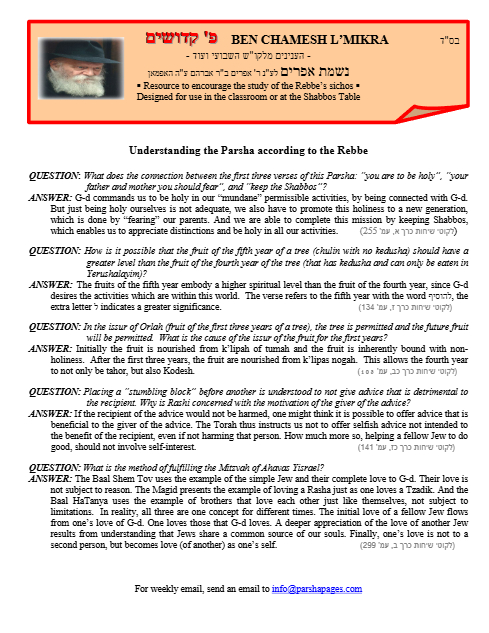
Understanding the Parsha according to the Rebbe
Parsha Pages • Acharei Mos-Kedoshim

Understanding the Parsha According to the Rebbe
Project Likkutei Sichos • Acharei Mos-Kedoshim

Parshas Kedoshim The Fifth Year
Project Likkutei Sichos • Acharei Mos-Kedoshim

ABSTRACT Lekutei Sichos
Project Likkutei Sichos • Acharei Mos-Kedoshim

OVERVIEW Lekutei Sichos
Project Likkutei Sichos • Acharei Mos-Kedoshim