Falling From Power
BET Journal | May 08, 2025
Print This Article
View Original PDF

Falling From Power

BET Journal | June 27, 2025

“Aharon shall place lots upon the two he-goats: one lot ‘for Hashem’ and one lot ‘for Azazel'”(16:8)

After having performed the primary Yom Kippur service in the Sanctuary, the Kohein Gadol would place his hands upon the head of a he-goat, confessing the sins of Bnei Yisroel. He would then send it with a designated person into the desert, where it was cast off a rugged mountain. This goat is known as the “se’ir,” he-goat, “la’azazel.” The Talmud translates “azazel” as a contraction of the words “az” (harsh) and “eil” (strong), indicating that the goat should be taken to the most rugged of mountains.

A second interpretation that is offered explains that “azazel” is a contraction of “Uza” and “Aza’el,” the names of two angels of destruction who fell to earth and proceeded to engage in various forms of licentious behavior, including adultery, as is related at the end of Parshas Bereishis. The he-goat “la’azazel” atones for these sins of licentiousness. The above passage appears to conflict with another section in the Talmud. The Talmud derives from the verse that states that Aharon confessed “lechol chatosam,” “for all their sins,” that there are no limitations as to the sorts of sins for which the he-goat atones. Why, then, is licentiousness singled out as the sin for which the he-goat atones?

Rabbeinu Bechaya comments that “lo sachmod,” “do not covet,” is the last of the ten commandments, for it includes all of the other prohibitions. The explanation for this comment is as follows: Coveting referred to in the Decalogue is not a function of desire or lust, for although this would explain a man coveting another man’s wife, lust cannot be the basis for his coveting another man’s possessions. Rather than lust, the Torah is addressing a person’s desire for power and control. Adultery and indulgence in prohibited relationships do not always stem from a lack of self-control or overpowering lust. Rather, these indiscretions often stem from a person’s need to impose their will and assert control over others. It is common to see people in leadership positions fall prey to licentious indiscretions as a result of their need to assert themselves within their positions of power. Coveting a neighbor’s wife or possessions is a manner by which a person can impose his will and assert control over his neighbor.

This deep-seeded need for control over others is not only a societal malignancy but an affront to our relationship with our Creator as well. The Ibn Ezra expresses this notion succinctly by stating that a person who covets is also violating the first commandment of “Anochi” – “I am Hashem,” for the very act of asserting control over others is a rebellion against Hashem. If we are cognizant of the fact that our right to exist is granted by Hashem, we must also realize that we have no right to impose our will upon others.

The fallen angels are referred to in Parshas Bereishis as “Bnei Elohim.” Rashi explains that whenever the term “Elohim” is used, it denotes power and authority. The Torah describes these angels in such a manner to reveal that the basis for their adulterous and licentious behavior is their need to dominate mankind. To some degree, every sin we commit is tainted by our need to assert control. Therefore, the se’ir la’azazel, which atones for the sins of Uza and Aza’el, atones for every transgression committed by Bnei Yisroel.
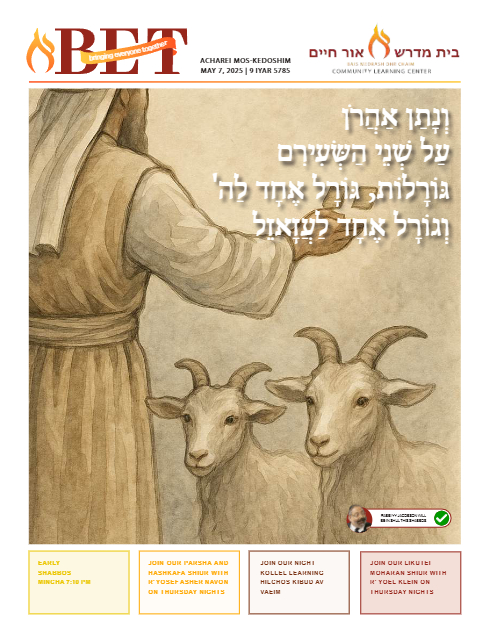
“Aharon shall place lots upon the two he-goats: one lot ‘for Hashem’ and one lot ‘for Azazel'”(16:8)

After having performed the primary Yom Kippur service in the Sanctuary, the Kohein Gadol would place his hands upon the head of a he-goat, confessing the sins of Bnei Yisroel. He would then send it with a designated person into the desert, where it was cast off a rugged mountain. This goat is known as the “se’ir,” he-goat, “la’azazel.” The Talmud translates “azazel” as a contraction of the words “az” (harsh) and “eil” (strong), indicating that the goat should be taken to the most rugged of mountains.

A second interpretation that is offered explains that “azazel” is a contraction of “Uza” and “Aza’el,” the names of two angels of destruction who fell to earth and proceeded to engage in various forms of licentious behavior, including adultery, as is related at the end of Parshas Bereishis. The he-goat “la’azazel” atones for these sins of licentiousness. The above passage appears to conflict with another section in the Talmud. The Talmud derives from the verse that states that Aharon confessed “lechol chatosam,” “for all their sins,” that there are no limitations as to the sorts of sins for which the he-goat atones. Why, then, is licentiousness singled out as the sin for which the he-goat atones?

Rabbeinu Bechaya comments that “lo sachmod,” “do not covet,” is the last of the ten commandments, for it includes all of the other prohibitions. The explanation for this comment is as follows: Coveting referred to in the Decalogue is not a function of desire or lust, for although this would explain a man coveting another man’s wife, lust cannot be the basis for his coveting another man’s possessions. Rather than lust, the Torah is addressing a person’s desire for power and control. Adultery and indulgence in prohibited relationships do not always stem from a lack of self-control or overpowering lust. Rather, these indiscretions often stem from a person’s need to impose their will and assert control over others. It is common to see people in leadership positions fall prey to licentious indiscretions as a result of their need to assert themselves within their positions of power. Coveting a neighbor’s wife or possessions is a manner by which a person can impose his will and assert control over his neighbor.

This deep-seeded need for control over others is not only a societal malignancy but an affront to our relationship with our Creator as well. The Ibn Ezra expresses this notion succinctly by stating that a person who covets is also violating the first commandment of “Anochi” – “I am Hashem,” for the very act of asserting control over others is a rebellion against Hashem. If we are cognizant of the fact that our right to exist is granted by Hashem, we must also realize that we have no right to impose our will upon others.

The fallen angels are referred to in Parshas Bereishis as “Bnei Elohim.” Rashi explains that whenever the term “Elohim” is used, it denotes power and authority. The Torah describes these angels in such a manner to reveal that the basis for their adulterous and licentious behavior is their need to dominate mankind. To some degree, every sin we commit is tainted by our need to assert control. Therefore, the se’ir la’azazel, which atones for the sins of Uza and Aza’el, atones for every transgression committed by Bnei Yisroel.

PDF Preview