Haftorah of Sidra Acharei Mos (Ammos)
There are various customs concerning the Haftoras of the Sidras אחרי מות and קדושים. In a non-leap year, Sidra אחרי מות is always read together with Sidra קדושים. Now, usually, when two Sidras are read together, we read the Haftorah of the second Sidra. However, the combined Sidras of אחרי מות and קדושים are an exception and the Haftorah of אחרי מות is read. (This is the Haftorah which is discussed below.) It is taken from the Book of Ammos, one of the shorter Books of the Prophets which together make up “The Twelve,” and is from Chapter 9, verses 7 — 15. (Incidentally, it is one of the shortest Haftoras, consisting of only nine Pessukim.) This is according to the Ashkenazzim. According to the Sefaradim, no exception is made to the general rule of combined Sidras and when אחרי מות and קדושים are together, the Haftorah of קדושים is read and according to the Sefaradim, that Haftorah is taken from Sefer Yechezkel, Chapter 20, verses 2 — 20.
In a leap year, the two Sidras are not combined but are read in their own weeks and the Haftorah for אחרי מות is from Sefer Ammos (as just said) and the Haftorah for the following Sidra קדושים is from Sefer Yechezkel, Chapter 22, verses 1 — 16. However, if Rosh Chodesh is on the Sunday immediately after Shabbos אחרי מות, in which case the Haftorah on that Shabbos of אחרי מות is the Haftorah “Mochor Chodesh,” (taken from the First Book of Shmuel, from Chapter 20, verses 18 — 42) or if Shabbos אחרי מות is שבת הגדול, in which case the Haftorah for שבת הגדול is read (that Haftorah is taken from the Sefer Malachi, from Chapter 3, verses 4 — 24) in both these cases, the Haftorah for Sidra אחרי מות will be read on the following Shabbos as the Haftorah of Sidra קדושים.
According to another custom, Ashkenazzim take for the Haftorah of אחרי מות from Sefer Yechezkel, from Chapter 22, verses 1— 16 and for the Haftorah of Sidra קדושים from the Book of Ammos, from Chapter 9, verses 7 — 15 (given here as the Haftorah of אחרי מות) and Sefaradim read for Sidra אחרי מות the Haftorah from Sefer Ammos, as given here, and for Sidra קדושים the Haftorah is from Sefer Yechezkel, Chapter 22, from verse 1 till verse 16. According to yet others, the Haftorah for קדושים is from Sefer Yechezkel, but from Chapter 20, verses 2 — 20).
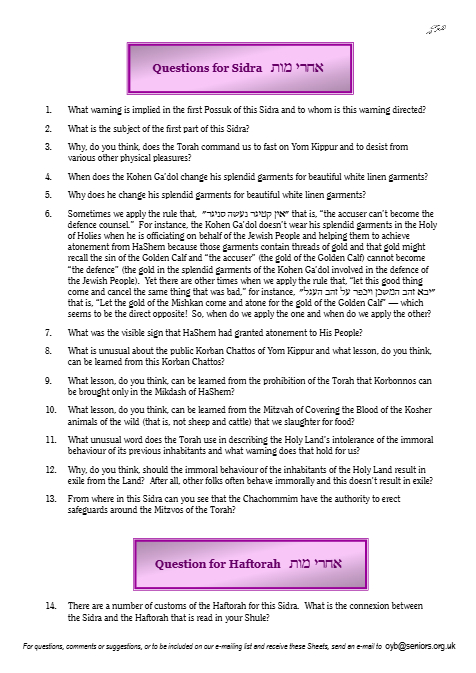
- The connexion of this Haftorah with the Sidra is the warning in both that if the Jewish People are not loyal to HaShem and do not keep His Torah, they will be exiled from their Land.
- The Novvi Ammos was an older contemporary of Hoshay’a and Yonah, who lived in the time of King Yerov’om the Second (ben Yehoash) of the Northern Kingdom of Israel. In this prophecy (which is the conclusion of the Sefer Ammos) he proclaims that HaShem will bring an end to this corrupt monarchy which exploits the poor and the disadvantaged and whose kings indulge themselves in luxuries (none of the kings of the breakaway Kingdom of Israel was any good: they were all idolworshippers and led the people away from the Torah) but that He will spare the righteous ones of the House of Yaakov. The whole Nation will, as it were, be sifted and winnowed to remove the bad but everyone found to be good will be spared.
- The king and his officials do not to see the Hand of HaShem in the affairs of mankind, says Ammos. They choose not see how other nations have been exiled and then have had their freedom restored, just as His Jewish People, too, were redeemed by HaShem from Egypt. But because they are His People, He expects of them a high standard of righteousness and the sinners who have so badly misled His People will be destroyed.
- But then, when the whole Nation will have returned to HaShem and the Torah, the House of Dovid will be re-established and the people will be settled once more in their land. They will rebuild the once-desolated cities and they will again enjoy — without disturbance — the superlative and abundant produce of their Land, given to them by HaShem.