The Three Types of Kareis and Their Implications
Parsha Pages | May 07, 2025
Print This Article
View Original PDF

The Three Types of Kareis and Their Implications

Parsha Pages | June 27, 2025

More than half of the thirty-six sins that carry the penalty of kareis (excision) are mentioned at the end of Parashas Acharei Mos. In discussing the nature of this punishment, Ramban (ad loc.) explains that there are three types of kareis and what each one entails:

Someone who is essentially a good person but had a momentary lapse and ate, for example, cheilev (the prohibited fat of an animal) or dam (blood) will be punished with a shortened life, but no punishment of the soul in the Afterlife. Regarding such a person, the Torah uses the phrase (Vayikra 17:9), “Ve’nichras ha’ish hahu mei’amav — That man shall be cut off from his people,” with no mention of his soul being punished.

One who is fundamentally wicked, having committed more sins than mitzvos, will only be punished in the Afterlife, which includes punishment and then destruction of his soul. He may live out a normal life, well into old age. Regarding this type of kareis, the Torah says, “Ve’nichresah hanefesh hahi mi’lefanai — That person shall be cut off from before Me” (Vayikra 22:3), where the pasuk makes mention of the nefesh and not the man. (This is the type of kareis mentioned in the verse at the beginning.)

The last category of kareis applies to an individual guilty of idolatry or cursing HaShem. About him, the verse says (Bamidbar 15:31), “Hikareis tikareis hanefesh hahi avonah vah — That person will surely be cut off, his sin is upon him.” This repetition, explain Chazal (Shavuos 13a), indicates excision in both This World and the Next, meaning a shortened physical life, as well as destruction of the soul in the Afterlife. (See Abarbanel Bamidbar 15:22.)

The punishment of kareis (which includes some form of destruction of the soul) is also discussed in a vort of Rav Yaakov Ettlinger in Aruch LaNer (Yevamos 122b). The Aruch LaNer points out that four masechtos in Shas — Berachos, Nazir, Yevamos, and Kerisus — all conclude with the same statement: “Amar Rabbi Elazar amar Rabbi Chanina talmidei chachamim marbim shalom ba’olam she’ne’emar ve’chol banayich limudei HaShem ve’rav shalom banayich al tikrei banayich ella bonayich — Rabbi Elazar said in the name of Rabbi Chanina: Torah scholars increase peace in the world, as it says (Yeshayahu 54:13), ‘All your children will be students of HaShem, and all your children’s peace will be abundant.’ Do not read the words as ‘banayich,’ your sons, but ‘bonayich,’ your builders.” The Aruch LaNer (see also Gra: Imrei Noam, end of Berachos) notes that the roshei teivos of these four masechtos: ברכות נזיר יבמות כריתות form the word בניך, your sons, as in “Ve’chol banayich limudei HaShem.”
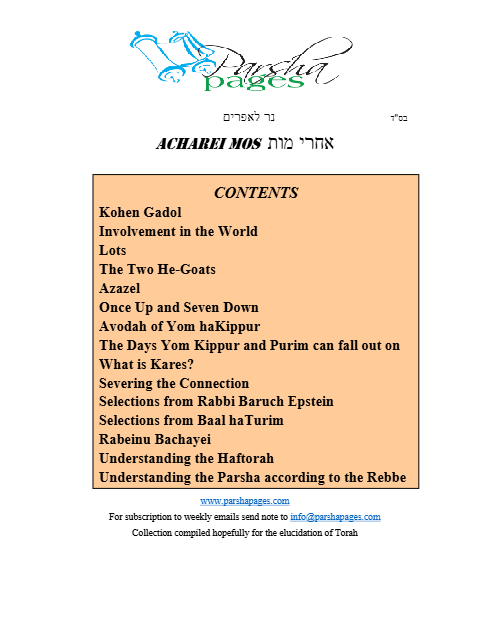
More than half of the thirty-six sins that carry the penalty of kareis (excision) are mentioned at the end of Parashas Acharei Mos. In discussing the nature of this punishment, Ramban (ad loc.) explains that there are three types of kareis and what each one entails:

Someone who is essentially a good person but had a momentary lapse and ate, for example, cheilev (the prohibited fat of an animal) or dam (blood) will be punished with a shortened life, but no punishment of the soul in the Afterlife. Regarding such a person, the Torah uses the phrase (Vayikra 17:9), “Ve’nichras ha’ish hahu mei’amav — That man shall be cut off from his people,” with no mention of his soul being punished.

One who is fundamentally wicked, having committed more sins than mitzvos, will only be punished in the Afterlife, which includes punishment and then destruction of his soul. He may live out a normal life, well into old age. Regarding this type of kareis, the Torah says, “Ve’nichresah hanefesh hahi mi’lefanai — That person shall be cut off from before Me” (Vayikra 22:3), where the pasuk makes mention of the nefesh and not the man. (This is the type of kareis mentioned in the verse at the beginning.)

The last category of kareis applies to an individual guilty of idolatry or cursing HaShem. About him, the verse says (Bamidbar 15:31), “Hikareis tikareis hanefesh hahi avonah vah — That person will surely be cut off, his sin is upon him.” This repetition, explain Chazal (Shavuos 13a), indicates excision in both This World and the Next, meaning a shortened physical life, as well as destruction of the soul in the Afterlife. (See Abarbanel Bamidbar 15:22.)

The punishment of kareis (which includes some form of destruction of the soul) is also discussed in a vort of Rav Yaakov Ettlinger in Aruch LaNer (Yevamos 122b). The Aruch LaNer points out that four masechtos in Shas — Berachos, Nazir, Yevamos, and Kerisus — all conclude with the same statement: “Amar Rabbi Elazar amar Rabbi Chanina talmidei chachamim marbim shalom ba’olam she’ne’emar ve’chol banayich limudei HaShem ve’rav shalom banayich al tikrei banayich ella bonayich — Rabbi Elazar said in the name of Rabbi Chanina: Torah scholars increase peace in the world, as it says (Yeshayahu 54:13), ‘All your children will be students of HaShem, and all your children’s peace will be abundant.’ Do not read the words as ‘banayich,’ your sons, but ‘bonayich,’ your builders.” The Aruch LaNer (see also Gra: Imrei Noam, end of Berachos) notes that the roshei teivos of these four masechtos: ברכות נזיר יבמות כריתות form the word בניך, your sons, as in “Ve’chol banayich limudei HaShem.”

PDF Preview