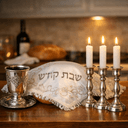
Ohev Yisrael On Shabbos After Pesach Shlissel Challa
Rav Avraham Yehoshua Heschel of Apta Mezibuz
The Apta Rav asks why we use a key to mark the challos on the Shabbos after Pesach, because surely the minhag of our forefathers is Torah!
The pasuk says in Shir HaShirim (5:2), “Open for me, my sister, my beloved.” The Medrash there says that Hashem is asking Knesses Yisrael to open for Him just a small opening, the size of the eye of a needle and He will reciprocate and open for them an opening the size of a large hall. Says the Apta Rav, Knesses Yisrael is compared to a bride, and a woman is sometimes compared to bread, as in Bereishis 39:6 (see Rashi there).
On Pesach all the heavenly gates and the doors of the supernal mind called the Mochin Illo’in are open. After Pesach they are locked once more and it is up to us to open them. This is why we mark the challa on the Shabbos following Pesach with keys, symbolizing that we are making an opening, and asking that Hashem open for us His great treasury and command the heavens above to open for us. Just as Hashem sent our forefathers the mon during the month of Iyar which we bless on this Shabbos, so may He bless us.
In the Likkutim Chadoshim at the end of Ohev Yisrael, the Apta Rav gives us three more reasons for the minhag of baking shlissel challa:
The first reason is that this is the period when Bnei Yisrael stopped eating from the mon and began to eat from the produce of Eretz Yisrael, as it says in Yehoshua 5:11 that after Pesach they began to eat produce and stopped eating mon. Everything has its corresponding gate and we ask Hashem to open for us the gates of parnossa at this time, when we are no longer receiving mon from Heaven. We therefore make the shape of a key on the challos to hint at the fact that we are asking Hashem to open up the gates of parnossa for us.
The second reason for this minhag is that we are now counting the seven weeks of the Omer, which amounts to forty-nine days, alluding to the fiftieth gate of the attribute of Bina. As we proceed from gate to gate, each gate has its key and so we make the shape of a key.
The third reason is based on Shir HaShirim 1:11 where the pasuk says, torei zohov na’aseh loch im nekudos hakosef.
In the Mishkon we find that three precious metals were used (Shemos 25:3): gold, silver and copper. Gold precedes silver. However, in the story of Creation we read (Bereishis 1:3), “And Hashem said, ‘Let there be light,’ and there was light”. This is the light of Avrohom Avinu – the light of chessed (loving-kindness) [alluding to silver], and afterward we learn about the second day, whose attribute is gevura (strength), which hints at gold. Here silver precedes gold. The reason for the change in order is that the world is created through chessed, as it says (Tehillim 89:3) that the world is created through chessed. Therefore chessed, which alludes to silver, precedes gevura, which hints at gold. However, the Mishkon, a microcosm of the entire world, constructed in miniature as a place where Hashem’s presence, the Shechina, would restrict Herself in tzimtzum to dwell therein, represents an act of gevura. Gold therefore precedes silver in its construction.
Gold is vocalized with the vowel pasach in the construct form, as in Shemos 38:24: zehav hetenufa. This is the nekuda of chessed and chochma. Pasach also means an opening or a gateway and alludes to the opening where all manner of chessed comes from. This is what the pasuk in Shir HaShirim alludes to. The Mishkon contains the tzimtzum of torei zohov but it is tempered by the nekudos hakesef, the vowels or nekudos of pasach, which is chessed.
The Shabbos after Pesach is always in the second week of Sefiras HaOmer, which corresponds to the attribute of Gevura. However, it is vowelized with kesef and pasach which is chessed, the gate through which all blessings flow. Since every gate has a key, we make the shape of a key on the challos.

Related Articles