Rabbeinu Bachye on the Karas Penalty
Parsha Pages | April 28, 2024
Print This Article
View Original PDF

Rabbeinu Bachye on the Karas Penalty

Parsha Pages | June 27, 2025

Rabbeinu Bachye (on Lev. 18:29) provides another view.
The karas penalty appears in the Torah in three different guises. There is a karas penalty which is applicable only to the body of the guilty party. There is also a karas penalty which applies only to the soul; finally, there is a karas penalty which applies both to the body and the soul of the sinner in question.

A karas penalty applied to the body only is recognizable by premature death of the guilty person. If someone has led a generally righteous life but has become guilty of a single sin punishable by the karas penalty he is condemned to die prematurely, living maybe only half the number of years allotted to him when he was born. An example of such a karas penalty is the young scholar who had touched his wife during the days she had to observe the ritual waiting period before immersing herself in a ritual bath after she had stopped bleeding from her monthly cycle (Shabbos 13). This is called כרת של שנים, a karas penalty resulting in the loss of years [Seeing that the sin was committed inadvertently through ignorance and it is not recorded that merely touching one’s wife is subject to this terrible penalty even when committed knowingly, it is hard to understand that this should have been the only reason for the early demise of this young scholar. The scholar giving the widow this reason for her husband’s early death may have implied that G’d is especially strict with Torah scholars who ought to have been models of pious conduct.)

There is also another variation of the karas penalty being applied to the body only when the sin was committed late in the life of the guilty party so that the karas penalty through cutting off many years of the life of the person could no longer be applied. An example illustrating this type of the karas penalty is recorded in Moed Katan 28. We are told that when Rav Yoseph reached his 60th birthday he threw a party inviting all his colleagues the scholars. He celebrated the fact that he now had proof that up until that point in his life he had not been found guilty of the aforementioned karas penalty. He was, however, still subject to the karas penalty known as כרת של ימים, i.e. not living out his allotted time although he had reached what is considered “old age.” Rav Yoseph consoled himself with having definitely escaped the full impact of the karas penalty. Some scholars hold that the karas penalty described as כרת של ימים refers to sudden death, not being able to make preparations for one’s death. The soul of such a person will merit immediate transfer to the hereafter in the world of the souls and his resurrection at the time when this will take place is assured.

The karas penalty which applies to the soul only applies to people who have sinned by violating very severe laws such as eating chametz on Passover, or eating on the Day of Atonement, or performing forbidden kind of work on that day. If he violated the עריות legislation in our chapter knowingly he is also subject to the karas penalty involving his soul. If the sum total of his sins was greater that his accumulated merits this penalty of karas is applied to his soul after it has been separated from his body. As a result, he forfeits his share in the hereafter of the world of the disembodied souls.
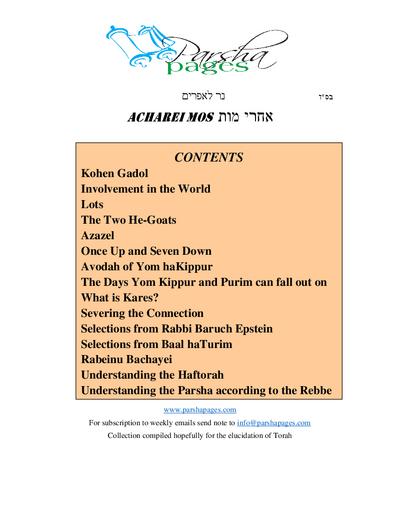
Rabbeinu Bachye (on Lev. 18:29) provides another view.
The karas penalty appears in the Torah in three different guises. There is a karas penalty which is applicable only to the body of the guilty party. There is also a karas penalty which applies only to the soul; finally, there is a karas penalty which applies both to the body and the soul of the sinner in question.

A karas penalty applied to the body only is recognizable by premature death of the guilty person. If someone has led a generally righteous life but has become guilty of a single sin punishable by the karas penalty he is condemned to die prematurely, living maybe only half the number of years allotted to him when he was born. An example of such a karas penalty is the young scholar who had touched his wife during the days she had to observe the ritual waiting period before immersing herself in a ritual bath after she had stopped bleeding from her monthly cycle (Shabbos 13). This is called כרת של שנים, a karas penalty resulting in the loss of years [Seeing that the sin was committed inadvertently through ignorance and it is not recorded that merely touching one’s wife is subject to this terrible penalty even when committed knowingly, it is hard to understand that this should have been the only reason for the early demise of this young scholar. The scholar giving the widow this reason for her husband’s early death may have implied that G’d is especially strict with Torah scholars who ought to have been models of pious conduct.)

There is also another variation of the karas penalty being applied to the body only when the sin was committed late in the life of the guilty party so that the karas penalty through cutting off many years of the life of the person could no longer be applied. An example illustrating this type of the karas penalty is recorded in Moed Katan 28. We are told that when Rav Yoseph reached his 60th birthday he threw a party inviting all his colleagues the scholars. He celebrated the fact that he now had proof that up until that point in his life he had not been found guilty of the aforementioned karas penalty. He was, however, still subject to the karas penalty known as כרת של ימים, i.e. not living out his allotted time although he had reached what is considered “old age.” Rav Yoseph consoled himself with having definitely escaped the full impact of the karas penalty. Some scholars hold that the karas penalty described as כרת של ימים refers to sudden death, not being able to make preparations for one’s death. The soul of such a person will merit immediate transfer to the hereafter in the world of the souls and his resurrection at the time when this will take place is assured.

The karas penalty which applies to the soul only applies to people who have sinned by violating very severe laws such as eating chametz on Passover, or eating on the Day of Atonement, or performing forbidden kind of work on that day. If he violated the עריות legislation in our chapter knowingly he is also subject to the karas penalty involving his soul. If the sum total of his sins was greater that his accumulated merits this penalty of karas is applied to his soul after it has been separated from his body. As a result, he forfeits his share in the hereafter of the world of the disembodied souls.

PDF Preview