The Apostate Jew
In a city not far from Apta, there lived a Jewish apostate who caused his former brethren much trouble and heartache. He rose to a very high position in the government, becoming one of the king's most trusted officials. He made sure to utilise his position the make the Jews' lives miserable.
Every once in a while, the king would meet with all his ministers to discuss various issues and discuss all sorts of ideas that might benefit the inhabitants of the kingdom.
The apostate considered these meeting prime opportunities to disparage the Jews, his former brothers, in the eyes of the king.
At one such meeting, one of the officials, also a virulent anti-Semite, rose and told the king a shocking tale. In his village, he said, a non-Jewish girl had gone out to draw water from the well and never returned home. She simply disappeared without a trace!
It was Erev Pesach, a time when the Jewish people were preparing for the holy holiday by eliminating the chametz (leavened foods) from their homes and baking matzot.
After much investigation, said the official, it was discovered that the Jews were to blame for the girl's disappearance; they had murdered her in order to mix her blood into their holiday matzot.
All those present at the meeting were horrified by the minister's story and their fury knew no bounds.
They drew up a terrible decree that would affect all the Jews in the kingdom. In order for the decree to be valid, the document needed all the officials' signatures.
When it came to the apostate's turn to sign, however, a spirit of purity overcame him. Instead of enthusiastically joining the officials in drawing up a decree against the Jews, whom he so despised, he rose and announced to all the ministers that he too was a Jew and the whole accusation was a ridiculous bluff.
He explained that the consumption of blood was one of the most serious prohibitions in Jewish law. He knew this for certain, he assured the king and the ministers, for he had grown up among the Jews, and he knew their customs well.
His sincere words convinced the king and the ministers, especially since they knew him to be a renegade Jew who was a sworn enemy of his former people, and not one to speak well of them under ordinary circumstances.
If he was defending the Jews, they felt certain, he must be speaking the truth.
And so, in his merit, the decree never came to fruition.
The mitzvah of rescuing Jews from destruction awakened hidden sparks within the converted Jew, and he began to want to return to his people and draw closer to Hashem and His Torah.
However, he immediately rejected this thought, certain that it would be impossible for him to ever return to his people.
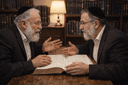
The situation seemed hopeless. Nevertheless, he decided to travel to the Apter Rav and seek his advice. Perhaps the tzadik would be able to help him find a way out; perhaps there was a chance he still could return to the One G-D.
His longing to repent gave him no rest. He showed up at the Apter Rebbe's house that very night, brokenhearted and filled with remorse for his evil ways.
When the tzadik saw him and recognized him as the infamous apostate who constantly sought opportunities to cause the Jews no end of tragedy, he grew frightened that the man had come to stir up more trouble.
At first, he sought to politely avoid him, apologising that he was old and weak and hadn't the strength to receive him so late at night.
The man refused to budge, begging the tzadik to hear him out.
The Apter Rav, however, had made up his mind not to talk to the loathsome Jew hater, come what may.
He told the man that he would speak to him only when grass started growing on the stick standing nearby.
Incredibly, the stick immediately began sprouting bright green grass.
When the tzadik saw this miracle, he summoned the apostate into his home and allowed him to speak.
The man began telling him all that had happened. He told the tzadik his forceful rejection had aroused in him the desire to abandon his evil ways and return to the Judaism of his parents and ancestors. but didn't know how to go about it.
The Apter Rebbe accepted responsibility to deal with the man's 'tikkun' (rectification). He outlined a path of teshuva (return [to mitzvah observance]) for the man, providing him with a list of behaviours to accept upon himself.
The man immediately began acting in accordance with the tzadik's instructions. No more than two weeks passed when the rabbi of the neighbouring village sent word to the Apta Rav that the man's house had gone up in flames but no harm had come to the former apostate.
The Apter Rebbe immediately informed the man that his repentance had been accepted by Heaven and he could return to his home, to his worthy wife and children.
The man became a true ba'al teshuva - a sincere Torah observant Jew.
Reprinted from ascentofsafed.com