The Youngest Son
Living Jewish | May 03, 2024
Print This Article
View Original PDF

The Youngest Son

Living Jewish | June 27, 2025

In honor of the birthday of the Rebbe Maharash (the fourth Rebbe of Chabad) on the 2nd of Iyar (Thursday night and Friday of the coming week), we present the following story:

About half a year before the Tzemach Tzedek’s passing on the 13th of Nissan 5626 (1866), he instructed his youngest son, the Rebbe Maharash, to begin saying Chassidus. This may have come as a surprise to many of the Chassidim. The Rebbe Maharash was the quietest of the Tzemach Tzedek’s seven sons.

While others, such as the Maharil (Rabbi Yehuda Leib, the second son of the Tzemach Tzedek), were well known to the Chassidim, the Rebbe Maharash had never taken an active part in leading Chassidim or demonstrating his talents and knowledge in Torah. Along with the Tzemach Tzedek’s instructions came a message for the Chassidim, “listen to him, just as you have listened to me.”

Another letter of the Tzemach Tzedek, this one directed to the Rebbe Maharash himself, also seems to be from that period of time. In it, the Tzemach Tzedek writes that he had read the Rebbe Maharash’s Chassidus, and that it was good in his eyes. “Ani somech ot’cha b’smicha rabbah,” (“I offer you ordination with great joy”) the Tzemach Tzedek writes, and includes many blessings in the letter.

Excitement and Crying

After the passing, many Chassidim didn’t know which of the Tzemach Tzedek’s sons to turn to, and many visited each one separately. One account tells of a chassid who davened each day in the presence of a different brother to witness their unique service.

The chassid related that the Maharil was known for his hispa’alut (excitement) during davening; once he began davening, he would lose track of time and space and would pace around the room davening slowly, totally oblivious to the fact that he was the chazan. Once, he agreed to be tied to the amud (prayer lectern) to help him remain aware of his surroundings, but even then, he simply dragged the amud around the room.

Another brother, the Maharin (Rabbi Yisrael Noach, the fourth son), was known for his intense crying. Everyone participating in his minyan would be swept along in his tears; no one would be able to retain their composure. When a few young Chassidim decided to pinch each other so they wouldn’t cry, nothing changed. The first began to cry, and when they pinched him, it only strengthened his sobs. Soon enough, everyone was crying along with him.

This Time, Our Father Said It...

The Rebbe Maharash’s minyan was entirely different. His davening was simple; no cries, no ecstasy, no length. The only thing they noticed was before Ashrei and Uva L’tziyon, he would pull his tallit over his head and do something. A young chassid brazenly peeked under the tallit to see what he was doing, and the Rebbe Maharash flicked his nose. The chassid later told his friends, “while I did get a flick, I also got to see what he was doing.” The Rebbe Maharash was changing his head tefillin from Rashi to Shimusha Rabba.

During that period, most of the Tzemach Tzedek’s sons began saying Chassidus, and Chassidim went from one son to another to try to decide whom to accept as a Rebbe.

One Friday night, the Rebbe Maharash said the maamar (Chassidic discourse), “Az Yashir... Ali Be’er.” The next day, Shabbat morning, his brother the Maharil repeated the maamar with an addition of his own. On Motzei Shabbat, the Rebbe Maharash repeated the maamar with an addition of his own. This repeated itself a number of times, until Tuesday evening, when the Rebbe Maharash said the maamar for the fifth time, again adding something new. With that, the Maharil came to him and said, “this time, our father said it, and I don’t want to stand up against father.”

The Hidden Rebbe

One of the young Chassidim at the time, Reb Shmuel Gronem Esterman, went to consult with Reb Shmuel Ber Barisover, a distinguished chassid, regarding whom he should accept as Rebbe. Reb Shmuel Ber advised him as follows: “we cannot distinguish between the Rebbe’s sons, since they are all tzaddikim, and so I cannot advise you. What I can say is I will travel to the youngest son [the Rebbe Maharash].”

Rabbi Shmuel Ber explained why. “I was recently in Lubavitch. The Tzemach Tzedek said Chassidus, and among other things, he referred to something that seemed to contradict the text Eitz Chaim. I thought about this and found no solution.

“On Motzei Shabbat, I went to one of the Tzemach Tzedek’s sons and presented this question. He began to explain it to me, but I didn’t accept his answer.

“I went to a different son and presented my question, and he said it was a strong question and began to resolve it. But for some reason his explanation also didn’t sit well with me...

“Suddenly, I saw that the house of the youngest son was lit up. I said to myself, ‘I’ll go to him and ask him my question.’

“I peeked through the window and noticed to my excitement that he was studying the very passage in Eitz Chaim that had bothered me. I tried opening the door, but it was locked.

“‘Who’s there?’ he asked.

“‘Shmuel Ber,’ I answered.

“‘Just one second.’

“When he opened the door, I saw only newspapers spread across the table.

“‘Yes, Reb Shmuel Ber, how can I help you?’

“I told him that I had a question on the maamar that had been said on Shabbat.

“He looked at me and said, ‘Reb Shmuel Ber, they say you are a smart man. Why are you coming to me about this?’

“I told him, ‘I saw that you were studying Eitz Chayim a moment ago. If you don’t help me, I will tell everyone what I saw.’

“Hearing that, he began to smile, and we spent the rest of the night in discussion.”

Reprinted from Derher
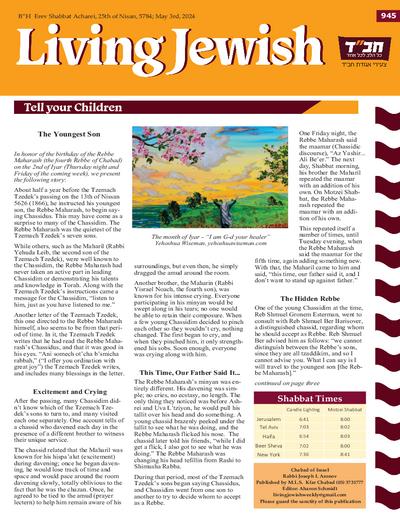
In honor of the birthday of the Rebbe Maharash (the fourth Rebbe of Chabad) on the 2nd of Iyar (Thursday night and Friday of the coming week), we present the following story:

About half a year before the Tzemach Tzedek’s passing on the 13th of Nissan 5626 (1866), he instructed his youngest son, the Rebbe Maharash, to begin saying Chassidus. This may have come as a surprise to many of the Chassidim. The Rebbe Maharash was the quietest of the Tzemach Tzedek’s seven sons.

While others, such as the Maharil (Rabbi Yehuda Leib, the second son of the Tzemach Tzedek), were well known to the Chassidim, the Rebbe Maharash had never taken an active part in leading Chassidim or demonstrating his talents and knowledge in Torah. Along with the Tzemach Tzedek’s instructions came a message for the Chassidim, “listen to him, just as you have listened to me.”

Another letter of the Tzemach Tzedek, this one directed to the Rebbe Maharash himself, also seems to be from that period of time. In it, the Tzemach Tzedek writes that he had read the Rebbe Maharash’s Chassidus, and that it was good in his eyes. “Ani somech ot’cha b’smicha rabbah,” (“I offer you ordination with great joy”) the Tzemach Tzedek writes, and includes many blessings in the letter.

Excitement and Crying

After the passing, many Chassidim didn’t know which of the Tzemach Tzedek’s sons to turn to, and many visited each one separately. One account tells of a chassid who davened each day in the presence of a different brother to witness their unique service.

The chassid related that the Maharil was known for his hispa’alut (excitement) during davening; once he began davening, he would lose track of time and space and would pace around the room davening slowly, totally oblivious to the fact that he was the chazan. Once, he agreed to be tied to the amud (prayer lectern) to help him remain aware of his surroundings, but even then, he simply dragged the amud around the room.

Another brother, the Maharin (Rabbi Yisrael Noach, the fourth son), was known for his intense crying. Everyone participating in his minyan would be swept along in his tears; no one would be able to retain their composure. When a few young Chassidim decided to pinch each other so they wouldn’t cry, nothing changed. The first began to cry, and when they pinched him, it only strengthened his sobs. Soon enough, everyone was crying along with him.

This Time, Our Father Said It...

The Rebbe Maharash’s minyan was entirely different. His davening was simple; no cries, no ecstasy, no length. The only thing they noticed was before Ashrei and Uva L’tziyon, he would pull his tallit over his head and do something. A young chassid brazenly peeked under the tallit to see what he was doing, and the Rebbe Maharash flicked his nose. The chassid later told his friends, “while I did get a flick, I also got to see what he was doing.” The Rebbe Maharash was changing his head tefillin from Rashi to Shimusha Rabba.

During that period, most of the Tzemach Tzedek’s sons began saying Chassidus, and Chassidim went from one son to another to try to decide whom to accept as a Rebbe.

One Friday night, the Rebbe Maharash said the maamar (Chassidic discourse), “Az Yashir... Ali Be’er.” The next day, Shabbat morning, his brother the Maharil repeated the maamar with an addition of his own. On Motzei Shabbat, the Rebbe Maharash repeated the maamar with an addition of his own. This repeated itself a number of times, until Tuesday evening, when the Rebbe Maharash said the maamar for the fifth time, again adding something new. With that, the Maharil came to him and said, “this time, our father said it, and I don’t want to stand up against father.”

The Hidden Rebbe

One of the young Chassidim at the time, Reb Shmuel Gronem Esterman, went to consult with Reb Shmuel Ber Barisover, a distinguished chassid, regarding whom he should accept as Rebbe. Reb Shmuel Ber advised him as follows: “we cannot distinguish between the Rebbe’s sons, since they are all tzaddikim, and so I cannot advise you. What I can say is I will travel to the youngest son [the Rebbe Maharash].”

Rabbi Shmuel Ber explained why. “I was recently in Lubavitch. The Tzemach Tzedek said Chassidus, and among other things, he referred to something that seemed to contradict the text Eitz Chaim. I thought about this and found no solution.

“On Motzei Shabbat, I went to one of the Tzemach Tzedek’s sons and presented this question. He began to explain it to me, but I didn’t accept his answer.

“I went to a different son and presented my question, and he said it was a strong question and began to resolve it. But for some reason his explanation also didn’t sit well with me...

“Suddenly, I saw that the house of the youngest son was lit up. I said to myself, ‘I’ll go to him and ask him my question.’

“I peeked through the window and noticed to my excitement that he was studying the very passage in Eitz Chaim that had bothered me. I tried opening the door, but it was locked.

“‘Who’s there?’ he asked.

“‘Shmuel Ber,’ I answered.

“‘Just one second.’

“When he opened the door, I saw only newspapers spread across the table.

“‘Yes, Reb Shmuel Ber, how can I help you?’

“I told him that I had a question on the maamar that had been said on Shabbat.

“He looked at me and said, ‘Reb Shmuel Ber, they say you are a smart man. Why are you coming to me about this?’

“I told him, ‘I saw that you were studying Eitz Chayim a moment ago. If you don’t help me, I will tell everyone what I saw.’

“Hearing that, he began to smile, and we spent the rest of the night in discussion.”

Reprinted from Derher

PDF Preview