Torah and Horaah Dinlonlineorg
Parsha Pages | July 08, 2025
Print This Article
View Original PDF

Torah and Horaah Dinlonlineorg

Parsha Pages | December 10, 2025

The Mishnah (Bava Basra 60a) teaches that it is forbidden to open a door opposite a neighbor's door, or a window across from a neighbor's window. The reason for this is to protect the privacy of the private domain. The Gemara explains that this prohibition is derived from a verse in this week's parashah. Casting his eyes on the tents of the Jewish people, Bilam saw that the entrances to the tents were carefully planned so that one should not see into the other. Upon seeing this, he exclaimed: "How good are your tents, O Yaakov, your abodes, O Israel."

Elsewhere, Chazal interpret the verse in an altogether different sense. Reflecting on the blessings that Bilam gave, the Gemara writes that all the blessings returned to the curses that Bilam originally intended, except for the "houses of prayer and houses of Torah study." The shuls and the batei midrash, according to this interpretation, are the "good tents" to which Bilam referred.

What connection is there between these two interpretations? Is there a connection between the privacy of individual domains, and the virtue of our shuls and batei midrash? It would appear that there is, indeed, a deep connection. The Maharal (Netzach Yisrael, Chap. 4) explains that the virtue of the Second Temple was the virtue of national unity. The place of the Temple is unique to Hashem among all places in the world, and the nation of Israel is unique to Hashem among all nations of the world. Therefore, the Temple was destroyed because of baseless hatred: The Temple was destroyed on account of the shattered unity of the nation.

A basic precondition to national unity is that the entrances to individual tents should not open one across the other. The point is not merely that one private domain should not disturb the privacy of another. Rather, the separate domains imply a far deeper separation, indicating that each tent is a world unto itself.

Each individual household has its special character and essence; each person has particular capacities and particular traits. One person is attracted to halachah, and another to philosophical inquiry; one is pulled to kindness, and another to judgment. Each is distinct, each is individual.

This individuality is a precondition to the concept of achdus. Being a united people does not mean being a uniform or homogenous people. In fact, the two concepts contradict one another: the unity of a homogenous people has little meaning—they are united because they are the same. The greatness of national unity is that people who are different unite together to form different parts of one national body.

In achieving national unity, including the precondition that our doors and windows should not face one another, we merit the "small sanctuary" of the shuls and the batei midrash. Ultimately, we merit even the rebuilding of the Temple—may it come speedily, and in our times. "How good are your tents, O Yaakov, your abodes, O Israel."
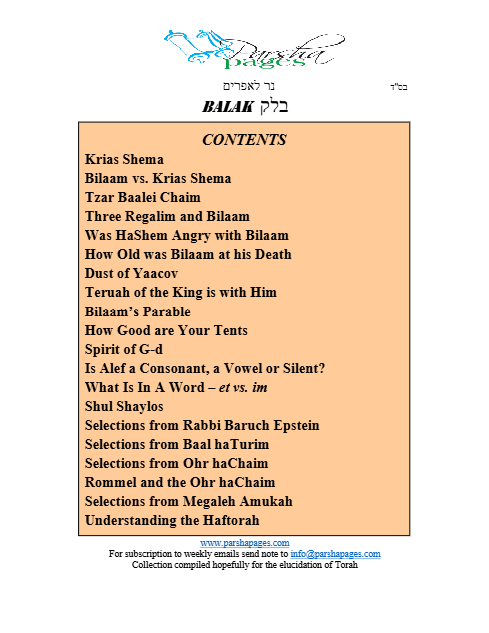

The Mishnah (Bava Basra 60a) teaches that it is forbidden to open a door opposite a neighbor's door, or a window across from a neighbor's window. The reason for this is to protect the privacy of the private domain. The Gemara explains that this prohibition is derived from a verse in this week's parashah. Casting his eyes on the tents of the Jewish people, Bilam saw that the entrances to the tents were carefully planned so that one should not see into the other. Upon seeing this, he exclaimed: "How good are your tents, O Yaakov, your abodes, O Israel."

Elsewhere, Chazal interpret the verse in an altogether different sense. Reflecting on the blessings that Bilam gave, the Gemara writes that all the blessings returned to the curses that Bilam originally intended, except for the "houses of prayer and houses of Torah study." The shuls and the batei midrash, according to this interpretation, are the "good tents" to which Bilam referred.

What connection is there between these two interpretations? Is there a connection between the privacy of individual domains, and the virtue of our shuls and batei midrash? It would appear that there is, indeed, a deep connection. The Maharal (Netzach Yisrael, Chap. 4) explains that the virtue of the Second Temple was the virtue of national unity. The place of the Temple is unique to Hashem among all places in the world, and the nation of Israel is unique to Hashem among all nations of the world. Therefore, the Temple was destroyed because of baseless hatred: The Temple was destroyed on account of the shattered unity of the nation.

A basic precondition to national unity is that the entrances to individual tents should not open one across the other. The point is not merely that one private domain should not disturb the privacy of another. Rather, the separate domains imply a far deeper separation, indicating that each tent is a world unto itself.

Each individual household has its special character and essence; each person has particular capacities and particular traits. One person is attracted to halachah, and another to philosophical inquiry; one is pulled to kindness, and another to judgment. Each is distinct, each is individual.

This individuality is a precondition to the concept of achdus. Being a united people does not mean being a uniform or homogenous people. In fact, the two concepts contradict one another: the unity of a homogenous people has little meaning—they are united because they are the same. The greatness of national unity is that people who are different unite together to form different parts of one national body.

In achieving national unity, including the precondition that our doors and windows should not face one another, we merit the "small sanctuary" of the shuls and the batei midrash. Ultimately, we merit even the rebuilding of the Temple—may it come speedily, and in our times. "How good are your tents, O Yaakov, your abodes, O Israel."

PDF Preview