Parsha Pizzazz
Parsha Pages Youth | June 02, 2024
Print This Article
View Original PDF

Parsha Pizzazz

Parsha Pages Youth | June 27, 2025

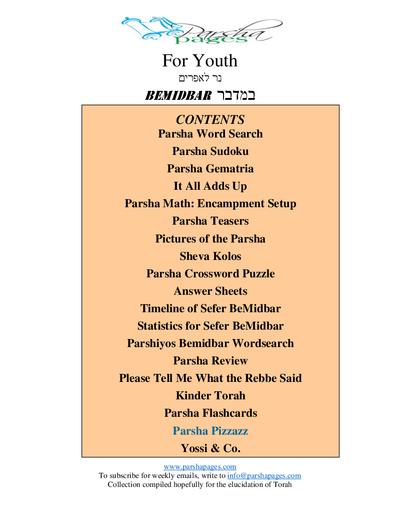
Parsha Pizzazz - Bamidbar

This week's parsha begins the Book of Bamidbar. We'll pick up the story of the Jewish people where we left off at the end of the Book of Shmot. "Bamidbar" means "in the desert" - and that's where the Jews were, on their way from Egypt to Israel! In the first parsha of Bamidbar, there's a whole lot of counting going on...

Everybody Counts!

One month after the Mishkan was dedicated, HaShem said to Moshe, "Count all of the men who are between 20 and 60 years old. Keep a total for each tribe, and make sure that each person gives you proof of which tribe he belongs to."

Moshe quickly gathered the nesi'im (leaders) of each tribe together for a meeting. He told them, "HaShem has commanded me to count the Jewish people. It's a big job, and I'm going to need your help!"

Moshe then assembled all of the Jewish people and announced, "May I have your attention, please! HaShem has asked for a population count. All Jewish men over age 20, line up! And make sure you have a half-shekel coin with you, as well as documents to prove your tribal lineage!"

What was the purpose of giving the half-shekel coin? Since one is not allowed to count Jews directly, coins were collected so that they could be counted instead.

Soon there was a line of people that stretched as far as the eye could see. One by one, beginning with the tribe of Reuven, each man stepped up in front of Moshe, Aharon, and the nesi'im, and dropped his coin into a collection box.

It was a simple enough thing to do, and it took only a minute. But it was actually the experience of a lifetime! Each man had his own personal, face-to-face encounter with the spiritual leaders of his generation: Moshe, the greatest Jewish prophet of all time, and Aharon, the holy Kohein Gadol! In the presence of Moshe and Aharon, each man said his name, and then Moshe and Aharon blessed him. Each one knew that he was important in the eyes of HaShem.

Once every man had given his half-shekel, all of the coins were counted. This took quite a while... There were 603,550 coins! This total did not include the tribe of Levi, who were counted separately.

Places, Everyone!

Just before Yaakov passed away, he had given instructions for how his twelve sons should position themselves when they would carry his coffin. Yehudah, Yissachar, and Zevulun stood on the east side of the coffin; Reuven, Shimon, and Gad on the south side; Efrayim, Menashe, and Binyamin on the west side; and Dan, Asher, and Naftali on the north side.

But aren't two tribes missing? What about Yosef and Levi?

Yaakov didn't want Yosef to carry his coffin because Yosef was a king. It wouldn't be right for a person of such great stature to carry a coffin. So Yosef's sons, Efrayim and Menashe, took his place.

And Yaakov didn't want Levi to carry his coffin, because he knew that in the future, Levi's tribe would have the honor of carrying the Aron (ark) containing the Ten Commandments - the living words of HaShem. It would not be proper for the tribe of Levi to be involved in carrying symbols of both death and life. HaShem honored Yaakov's arrangement of his sons when it was time to assign each tribe its place in the camps around the Mishkan.

Camping Out

HaShem described to Moshe how the tribes' camps should be positioned. In the center of all the camps was the Mishkan itself - which was called the Camp of the Shechina (Divine Presence). The tribe of Levi - including Moshe and Aharon's families -- surrounded the Mishkan. This was called the Camp of the Levi'im, and it was the position of the highest honor.

The rest of the tribes were arranged on all four sides of the Levi'im. This was Machaneh Yisrael, the Camp of the Jewish People.

On the east side were the camps of the tribes of Yehudah, Yissachar, and Zevulun. On the south side were Reuven, Shimon, and Gad. On the west side were Efrayim, Menashe, and Binyamin. And on the north side were Dan, Asher, and Naftali.

And that's exactly how Yaakov's twelve sons were arranged around his coffin. Since everyone knew this, all of the tribes accepted their placement without fussing or fighting.

It's a Grand Old Flag

Each tribe had its own flag. When the people were camped in the desert, the flags were raised above each tribe's camp to identify it.

Each flag was different, with a special symbol, color, and passuk (verse from the Torah) representing each tribe.

Going Door to Door

After most of the Jewish men were counted, Moshe still needed to count the men of the tribe of Levi. The Levi'im needed to be counted separately, because for them, the count would include babies and children, one month old and up. (For of the other tribes, only men over age 20 were counted.)

But counting babies and children was tricky. Babies wouldn't be able to wait on line for hours and hours in the hot desert sun, so what was Moshe to do?

"HaShem," Moshe said. "What should I do? Go door to door, intruding on every family to ask how many children live there?"

Because of his sense of modesty, Moshe was uncomfortable about going inside the homes of the Levi'im.

"Yes!" answered HaShem. "That's exactly what you need to do. But I'll help you so you won't need to go into everyone's tents."

Trusting HaShem to keep His promise, Moshe set out for the first tent. He knocked on the door.

Just then a voice from Above called, "There are four boys in this tent!"

Moshe was so relieved! He would not have to go into each family's tent, and interrupt their dinner or the children's bedtime stories. He simply walked by each tent and marked down the number spoken by the heavenly voice.

A Little Math Problem

When Moshe finished counting all the Levi'im, the grand total was 22,300. This was thousands less than any other tribe. That's pretty strange, especially since the Levi'im's total included children! There are a few reasons for this unusual result. First of all, many Levi'im died as a result of not treating the Aron with complete respect when they carried it. Also, since the Levi'im did not do slave labor in Egypt, they did not receive HaShem's blessing to the tribes that did work - that the mothers would give birth to six babies at one time! Since the Levi'im had only one baby at a time, their population was smaller.

After Moshe counted the Levi'im, HaShem told him to count all of the first-born sons in the entire Jewish people, including all boys one month old and up. Moshe counted them, and the total was 22,273 first-born sons. The first-born sons were originally the ones who were supposed to offer sacrifices on behalf of their families. But since they took part in worshipping the Golden Calf, HaShem no longer wanted them to have this honor. In the Mishkan, the Levi'im would offer the sacrifices instead. So, each first-born was to be replaced by a Levi.

Now here comes the math.
Parsha Pizzazz - Bamidbar

This week's parsha begins the Book of Bamidbar. We'll pick up the story of the Jewish people where we left off at the end of the Book of Shmot. "Bamidbar" means "in the desert" - and that's where the Jews were, on their way from Egypt to Israel! In the first parsha of Bamidbar, there's a whole lot of counting going on...

Everybody Counts!

One month after the Mishkan was dedicated, HaShem said to Moshe, "Count all of the men who are between 20 and 60 years old. Keep a total for each tribe, and make sure that each person gives you proof of which tribe he belongs to."

Moshe quickly gathered the nesi'im (leaders) of each tribe together for a meeting. He told them, "HaShem has commanded me to count the Jewish people. It's a big job, and I'm going to need your help!"

Moshe then assembled all of the Jewish people and announced, "May I have your attention, please! HaShem has asked for a population count. All Jewish men over age 20, line up! And make sure you have a half-shekel coin with you, as well as documents to prove your tribal lineage!"

What was the purpose of giving the half-shekel coin? Since one is not allowed to count Jews directly, coins were collected so that they could be counted instead.

Soon there was a line of people that stretched as far as the eye could see. One by one, beginning with the tribe of Reuven, each man stepped up in front of Moshe, Aharon, and the nesi'im, and dropped his coin into a collection box.

It was a simple enough thing to do, and it took only a minute. But it was actually the experience of a lifetime! Each man had his own personal, face-to-face encounter with the spiritual leaders of his generation: Moshe, the greatest Jewish prophet of all time, and Aharon, the holy Kohein Gadol! In the presence of Moshe and Aharon, each man said his name, and then Moshe and Aharon blessed him. Each one knew that he was important in the eyes of HaShem.

Once every man had given his half-shekel, all of the coins were counted. This took quite a while... There were 603,550 coins! This total did not include the tribe of Levi, who were counted separately.

Places, Everyone!

Just before Yaakov passed away, he had given instructions for how his twelve sons should position themselves when they would carry his coffin. Yehudah, Yissachar, and Zevulun stood on the east side of the coffin; Reuven, Shimon, and Gad on the south side; Efrayim, Menashe, and Binyamin on the west side; and Dan, Asher, and Naftali on the north side.

But aren't two tribes missing? What about Yosef and Levi?

Yaakov didn't want Yosef to carry his coffin because Yosef was a king. It wouldn't be right for a person of such great stature to carry a coffin. So Yosef's sons, Efrayim and Menashe, took his place.

And Yaakov didn't want Levi to carry his coffin, because he knew that in the future, Levi's tribe would have the honor of carrying the Aron (ark) containing the Ten Commandments - the living words of HaShem. It would not be proper for the tribe of Levi to be involved in carrying symbols of both death and life. HaShem honored Yaakov's arrangement of his sons when it was time to assign each tribe its place in the camps around the Mishkan.

Camping Out

HaShem described to Moshe how the tribes' camps should be positioned. In the center of all the camps was the Mishkan itself - which was called the Camp of the Shechina (Divine Presence). The tribe of Levi - including Moshe and Aharon's families -- surrounded the Mishkan. This was called the Camp of the Levi'im, and it was the position of the highest honor.

The rest of the tribes were arranged on all four sides of the Levi'im. This was Machaneh Yisrael, the Camp of the Jewish People.

On the east side were the camps of the tribes of Yehudah, Yissachar, and Zevulun. On the south side were Reuven, Shimon, and Gad. On the west side were Efrayim, Menashe, and Binyamin. And on the north side were Dan, Asher, and Naftali.

And that's exactly how Yaakov's twelve sons were arranged around his coffin. Since everyone knew this, all of the tribes accepted their placement without fussing or fighting.

It's a Grand Old Flag

Each tribe had its own flag. When the people were camped in the desert, the flags were raised above each tribe's camp to identify it.

Each flag was different, with a special symbol, color, and passuk (verse from the Torah) representing each tribe.

Going Door to Door

After most of the Jewish men were counted, Moshe still needed to count the men of the tribe of Levi. The Levi'im needed to be counted separately, because for them, the count would include babies and children, one month old and up. (For of the other tribes, only men over age 20 were counted.)

But counting babies and children was tricky. Babies wouldn't be able to wait on line for hours and hours in the hot desert sun, so what was Moshe to do?

"HaShem," Moshe said. "What should I do? Go door to door, intruding on every family to ask how many children live there?"

Because of his sense of modesty, Moshe was uncomfortable about going inside the homes of the Levi'im.

"Yes!" answered HaShem. "That's exactly what you need to do. But I'll help you so you won't need to go into everyone's tents."

Trusting HaShem to keep His promise, Moshe set out for the first tent. He knocked on the door.

Just then a voice from Above called, "There are four boys in this tent!"

Moshe was so relieved! He would not have to go into each family's tent, and interrupt their dinner or the children's bedtime stories. He simply walked by each tent and marked down the number spoken by the heavenly voice.

A Little Math Problem

When Moshe finished counting all the Levi'im, the grand total was 22,300. This was thousands less than any other tribe. That's pretty strange, especially since the Levi'im's total included children! There are a few reasons for this unusual result. First of all, many Levi'im died as a result of not treating the Aron with complete respect when they carried it. Also, since the Levi'im did not do slave labor in Egypt, they did not receive HaShem's blessing to the tribes that did work - that the mothers would give birth to six babies at one time! Since the Levi'im had only one baby at a time, their population was smaller.

After Moshe counted the Levi'im, HaShem told him to count all of the first-born sons in the entire Jewish people, including all boys one month old and up. Moshe counted them, and the total was 22,273 first-born sons. The first-born sons were originally the ones who were supposed to offer sacrifices on behalf of their families. But since they took part in worshipping the Golden Calf, HaShem no longer wanted them to have this honor. In the Mishkan, the Levi'im would offer the sacrifices instead. So, each first-born was to be replaced by a Levi.

Now here comes the math.

PDF Preview