The Sound of Silence
BET Journal | June 06, 2024
Print This Article
View Original PDF

The Sound of Silence

BET Journal | June 27, 2025

There is a spiritual reason that the Torah was given in the desert. The desert is a place of silence. There is nothing visually to distract you, and there is no ambient noise to muffle sound. To be sure, when the Israelites received the Torah, there was thunder and lightning and the sound of a shofar. The earth felt as if it were shaking at its foundations. But in a later age, when the Prophet Elijah stood at the same mountain after his confrontation with the prophets of Baal, he encountered God not in the whirlwind or the fire or the earthquake but in the kol demamah dakah, the still, small voice, literally “the sound of a slender silence” (1 Kings 19:9-12).” I define this as the sound you can only hear if you are listening. In the silence of the midbar, the desert, you can hear the Medaber, the Speaker, and the medubar, that which is spoken. To hear the voice of God you need a listening silence in the soul.

Many years ago British television produced a documentary series, The Long Search, on the world’s great religions.[4] When it came to Judaism, the presenter Ronald Eyre seemed surprised by its blooming, buzzing confusion, especially the loud, argumentative voices in the beit midrash, the house of study. Remarking on this to Elie Wiesel, he asked, “Is there such a thing as a silence in Judaism?” Wiesel replied: “Judaism is full of silences ... but we don’t talk about them.”

Judaism is a very verbal culture, a religion of holy words. Much of Judaism is about the power of words to make or break worlds. So silence in Tanach often has a negative connotation.

But not all silence is sad.

The Sages valued silence. They called it “a fence to wisdom” (Mishna Avot 3:13). “If words are worth a coin, silence is worth two” (Megilla 18a).

The service of the Priests in the Temple was accompanied by silence. The Levites sang in the courtyard, but the Priests – unlike their counterparts in other ancient religions – neither sang nor spoke while offering the sacrifices.

Our most profound prayer, the private saying of the Amidah, is called tefillah be-lachash, the “silent prayer”. It is based on the precedent of Hannah, praying for a child. “She spoke in her heart. Her lips moved but her voice was not heard.” 1 Sam. 1:13. God hears our silent cry, and hears our thoughts, even when they are not expressed in audible speech.

The silence that counts, in Judaism, is thus a listening silence – and listening is the supreme religious art. Listening means making space for others to speak and be heard.

There is the voice of history that was heard by the prophets. And there is the commanding voice of Sinai that continues to speak to us across the abyss of time. I sometimes think that people in the modern age have found the concept of “Torah from Heaven” problematic, not because of some new archaeological discovery, but because we have lost the habit of listening to the sound of transcendence, a voice beyond the merely human.

Is there enough listening in the Jewish world today? Do we, in marriage, really listen to our spouses? Do we as parents truly listen to our children? Do we, as leaders, hear the unspoken fears of those we seek to lead? Do we internalize the sense of hurt of the people who feel excluded from the community? Can we really claim to be listening to the voice of God if we fail to listen to the voices of our fellow humans?

From time to time we need to step back from the noise and hubbub of the social world and create in our hearts the stillness of the desert where, within the silence, we can hear the kol demamah dakah, the still, small voice of God, telling us we are loved, we are heard, we are embraced by God’s everlasting arms, we are not alone.
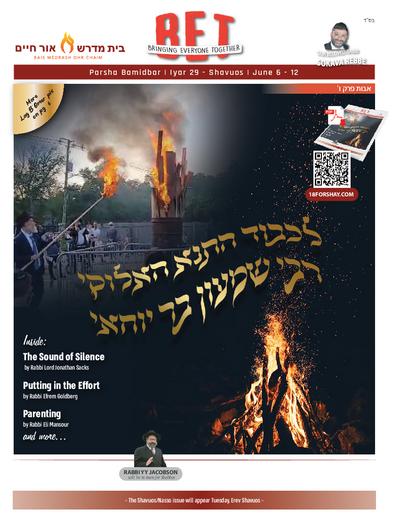

There is a spiritual reason that the Torah was given in the desert. The desert is a place of silence. There is nothing visually to distract you, and there is no ambient noise to muffle sound. To be sure, when the Israelites received the Torah, there was thunder and lightning and the sound of a shofar. The earth felt as if it were shaking at its foundations. But in a later age, when the Prophet Elijah stood at the same mountain after his confrontation with the prophets of Baal, he encountered God not in the whirlwind or the fire or the earthquake but in the kol demamah dakah, the still, small voice, literally “the sound of a slender silence” (1 Kings 19:9-12).” I define this as the sound you can only hear if you are listening. In the silence of the midbar, the desert, you can hear the Medaber, the Speaker, and the medubar, that which is spoken. To hear the voice of God you need a listening silence in the soul.

Many years ago British television produced a documentary series, The Long Search, on the world’s great religions.[4] When it came to Judaism, the presenter Ronald Eyre seemed surprised by its blooming, buzzing confusion, especially the loud, argumentative voices in the beit midrash, the house of study. Remarking on this to Elie Wiesel, he asked, “Is there such a thing as a silence in Judaism?” Wiesel replied: “Judaism is full of silences ... but we don’t talk about them.”

Judaism is a very verbal culture, a religion of holy words. Much of Judaism is about the power of words to make or break worlds. So silence in Tanach often has a negative connotation.

But not all silence is sad.

The Sages valued silence. They called it “a fence to wisdom” (Mishna Avot 3:13). “If words are worth a coin, silence is worth two” (Megilla 18a).

The service of the Priests in the Temple was accompanied by silence. The Levites sang in the courtyard, but the Priests – unlike their counterparts in other ancient religions – neither sang nor spoke while offering the sacrifices.

Our most profound prayer, the private saying of the Amidah, is called tefillah be-lachash, the “silent prayer”. It is based on the precedent of Hannah, praying for a child. “She spoke in her heart. Her lips moved but her voice was not heard.” 1 Sam. 1:13. God hears our silent cry, and hears our thoughts, even when they are not expressed in audible speech.

The silence that counts, in Judaism, is thus a listening silence – and listening is the supreme religious art. Listening means making space for others to speak and be heard.

There is the voice of history that was heard by the prophets. And there is the commanding voice of Sinai that continues to speak to us across the abyss of time. I sometimes think that people in the modern age have found the concept of “Torah from Heaven” problematic, not because of some new archaeological discovery, but because we have lost the habit of listening to the sound of transcendence, a voice beyond the merely human.

Is there enough listening in the Jewish world today? Do we, in marriage, really listen to our spouses? Do we as parents truly listen to our children? Do we, as leaders, hear the unspoken fears of those we seek to lead? Do we internalize the sense of hurt of the people who feel excluded from the community? Can we really claim to be listening to the voice of God if we fail to listen to the voices of our fellow humans?

From time to time we need to step back from the noise and hubbub of the social world and create in our hearts the stillness of the desert where, within the silence, we can hear the kol demamah dakah, the still, small voice of God, telling us we are loved, we are heard, we are embraced by God’s everlasting arms, we are not alone.

PDF Preview