The Endless Quest
L’Chaim | May 29, 2024
Print This Article
View Original PDF

The Endless Quest

L’Chaim | June 27, 2025

This Shabbat we read the Torah portion of Bechukotai which is the final portion in the book of Vayikra (Leviticus). Bechukotai begins with the Divine promise: “If you will walk in My statutes, and keep My mitzvot and do them”--then G-d will bestow many blessings, including rain at the right time, ample produce, security and peace.

One might wonder: Should we be fulfilling the mitzvot for the sake of material rewards or for their own sake--because G-d commanded them?

Among the many answers to this question, Maimonides gives the following answer: The mitzvot must, indeed, be fulfilled unconditionally and without regard for reward. However, there are inevitably various distractions and difficulties connected with daily life that makes it harder to fulfill the mitzvot. When these distractions are minimized, it is much easier to carry out the mitzvot fully and completely. But when material circumstances are not quite so satisfactory, though the same performance of the mitzvot is expected, it requires a greater effort. For it is obviously harder to concentrate on Torah and mitzvot when one has to overcome outside pressures.

G-d’s promise of material rewards is not meant to provide reason for keeping the Torah and mitzvot. But it is a promise that where there is a firm resolve to walk in G-d’s ways and keep His mitzvot, He will make it easier by providing all material needs and reducing outside pressures to a minimum.

The book of Leviticus, which we complete this Shabbat, is also known as Torat Kohanim (the Laws of the Priests) and the Book of Sacrifices.

Jews, as a people, and individually, are expected to behave like kohanim (priests), as G-d has declared: “And you should be unto Me a Kingdom of Kohanim.” Just as the kohen has been selected to dedicate himself to the Divine Service--and not only for his own sake, but also for the whole Jewish people--so has every Jew been chosen to serve G-d, with a responsibility also for his entire environment.

To serve G-d does not mean to withdraw from the world; it rather means to serve G-d within this world and together with this world. The beginning of this G-dly service is in one’s own home-life, by conducting it in such a way that G-d’s Presence should dwell in it, as it is written: “They shall make Me a Sanctuary that I may dwell among them.”

This is accomplished by a way of life exemplified by the sacrifices of old. The service of the sacrifices consisted in taking things from one’s possession--a lamb, flour, oil, wine, salt, etc.--and consecrating them.

This is the way a Jewish home should be conducted; every detail of one’s life should be consecrated to G-d. How is this accomplished? By bringing spirituality into our daily lives and our homes through charity and good deeds, communicating with G-d, and Jewish education. And then the Divine Presence dwells there, and it is a home blessed by G-d, materially and spiritually.

Adapted from the works of the Lubavitcher Rebbe.

Story

It was Simchat Torah, the holiday that celebrates the completion of the Torah, and the disciples of the great Chassidic master Rabbi Mendel of Horodok were awaiting him. They approached his student, Rabbi Schneur Zalman of Liadi, to ask their revered Rebbe to join his followers. Rabbi Shneur Zalman found the Chassidic master deeply engrossed in his thoughts. “The chassidim are waiting for you,” he told him.

“I cannot join them!” was the response. Rabbi Mendel explained to his student that he knew of one hundred teachings on the Biblical verse of ‘Atah Hor’eisa,’ which is recited prior to the joyous hakafot - dancing with the Torah. “I cannot recite the verse without a proper comprehension of its significance,” cried Rabbi Mendel.

“Rebbe!” said Rabbi Schneur Zalman. “When you will reach a full comprehension of the hundred meanings, you will discover another hundred...”

“You are right,” said Rabbi Mendel, “Come, let us go to hakafot, let us go rejoice with the Torah.”

Insights

An interesting verse in this week’s portion, Bechokosei, reads, “You will eat the very old [grain] and you will remove the old to make way for the new.”

A homiletic interpretation understands “the very old” to symbolize G-d, who represents eternity. One ought to satiate one’s hunger with G-d.

Yet we should never get stuck in our old understandings of G-d which can hinder our growth and spiritual journey. The only definition of G-d in Judaism is that He has no definition.

The Chassidic master, Rabbi Elimelech of Liszhensk, asks: Why do we begin blessings by addressing G-d in second person, “Blessed are You, Lord our G-d”, and then conclude by addressing Him in third person, “Who has sanctified us with His commandments”?

In the beginning of one’s spiritual journey, G-d seems very near. You feel that you “have G-d,” that you grasp His depth.

But as you continue to climb, you discover the gulf between you and infinity. When you come close to truth, you can begin to sense how far you are from truth.

When Abraham took Isaac to the akeida - the binding of Isaac, the Torah tells us that “On the third day, Abraham looked up and saw the place from afar. Abraham said to his attendants, ‘You stay here with the donkey, and I and the lad will go yonder....’”

Why did Abraham take his attendants along if he was to leave them behind anyway? Because it was only Abraham who “looked up and saw the place from afar.” Only Abraham realized how remote he still was from the Divine mountain. His attendants actually thought that the place was near. At that moment, Abraham knew that they were not ready to accompany him on his journey toward G-d.

Thus is the paradox of one’s spiritual process. The closer you become, the further you must become. And G-d sends forth His promise: “I will heal he who is far and near.”

Excerpts from an article by Rabbi YY Jacobson
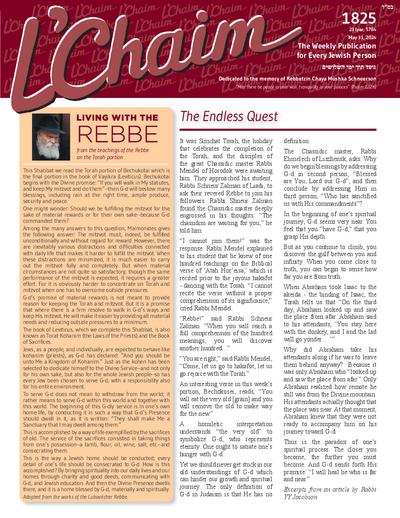
This Shabbat we read the Torah portion of Bechukotai which is the final portion in the book of Vayikra (Leviticus). Bechukotai begins with the Divine promise: “If you will walk in My statutes, and keep My mitzvot and do them”--then G-d will bestow many blessings, including rain at the right time, ample produce, security and peace.

One might wonder: Should we be fulfilling the mitzvot for the sake of material rewards or for their own sake--because G-d commanded them?

Among the many answers to this question, Maimonides gives the following answer: The mitzvot must, indeed, be fulfilled unconditionally and without regard for reward. However, there are inevitably various distractions and difficulties connected with daily life that makes it harder to fulfill the mitzvot. When these distractions are minimized, it is much easier to carry out the mitzvot fully and completely. But when material circumstances are not quite so satisfactory, though the same performance of the mitzvot is expected, it requires a greater effort. For it is obviously harder to concentrate on Torah and mitzvot when one has to overcome outside pressures.

G-d’s promise of material rewards is not meant to provide reason for keeping the Torah and mitzvot. But it is a promise that where there is a firm resolve to walk in G-d’s ways and keep His mitzvot, He will make it easier by providing all material needs and reducing outside pressures to a minimum.

The book of Leviticus, which we complete this Shabbat, is also known as Torat Kohanim (the Laws of the Priests) and the Book of Sacrifices.

Jews, as a people, and individually, are expected to behave like kohanim (priests), as G-d has declared: “And you should be unto Me a Kingdom of Kohanim.” Just as the kohen has been selected to dedicate himself to the Divine Service--and not only for his own sake, but also for the whole Jewish people--so has every Jew been chosen to serve G-d, with a responsibility also for his entire environment.

To serve G-d does not mean to withdraw from the world; it rather means to serve G-d within this world and together with this world. The beginning of this G-dly service is in one’s own home-life, by conducting it in such a way that G-d’s Presence should dwell in it, as it is written: “They shall make Me a Sanctuary that I may dwell among them.”

This is accomplished by a way of life exemplified by the sacrifices of old. The service of the sacrifices consisted in taking things from one’s possession--a lamb, flour, oil, wine, salt, etc.--and consecrating them.

This is the way a Jewish home should be conducted; every detail of one’s life should be consecrated to G-d. How is this accomplished? By bringing spirituality into our daily lives and our homes through charity and good deeds, communicating with G-d, and Jewish education. And then the Divine Presence dwells there, and it is a home blessed by G-d, materially and spiritually.

Adapted from the works of the Lubavitcher Rebbe.

Story

It was Simchat Torah, the holiday that celebrates the completion of the Torah, and the disciples of the great Chassidic master Rabbi Mendel of Horodok were awaiting him. They approached his student, Rabbi Schneur Zalman of Liadi, to ask their revered Rebbe to join his followers. Rabbi Shneur Zalman found the Chassidic master deeply engrossed in his thoughts. “The chassidim are waiting for you,” he told him.

“I cannot join them!” was the response. Rabbi Mendel explained to his student that he knew of one hundred teachings on the Biblical verse of ‘Atah Hor’eisa,’ which is recited prior to the joyous hakafot - dancing with the Torah. “I cannot recite the verse without a proper comprehension of its significance,” cried Rabbi Mendel.

“Rebbe!” said Rabbi Schneur Zalman. “When you will reach a full comprehension of the hundred meanings, you will discover another hundred...”

“You are right,” said Rabbi Mendel, “Come, let us go to hakafot, let us go rejoice with the Torah.”

Insights

An interesting verse in this week’s portion, Bechokosei, reads, “You will eat the very old [grain] and you will remove the old to make way for the new.”

A homiletic interpretation understands “the very old” to symbolize G-d, who represents eternity. One ought to satiate one’s hunger with G-d.

Yet we should never get stuck in our old understandings of G-d which can hinder our growth and spiritual journey. The only definition of G-d in Judaism is that He has no definition.

The Chassidic master, Rabbi Elimelech of Liszhensk, asks: Why do we begin blessings by addressing G-d in second person, “Blessed are You, Lord our G-d”, and then conclude by addressing Him in third person, “Who has sanctified us with His commandments”?

In the beginning of one’s spiritual journey, G-d seems very near. You feel that you “have G-d,” that you grasp His depth.

But as you continue to climb, you discover the gulf between you and infinity. When you come close to truth, you can begin to sense how far you are from truth.

When Abraham took Isaac to the akeida - the binding of Isaac, the Torah tells us that “On the third day, Abraham looked up and saw the place from afar. Abraham said to his attendants, ‘You stay here with the donkey, and I and the lad will go yonder....’”

Why did Abraham take his attendants along if he was to leave them behind anyway? Because it was only Abraham who “looked up and saw the place from afar.” Only Abraham realized how remote he still was from the Divine mountain. His attendants actually thought that the place was near. At that moment, Abraham knew that they were not ready to accompany him on his journey toward G-d.

Thus is the paradox of one’s spiritual process. The closer you become, the further you must become. And G-d sends forth His promise: “I will heal he who is far and near.”

Excerpts from an article by Rabbi YY Jacobson

PDF Preview



