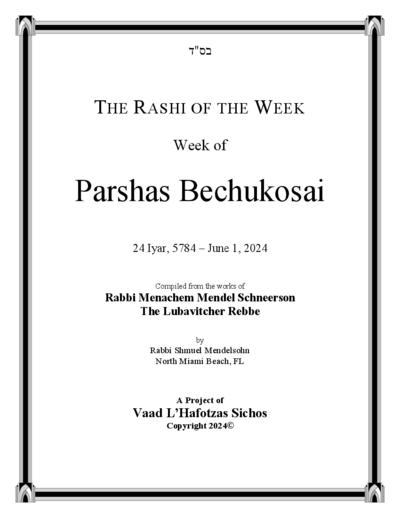
The Rashi of the Week Parshas Bechukosai
The Rashi of the Week | May 31, 2024
Print This Article
View Original PDF

The Rashi of the Week Parshas Bechukosai

The Rashi of the Week | June 25, 2025

Rashi in His Own Words

ויקרא כ"ו, ג': אִ םבְּ חֻקֹּ תַ י תֵּ לֵּכוּ וְּ אֶ ת מִ צְּ ו‍ֹ תַ יתִ שְּ מְּ רוּ וַעֲשִ יתֶ ם אֹּ תָ ם:
רש"י ד"ה אם בחקתי תלכו: יכול זה קיום המצות, כשהוא אומר ואת מצותי תשמרו, הרי קיום המצות אמור, הא מה אני מקיים אם בחקתי תלכו, שתהיו עמלים בתורה:
רש"י ד"ה ואת מצותי תשמרו: הוו עמלים בתורה על מנת לשמור ולקיים, כמו שנאמר (דברים ה ,' 'א) ולמדתם אותם ושמרתם לעשותם:

Vayikroh 26:3: If you follow My statutes and observe My commandments and perform them...

Rashi Heading: If you follow My statutes: I might think that this refers to the fulfillment of the commandments. However, when Scripture says, “and observe My commandments,” the fulfillment of the commandments is (already) stated. So, what is the meaning of “If you follow My statutes?” It means that you must toil in the study of Torah.

Synopsis

In this week's Torah portion, Bechukosai, G-d, tells us, "If you follow My statutes and observe My commandments and perform them," He will give you great rewards. The question is that "following in My statutes" and "observing My commandments" appear to be the same! Both seem to refer to fulfilling Mitzvos. Yet, the Torah is Hashem's Will and Wisdom. Every word is measured; each is precise, and it contains no redundancies. "Following His statutes" and "observing His commandments" cannot both mean the same thing. To explain this, Rashi tells us that "following in My statutes" refers to toiling in Torah study.

However, the word "Statutes - חוקים," which Rashi explains to mean "toiling in Torah study," refers to a specific sort of Mitzvah, i.e., those Mitzvos for which there is no rational explanation. If the Torah were referring to fulfilling the commandments, it would be perfectly natural to specify this type of Mitzvah. All Mitzvos, including those which we understand, to one degree or another, must be observed in the same manner that we fulfill "Statutes - חוקים." We must keep them because Hashem commanded us to, not because they make sense.

1. This is what is implied by the words “if you follow my statutes.”

Rashi's Explanation

In this week's Torah portion, Bechukosai, the Torah tells us an instance of cause and effect

1. "If you follow My statutes and observe My commandments and perform them," the Torah continues, "I will give your rains in their time, the land will yield its produce, and the tree of the field will give forth its fruit." Hashem continues with increasingly greater rewards, concluding, "I will place My dwelling in your midst, and My Spirit will not reject you. I will walk among you and be your G-d, and you will be My people."

Hashem's words appear to contain a redundancy; "If you follow My statutes and observe My commandments...." Both clauses seem to mean the same thing, referring to Mitzvah observance. Therefore, Rashi cites the words "if you follow My statutes" and states, "I might think this refers to the fulfillment of the commandments. However, this cannot be so. When the Torah says, 'and observe My commandments,' the fulfillment of the commandments is stated. What does the Torah mean by 'If you follow My statutes'? The Torah means that you must toil in the study of Torah." In other words, Rashi explains that following My statutes refers to toiling in Torah study while observing commandments, which refers to Mitzvah performance.

2. Our Parshah, Vayikroh 26:4.
3. Our Parshah, Vayikroh 26:11-12.

Difficulties in Understanding Rashi

There are three different types of Mitzvos:

  1. Ordinances - משפטים. These are Mitzvos that have a rational explanation. Even had the Torah not commanded us to perform these Mitzvos, we would have understood the need to keep them on our own. Most of the interpersonal Mitzvos are included in this category. Examples of this sort of Mitzvah would be not to murder, steal, or deceive a fellow. This is in keeping with the saying of the Sages that "Had the Torah (G-d forbid) not been given, we would have learned modesty from a cat and honesty (not stealing) from an ant."
  2. Testimonies - עדות. These are commandments that we can also comprehend with our human intellect. However, had the Torah not commanded us to perform these, we would not have felt a need to fulfill them independently. For example, we can all understand that since Hashem redeemed us from the slavery of Egypt on the 15th of Nissan, we must celebrate Pesach every year on this same date. However, had the Torah not commanded us to do so, we would not necessarily have instituted the festival of Pesach.
  3. Statutes - חוקים. These are commandments that the human intellect cannot fathom—for example, the Torah's prohibition against wearing a garment containing both wool and linen. The only reason for observing these Mitzvos is Hashem's commandment. As the Sages say, "Because Satan and the nations of the world taunt Israel saying, 'What is this commandment, and what purpose does it have?' Therefore, the Torah uses the term 'statute.' I have decreed it; you have no right to challenge it."

In the verse we are discussing, "following My statutes" referred to Mitzvah observance; we could easily understand the Torah's use of the word "Statutes - חוקים." After all, we must fulfill all Mitzvos as statutes, regardless of whether or not we understand them. Mitzvah means commandment; all Mitzvos are the King's commandments, and following them is essential to accepting the yoke of Hashem's kingship. Whether or not we understand them is irrelevant.

However, Rashi explains that "following My statutes" refers not to Mitzvah observance but to the obligation of toiling in Torah study. The point of Torah study is striving to understand what one learns, which is true regarding toiling in Torah study. Study does not simply mean reviewing until one knows all of the Torah's obligations by heart; instead, it means grasping and understanding the Torah that one learns to the possible extent. The use of the term "Statutes – "חוקים would seem to contradict this idea since it refers to Mitzvos which we cannot comprehend.

The fact that there are Mitzvos that we cannot comprehend in and of itself contradicts what we are saying. As much as we may study these Mitzvos, we cannot expect to understand them. However, we can understand the overwhelming majority of Mitzvos with human intelligence to a greater or lesser extent. We must understand how Rashi can explain going in Hashem's statutes (following Mitzvos without a rational explanation) as "toiling in Torah."

A Deeper Lesson from Rashi

The Alter Rebbe explains in Likkutei Torah that aside from meaning a statute, the Hebrew word "חוקה" has an additional meaning, and it is also related to the word "חקיקה," which means engraved. According to Rashi's explanation, the Torah alludes to how we must study the Torah and how much more so this is true regarding toiling in the Torah.

There are two manners in which Hashem gave us the Torah; one is as a scroll, and the other is the two tablets that Moshe Rabbeinu received at Sinai. A Torah scroll is written with ink on parchment, which is two different things. However, when a scribe uses the ink to write a Torah on the parchment, the two become united as one.

However, Hashem also gave us two tablets of stone. He did not write the words on the stone; He engraved them in the stone. The letters do not exist as separate from the stone; instead, they are one with the stone. A person's toil in the Torah must cause him to become one with the Torah itself.

One who studies the Torah yet does not allow it to penetrate himself defeats the purpose. We find this regarding Doeg Hoedomi. The Sages teach us that the Torah he learned was "from his lips to the outside." In other words, despite having learned much Torah, it never penetrated his heart. He never became one with the Torah, which he studied. This is not the correct path of Torah study.

However, one might think that uniting oneself with the Torah in the same manner that ink is united with parchment is sufficient. The ink and the parchment are two separate entities, yet they become one. That certainly seems an excellent way of uniting oneself with the Torah! Our Parshah teaches us that even this is insufficient. My toil in the Torah must be in a manner of חקיקה. The Torah must become absolutely one with me.

Our unity with G-d and His Torah must be similar to what Moshe Rabbeinu, the first to receive the Torah from Hashem, demonstrated. His unity with G-d and G-dliness was so great that he could say, "I will give grass in your fields." How was he, a mortal, able to say these words? Because he was one with Hashem to the extent that "the Shechinah spoke through his throat." That is what Hashem demands from each of us.

The ultimate reward for our toil in Torah study in this manner is "I am the Lord your G-d Who took you out of the land of Egypt from being slaves to them. I broke the pegs of your yoke and led you upright." Leading us upright refers to the Redemption through our righteous Moshiach, who will lead us to "a day which is total Shabbos and rest for eternity." (Adapted from a talk given on Shabbos Parshas Bechukosai 5722)

I hope you gained as much by reading this as I did by translating and adapting it.
To dedicate a week, a month, or a year of the Rashi of the Week, click here.
You can find us on the web at www.RebbeTeachesRashi.org.
You can find our blog here.

Rashi in His Own Words

ויקרא כ"ו, ג': אִ םבְּ חֻקֹּ תַ י תֵּ לֵּכוּ וְּ אֶ ת מִ צְּ ו‍ֹ תַ יתִ שְּ מְּ רוּ וַעֲשִ יתֶ ם אֹּ תָ ם:
רש"י ד"ה אם בחקתי תלכו: יכול זה קיום המצות, כשהוא אומר ואת מצותי תשמרו, הרי קיום המצות אמור, הא מה אני מקיים אם בחקתי תלכו, שתהיו עמלים בתורה:
רש"י ד"ה ואת מצותי תשמרו: הוו עמלים בתורה על מנת לשמור ולקיים, כמו שנאמר (דברים ה ,' 'א) ולמדתם אותם ושמרתם לעשותם:

Vayikroh 26:3: If you follow My statutes and observe My commandments and perform them...

Rashi Heading: If you follow My statutes: I might think that this refers to the fulfillment of the commandments. However, when Scripture says, “and observe My commandments,” the fulfillment of the commandments is (already) stated. So, what is the meaning of “If you follow My statutes?” It means that you must toil in the study of Torah.

Synopsis

In this week's Torah portion, Bechukosai, G-d, tells us, "If you follow My statutes and observe My commandments and perform them," He will give you great rewards. The question is that "following in My statutes" and "observing My commandments" appear to be the same! Both seem to refer to fulfilling Mitzvos. Yet, the Torah is Hashem's Will and Wisdom. Every word is measured; each is precise, and it contains no redundancies. "Following His statutes" and "observing His commandments" cannot both mean the same thing. To explain this, Rashi tells us that "following in My statutes" refers to toiling in Torah study.

However, the word "Statutes - חוקים," which Rashi explains to mean "toiling in Torah study," refers to a specific sort of Mitzvah, i.e., those Mitzvos for which there is no rational explanation. If the Torah were referring to fulfilling the commandments, it would be perfectly natural to specify this type of Mitzvah. All Mitzvos, including those which we understand, to one degree or another, must be observed in the same manner that we fulfill "Statutes - חוקים." We must keep them because Hashem commanded us to, not because they make sense.

1. This is what is implied by the words “if you follow my statutes.”

Rashi's Explanation

In this week's Torah portion, Bechukosai, the Torah tells us an instance of cause and effect

1. "If you follow My statutes and observe My commandments and perform them," the Torah continues, "I will give your rains in their time, the land will yield its produce, and the tree of the field will give forth its fruit." Hashem continues with increasingly greater rewards, concluding, "I will place My dwelling in your midst, and My Spirit will not reject you. I will walk among you and be your G-d, and you will be My people."

Hashem's words appear to contain a redundancy; "If you follow My statutes and observe My commandments...." Both clauses seem to mean the same thing, referring to Mitzvah observance. Therefore, Rashi cites the words "if you follow My statutes" and states, "I might think this refers to the fulfillment of the commandments. However, this cannot be so. When the Torah says, 'and observe My commandments,' the fulfillment of the commandments is stated. What does the Torah mean by 'If you follow My statutes'? The Torah means that you must toil in the study of Torah." In other words, Rashi explains that following My statutes refers to toiling in Torah study while observing commandments, which refers to Mitzvah performance.

2. Our Parshah, Vayikroh 26:4.
3. Our Parshah, Vayikroh 26:11-12.

Difficulties in Understanding Rashi

There are three different types of Mitzvos:

  1. Ordinances - משפטים. These are Mitzvos that have a rational explanation. Even had the Torah not commanded us to perform these Mitzvos, we would have understood the need to keep them on our own. Most of the interpersonal Mitzvos are included in this category. Examples of this sort of Mitzvah would be not to murder, steal, or deceive a fellow. This is in keeping with the saying of the Sages that "Had the Torah (G-d forbid) not been given, we would have learned modesty from a cat and honesty (not stealing) from an ant."
  2. Testimonies - עדות. These are commandments that we can also comprehend with our human intellect. However, had the Torah not commanded us to perform these, we would not have felt a need to fulfill them independently. For example, we can all understand that since Hashem redeemed us from the slavery of Egypt on the 15th of Nissan, we must celebrate Pesach every year on this same date. However, had the Torah not commanded us to do so, we would not necessarily have instituted the festival of Pesach.
  3. Statutes - חוקים. These are commandments that the human intellect cannot fathom—for example, the Torah's prohibition against wearing a garment containing both wool and linen. The only reason for observing these Mitzvos is Hashem's commandment. As the Sages say, "Because Satan and the nations of the world taunt Israel saying, 'What is this commandment, and what purpose does it have?' Therefore, the Torah uses the term 'statute.' I have decreed it; you have no right to challenge it."

In the verse we are discussing, "following My statutes" referred to Mitzvah observance; we could easily understand the Torah's use of the word "Statutes - חוקים." After all, we must fulfill all Mitzvos as statutes, regardless of whether or not we understand them. Mitzvah means commandment; all Mitzvos are the King's commandments, and following them is essential to accepting the yoke of Hashem's kingship. Whether or not we understand them is irrelevant.

However, Rashi explains that "following My statutes" refers not to Mitzvah observance but to the obligation of toiling in Torah study. The point of Torah study is striving to understand what one learns, which is true regarding toiling in Torah study. Study does not simply mean reviewing until one knows all of the Torah's obligations by heart; instead, it means grasping and understanding the Torah that one learns to the possible extent. The use of the term "Statutes – "חוקים would seem to contradict this idea since it refers to Mitzvos which we cannot comprehend.

The fact that there are Mitzvos that we cannot comprehend in and of itself contradicts what we are saying. As much as we may study these Mitzvos, we cannot expect to understand them. However, we can understand the overwhelming majority of Mitzvos with human intelligence to a greater or lesser extent. We must understand how Rashi can explain going in Hashem's statutes (following Mitzvos without a rational explanation) as "toiling in Torah."

A Deeper Lesson from Rashi

The Alter Rebbe explains in Likkutei Torah that aside from meaning a statute, the Hebrew word "חוקה" has an additional meaning, and it is also related to the word "חקיקה," which means engraved. According to Rashi's explanation, the Torah alludes to how we must study the Torah and how much more so this is true regarding toiling in the Torah.

There are two manners in which Hashem gave us the Torah; one is as a scroll, and the other is the two tablets that Moshe Rabbeinu received at Sinai. A Torah scroll is written with ink on parchment, which is two different things. However, when a scribe uses the ink to write a Torah on the parchment, the two become united as one.

However, Hashem also gave us two tablets of stone. He did not write the words on the stone; He engraved them in the stone. The letters do not exist as separate from the stone; instead, they are one with the stone. A person's toil in the Torah must cause him to become one with the Torah itself.

One who studies the Torah yet does not allow it to penetrate himself defeats the purpose. We find this regarding Doeg Hoedomi. The Sages teach us that the Torah he learned was "from his lips to the outside." In other words, despite having learned much Torah, it never penetrated his heart. He never became one with the Torah, which he studied. This is not the correct path of Torah study.

However, one might think that uniting oneself with the Torah in the same manner that ink is united with parchment is sufficient. The ink and the parchment are two separate entities, yet they become one. That certainly seems an excellent way of uniting oneself with the Torah! Our Parshah teaches us that even this is insufficient. My toil in the Torah must be in a manner of חקיקה. The Torah must become absolutely one with me.

Our unity with G-d and His Torah must be similar to what Moshe Rabbeinu, the first to receive the Torah from Hashem, demonstrated. His unity with G-d and G-dliness was so great that he could say, "I will give grass in your fields." How was he, a mortal, able to say these words? Because he was one with Hashem to the extent that "the Shechinah spoke through his throat." That is what Hashem demands from each of us.

The ultimate reward for our toil in Torah study in this manner is "I am the Lord your G-d Who took you out of the land of Egypt from being slaves to them. I broke the pegs of your yoke and led you upright." Leading us upright refers to the Redemption through our righteous Moshiach, who will lead us to "a day which is total Shabbos and rest for eternity." (Adapted from a talk given on Shabbos Parshas Bechukosai 5722)

I hope you gained as much by reading this as I did by translating and adapting it.
To dedicate a week, a month, or a year of the Rashi of the Week, click here.
You can find us on the web at www.RebbeTeachesRashi.org.
You can find our blog here.

PDF Preview
