How Moshes Utmost Humbleness Counteracts Miriams Loshon Hora
Zera Shimshon | June 19, 2024
Print This Article
View Original PDF

How Moshes Utmost Humbleness Counteracts Miriams Loshon Hora

Zera Shimshon | June 27, 2025

Miriam and Aharon spoke about Moshe... They said, “Was it only with Moshe that Hashem spoke? Did He not speak with us, as well?”... Now, the man Moshe was exceedingly humble, more than any person on the face of the earth.

We need to understand why the Torah feels it necessary to tell us about Moshe’s great humbleness, soon after telling us about Miriam’s slander to Aharon about him. It doesn’t seem that the Torah’s intention is to enlighten us how it came to be that after hearing himself be defamed, Moshe just accepted the insult quietly without responding to her words at all. For, if that was the Torah’s intention, it would have sufficed to tell us that he was an ordinary humble person, of whom the Gemara in Yuma (כג ע"א) tells us that שומעין חרפתן ואינן משיבין – they hear their disgrace but do not reply, and there is no reason for the Torah to need to explicitly describe Moshe as being the most humble person ever.

There is something else that is extremely difficult to comprehend. After seeing Moshe going up to the Heavens and being in such close proximity of the Shechinah, something which neither they nor anyone else has ever merited, how did Aharon and Miriam find the heart to say about Moshe הרק אך במשה דבר ה', הלא גם בנו דבר – “Was it only with Moshe that Hashem spoke? Did He not speak with us, as well?”, when it was ever so clear that Moshe’s direct contact to Hashem was of a much greater level than that of their own?

We must say that Aharon and Miriam were both convinced that the reason Moshe reached these great heights of prophecy - up until ascending to the Heavens - wasn’t necessarily in his own merit, rather was in the merit of the Jewish People of whom he was an emissary, and indeed any other prophet who would have been be in that same position would merit that same close relationship to Hashem, even ascending to the Heavens. This idea, that Moshe merited his exalted greatness as a result of his being the envoy for the Jewish people, is indeed quite clear in the Gemara Yuma (כג ע"א) where we find the following dialogue, which took place between Hashem and Moshe after the sin of the Golden Calf.

וידבר ה' אל משה, לך רד. מאי לך רד, אמר ר' אלעזר, אמר לו הקב"ה למשה, משה רד מגדולתך, כלום נתתי לך גדולה אלא בשביל ישראל, ועכשיו ישראל חטאו אתה למה לי – The Passuk says, ‘And Hashem spoke to Moshe: “Go, descend, for your people that you have brought up from Egypt have become corrupt”. What is meant by the phrase, “Go, descend”? [i.e. This phrase cannot be understood literally, for had Moshe actually been commanded to descend, he would have complied immediately, yet the Torah records that Moshe remained and continued to converse with Hashem.] R’ Elazar said; Hashem said to Moshe, “Moshe descend from your position of greatness. Did I grant you greatness other than for the sake of the Jewish People, but now that the Jews sinned what need have I for you?” [i.e. The exalted level granted to Moshe was only so that he can lead the Nation to accept and observe the Torah. Now that they have sinned, he needed to descend from that lofty perch.] It was this thought in mind that brought Aharon and Miriam to talk disrespectfully about Moshe, and say, “Was it only with Moshe that Hashem spoke? Did He not speak with us, as well?”

It was after this incident, of Aharon and Miriam saying Loshon Hora about Moshe as a result of the grave misconception that Moshe’s greatness was solely as a result of him representing the Jews, that Hashem wanted to correct the matter by shedding light on Moshe’s true greatness and worthiness, which was the genuine cause for his exalted level of prophecy. It was for this reason that the Torah felt it appropriate to specifically discuss Moshe’s noble level of humbleness, which is the trait needed to be worthy of prophecy, as the Gemara Sotah (ה ע"א) says, ואת דכא ושפל רוח, אני את דכא – The Passuk that says, ‘I am with the unassuming and modest’, means to say that the Shechinah descends to those who are modest and humble.

Thereby, to counteract the notion that Moshe in his own personal level was not worthy of that exalted level of prophecy, the Torah writes that on the contrary, Moshe was on a level of unprecedented humbleness, and because humbleness is the attribute needed to be worthy of prophecy, it was for this very reason that Moshe was chosen to be the emissary of the Jews, which would need him to assume unprecedented levels of prophecy.

(זרע שמשון פרשתנו אות ו)
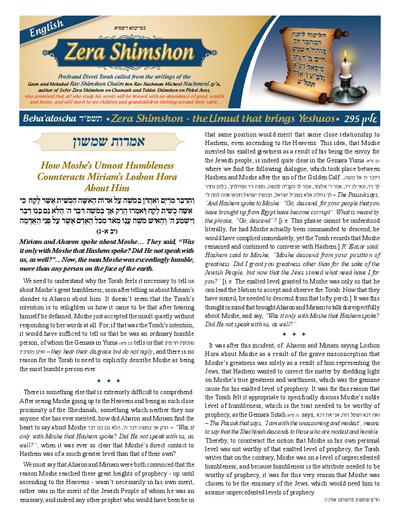
Miriam and Aharon spoke about Moshe... They said, “Was it only with Moshe that Hashem spoke? Did He not speak with us, as well?”... Now, the man Moshe was exceedingly humble, more than any person on the face of the earth.

We need to understand why the Torah feels it necessary to tell us about Moshe’s great humbleness, soon after telling us about Miriam’s slander to Aharon about him. It doesn’t seem that the Torah’s intention is to enlighten us how it came to be that after hearing himself be defamed, Moshe just accepted the insult quietly without responding to her words at all. For, if that was the Torah’s intention, it would have sufficed to tell us that he was an ordinary humble person, of whom the Gemara in Yuma (כג ע"א) tells us that שומעין חרפתן ואינן משיבין – they hear their disgrace but do not reply, and there is no reason for the Torah to need to explicitly describe Moshe as being the most humble person ever.

There is something else that is extremely difficult to comprehend. After seeing Moshe going up to the Heavens and being in such close proximity of the Shechinah, something which neither they nor anyone else has ever merited, how did Aharon and Miriam find the heart to say about Moshe הרק אך במשה דבר ה', הלא גם בנו דבר – “Was it only with Moshe that Hashem spoke? Did He not speak with us, as well?”, when it was ever so clear that Moshe’s direct contact to Hashem was of a much greater level than that of their own?

We must say that Aharon and Miriam were both convinced that the reason Moshe reached these great heights of prophecy - up until ascending to the Heavens - wasn’t necessarily in his own merit, rather was in the merit of the Jewish People of whom he was an emissary, and indeed any other prophet who would have been be in that same position would merit that same close relationship to Hashem, even ascending to the Heavens. This idea, that Moshe merited his exalted greatness as a result of his being the envoy for the Jewish people, is indeed quite clear in the Gemara Yuma (כג ע"א) where we find the following dialogue, which took place between Hashem and Moshe after the sin of the Golden Calf.

וידבר ה' אל משה, לך רד. מאי לך רד, אמר ר' אלעזר, אמר לו הקב"ה למשה, משה רד מגדולתך, כלום נתתי לך גדולה אלא בשביל ישראל, ועכשיו ישראל חטאו אתה למה לי – The Passuk says, ‘And Hashem spoke to Moshe: “Go, descend, for your people that you have brought up from Egypt have become corrupt”. What is meant by the phrase, “Go, descend”? [i.e. This phrase cannot be understood literally, for had Moshe actually been commanded to descend, he would have complied immediately, yet the Torah records that Moshe remained and continued to converse with Hashem.] R’ Elazar said; Hashem said to Moshe, “Moshe descend from your position of greatness. Did I grant you greatness other than for the sake of the Jewish People, but now that the Jews sinned what need have I for you?” [i.e. The exalted level granted to Moshe was only so that he can lead the Nation to accept and observe the Torah. Now that they have sinned, he needed to descend from that lofty perch.] It was this thought in mind that brought Aharon and Miriam to talk disrespectfully about Moshe, and say, “Was it only with Moshe that Hashem spoke? Did He not speak with us, as well?”

It was after this incident, of Aharon and Miriam saying Loshon Hora about Moshe as a result of the grave misconception that Moshe’s greatness was solely as a result of him representing the Jews, that Hashem wanted to correct the matter by shedding light on Moshe’s true greatness and worthiness, which was the genuine cause for his exalted level of prophecy. It was for this reason that the Torah felt it appropriate to specifically discuss Moshe’s noble level of humbleness, which is the trait needed to be worthy of prophecy, as the Gemara Sotah (ה ע"א) says, ואת דכא ושפל רוח, אני את דכא – The Passuk that says, ‘I am with the unassuming and modest’, means to say that the Shechinah descends to those who are modest and humble.

Thereby, to counteract the notion that Moshe in his own personal level was not worthy of that exalted level of prophecy, the Torah writes that on the contrary, Moshe was on a level of unprecedented humbleness, and because humbleness is the attribute needed to be worthy of prophecy, it was for this very reason that Moshe was chosen to be the emissary of the Jews, which would need him to assume unprecedented levels of prophecy.

(זרע שמשון פרשתנו אות ו)

PDF Preview