A Whole Nation
BET Journal | May 23, 2025
Print This Article
View Original PDF

A Whole Nation

BET Journal | June 27, 2025

Last week, we quoted the powerful Sfas Emes regarding becoming holy. We explained that part and parcel of the path to kedusha is to be part of Knesses Yisrael because the existence of the world depends on the existence of the Jewish people. It is actually somewhat of an irony that on the one hand, kedusha usually means separation, yet it’s conditioned on Klal Yisroel staying deeply connected.

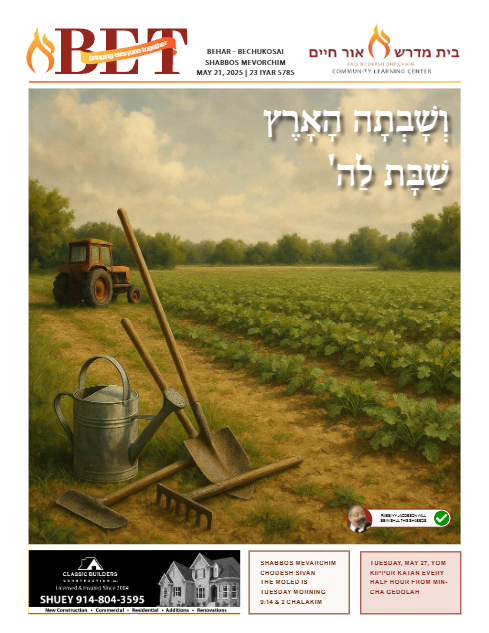
There is another aspect that emerges from this week’s parshios of Behar and Bechukosai. The beginning of Parshas Behar speaks about the mitzva of Shmitta, which, as the Ksav Sofer explains, is the ultimate test of unity and faith. Every owner who has a field that he invested time and effort in now has to make it totally ownerless and share it with everyone else. That isn’t simple; it has to come from deep emunah and love and appreciation of every Jew.

Right after the Tochecha in Parshas Bechukosai is the topic of arachin, which, simply translated, means the value of human beings.

What is the connection between the Tochecha and arachin?

The Biur Halacha writes that ideally, the Tochecha should be read loud and clear so that people will wake up and be inspired to live up to their potential.

The basic premise of arachin is what the word literally means, value, and the more we realize how much value we have, the more we will expect from ourselves.

Many times, a person gets stuck in life because they think they can’t do something. This is especially true today with the world of therapy and trauma. We mustn’t pretend that traumas and pain don’t exist, but we should also know that that doesn’t mean that we have to limit ourselves. Judaism teaches that pain and challenges are not fences that block us but, rather, paths of opportunities that we can forge through. How many times is it that people who went through the worst experiences, like rehab and therapy, are the only ones who can really help others who are struggling?

I was recently in Israel, and when I entered a cab to go to a sixth-grade reunion, I was dumbfounded. The driver didn’t look very religious or educated, but once he started talking, he could have passed for one of the most prominent Israeli Kabbalists and inspiring speakers. One of the profound statements he made was that he lives with Hashem (and he wasn’t just saying this; you could feel it and see it) because he knows without any doubt that he is a chelek Eloka mima’al, meaning that he knows he is a spark of divinity, that a part of Hashem is in him, and that makes him a super human being.

Many times, we might find ourselves like trees in the winter, challenged by the cold and snowy conditions. If we stop and remind ourselves of our inherent potential, we will be surprised at how much we can shine with success.

RABBI DANIEL COREN

SEMICHAS CHAVER SHIUR in R’ Coren’s office every Wednesday at 9:00 PM
Last week, we quoted the powerful Sfas Emes regarding becoming holy. We explained that part and parcel of the path to kedusha is to be part of Knesses Yisrael because the existence of the world depends on the existence of the Jewish people. It is actually somewhat of an irony that on the one hand, kedusha usually means separation, yet it’s conditioned on Klal Yisroel staying deeply connected.

There is another aspect that emerges from this week’s parshios of Behar and Bechukosai. The beginning of Parshas Behar speaks about the mitzva of Shmitta, which, as the Ksav Sofer explains, is the ultimate test of unity and faith. Every owner who has a field that he invested time and effort in now has to make it totally ownerless and share it with everyone else. That isn’t simple; it has to come from deep emunah and love and appreciation of every Jew.

Right after the Tochecha in Parshas Bechukosai is the topic of arachin, which, simply translated, means the value of human beings.

What is the connection between the Tochecha and arachin?

The Biur Halacha writes that ideally, the Tochecha should be read loud and clear so that people will wake up and be inspired to live up to their potential.

The basic premise of arachin is what the word literally means, value, and the more we realize how much value we have, the more we will expect from ourselves.

Many times, a person gets stuck in life because they think they can’t do something. This is especially true today with the world of therapy and trauma. We mustn’t pretend that traumas and pain don’t exist, but we should also know that that doesn’t mean that we have to limit ourselves. Judaism teaches that pain and challenges are not fences that block us but, rather, paths of opportunities that we can forge through. How many times is it that people who went through the worst experiences, like rehab and therapy, are the only ones who can really help others who are struggling?

I was recently in Israel, and when I entered a cab to go to a sixth-grade reunion, I was dumbfounded. The driver didn’t look very religious or educated, but once he started talking, he could have passed for one of the most prominent Israeli Kabbalists and inspiring speakers. One of the profound statements he made was that he lives with Hashem (and he wasn’t just saying this; you could feel it and see it) because he knows without any doubt that he is a chelek Eloka mima’al, meaning that he knows he is a spark of divinity, that a part of Hashem is in him, and that makes him a super human being.

Many times, we might find ourselves like trees in the winter, challenged by the cold and snowy conditions. If we stop and remind ourselves of our inherent potential, we will be surprised at how much we can shine with success.

RABBI DANIEL COREN

SEMICHAS CHAVER SHIUR in R’ Coren’s office every Wednesday at 9:00 PM

PDF Preview