Addendum Jewish Unity
ADDENDUM
Below is a letter sent by the Rebbe to Jews worldwide, dated Rosh Chodesh Sivan 5747.
Hisvaaduyos, pp. 156–157
To the sons and daughters of Israel everywhere, may Hashem bless them, Shalom u’vrachah!
The Torah relates that “in the third month after the Children of Israel left Egypt, on this day”—the day of Rosh Chodesh Sivan—“they came to the Sinai Desert, and Israel camped there.” The word “camped” is written in the singular (lit. “he camped”), which, as our Sages explain, indicates that the Jewish people were “like one man with one heart.” They camped “facing the mountain,” in order to receive the Torah.
On the second day of Sivan, the Jews were told, “And you shall be unto Me”—which includes both a command and a promise—“a kingdom of priests and a holy nation.”
On the third day, they were given the command to confine their movements—“guard yourselves lest you ascend the mountain.”
On the fourth day, they were given the command of abstinence from materiality and physicality—“today and tomorrow [the fifth of Sivan as well],” and were commanded “to prepare yourselves” during these [two] days for the actual day when they would receive the Torah.
On the sixth of Sivan, the Torah was actually given. These days are “recalled [appropriately] and [thereby re-] accomplished” each year like new—and new in actual fact—[culminating in the] “receiving the Torah with joy and with inwardness.”
Gather Jews and Rejoice
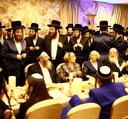
It has been our Yom Tov custom of many years to visit other Jews in the synagogues and study-halls of different communities in order to augment the joy of the festival by uniting many Jews of varying communities.
Disseminate Torah
This is especially so by saying and distributing words of Torah, from both the “revealed” and inner teachings—since “the statutes of G-d are upright; they gladden the heart.”
Family, Guests, and Tahaluchah
Although we are expected to rejoice with our families on Yom Tov, as well as with our guests—whom we cannot simply leave while we go elsewhere—nevertheless, we can undoubtedly arrange to participate in the Tahaluchah in such a manner that will not detract from our families’ and guests’ Yom Tov joy.
Do your footwork! The divine service that applies to one’s feet is relevant on Shavuos as well. For example, dancing with one’s feet to rejoice in the festival, or walking to other synagogues to bring joy to other Jews—which includes repeating and distributing Torah ideas regarding Shavuos, arousing people to study Torah, give their children a Torah-true education and the like. Second day of Shavuos 5747, Hisvaaduyos, p. 183.
Disregarding the obligation of “physical pleasure on Yom Tov,” there were a number of people who wore out their feet in order to go and bring joy to other Jews on the last night of Pesach… They specifically went to other synagogues and study-halls, and through causing the men to rejoice in the men’s section, they also had an affect on those in the women’s section—including the children there. Moreover, they connected the rejoicing with words of Torah—either verbally or by distributing printed material—regarding which it is stated, “they gladden the heart.” (Roshai Devarim to Acharon Shel Pesach 5748, Hisvaaduyos, p. 144)
Aharon Shel Pesach, Hisvaaduyos, p. 188.
That would run contrary to the mitzvah of welcoming guests, which is “greater than greeting the Shechinah [Divine Presence].” (Second day of Shavuos 5747, Hisvaaduyos, p. 183)

Related Articles