Generosity
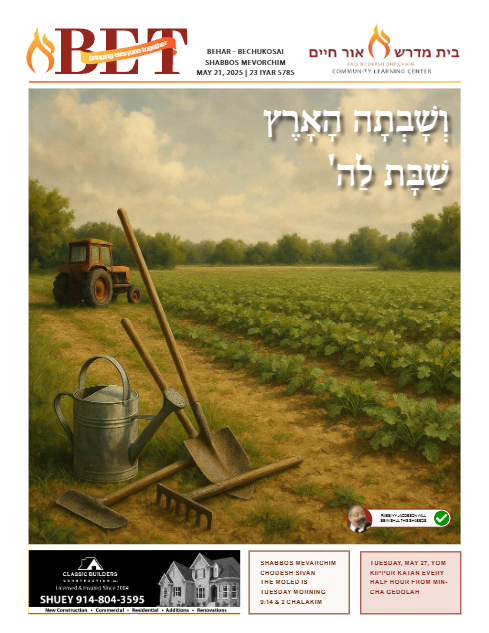
Parshat Behar begins with the laws of Shemitah, the Sabbatical year. There are many significant lessons that the Jew is to acquire from observing these laws, which include not working his land and not doing business with the produce that grows from the land in the seventh year.
The Seforno, in his comment on the verse where the Torah states, "The land shall observe a Shabbat rest for Hash- em," teaches that the purpose of this year when the farmer is not engaged in agriculture is not to travel or pursue other hobbies and interests, but "laShem," it is a year to be devot- ed to the study of His Torah. Imagine what a positive impact this can have on the life of the farmer and his family, as he now sits in the beit hamedrash for a full year and looks to serve Hashem through acts of chessed. Moreover, the Se- forno reminds us that the term "Shabbat laShem" is found in the Aseret HaDibrot (Shemot 20:10) regarding our week- ly observance of Shabbat. Likewise, the parsha's purpose is to attain a closeness to Hashem through Torah study.
The Chinuch, in his comment on Mitzva 34, presents two lessons to be derived from Shemitah. Firstly, we affirm our belief in Hashem as Creator. We work the land for six years and rest on the seventh, as we do every week, as we work six days and rest on Shabbat. This demonstrates both the belief that G-d created the world in six days and that He is always involved in the activities of man.
The second lesson to be learned is the development and enhancement of man's character and, specifically, his generosity of spirit. Our rabbis note that man comes into this world with his fists clenched, announcing his readiness and preparedness to acquire. It is the nature of man to be concerned about himself. The laws of Shemitah greatly im- pact helping the Jew to refocus and realize that what he possesses is not only for him, but "The destitute of your people shall eat." (Shemot 23:11) Taking down the "No Trespassing" sign for the seventh year helps the Shemitah observer develop from selfish to selfless.
This generosity of spirit is not only good for the rest of society, but the landowner benefits as well. It is interesting to note that in last week’s parshah, Emor, in Parshat Ha- Moadim (Chap. 23), there are many mitzvot related to the different holidays, but all are mitzvot between man and G-d, bein adam laShem. There is one exception. The closing verse of the holiday of Shavuot deals with the landown- er leaving a corner of his field for the poor, along with the gleanings of his harvest. (Vayikra 23:22) Why is this an in- tegral part of the Shavuot section, especially since this law is already taught in Parshat Kedoshim? Perhaps the Torah is hinting at the idea that your personal acquisition of Torah will be commensurate with your generosity to others. Gen- erosity of spirit is a prerequisite for Torah.
RABBI OZER ALPERT AISH.COM
RABBI BINYAMIN YUDIN