Singular and Plural
BET Journal | May 23, 2025
Print This Article
View Original PDF

Singular and Plural

BET Journal | June 27, 2025

דבר אל בני ישראל כי תבואו אל הארץ וגו' שש שנים תזרע שדך (כה', ב', ג)
Speak to Bnei Yisroel; when you come to the land, etc., six years you should sow your field (25:2, 3).

The Zera Shimshon points out that the passuk starts off in the plural tense, ”when you come to the land,” and then switches to the singular tense, ”you should sow your field for six years.” Why does the Torah do this? The wording and the tense of the pesukim should have either remained entirely in the plural tense or the singular tense, since Moshe Rabbeinu is addressing the Jewish people as a whole, and either wording could be suitable.

As well, it seems that the Torah is commanding the individual to work his field, while, in reality, there is no mitzva to work the land for the six years preceding Shmita. The only mitzva is that the land should rest in the seventh year. Why does the Torah word the commandment in a way that makes it sound as if the mitzva also includes working the land for the six years preceding Shmita?

The Zera Shimshon explains this as follows:

When Moshiach comes, the Jewish people will not have to work. Their labor will be done by itself. This is the way the world was designed before Adam HaRishon ate from the Eitz Hada’as.

As well, whenever the Jewish people do the will of Hashem, they are blessed that their land will be cultivated by others on their behalf.

However, if during this period of time there is an individual who isn’t acting as he should, he is obligated to cultivate his own land. This is because, since he isn’t righteous, he has no right to rely on the same miracle that his neighbors rely on, and he isn’t allowed to just sit back and throw his needs onto the public. He must do what it takes to take care of himself.

This is why the passuk begins in the plural, since the resting of the land is a mitzva for everyone. And if the Jewish people do what they are supposed to, the land will always be in a state of rest, since it will do its own work without having to be worked by humans.

However, the Torah switches to the singular tense when saying how one must work his field because, indeed, there may be a person who is obligated to cultivate his own field and not rely on the blessing that the nation as a whole is receiving, since he isn’t righteous. Therefore, he is obligated to and must actually work his field.

ZERA SHIMSHON

ZERA SHIMSHON SHIUR BY RABBI SIMCHA BUNIM BURGER
THURSDAY 8:15 PM - 9:15 PM (20 Upstairs)
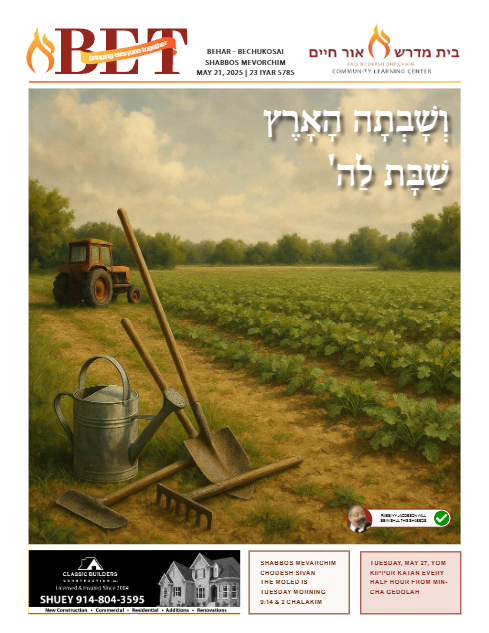
דבר אל בני ישראל כי תבואו אל הארץ וגו' שש שנים תזרע שדך (כה', ב', ג)
Speak to Bnei Yisroel; when you come to the land, etc., six years you should sow your field (25:2, 3).

The Zera Shimshon points out that the passuk starts off in the plural tense, ”when you come to the land,” and then switches to the singular tense, ”you should sow your field for six years.” Why does the Torah do this? The wording and the tense of the pesukim should have either remained entirely in the plural tense or the singular tense, since Moshe Rabbeinu is addressing the Jewish people as a whole, and either wording could be suitable.

As well, it seems that the Torah is commanding the individual to work his field, while, in reality, there is no mitzva to work the land for the six years preceding Shmita. The only mitzva is that the land should rest in the seventh year. Why does the Torah word the commandment in a way that makes it sound as if the mitzva also includes working the land for the six years preceding Shmita?

The Zera Shimshon explains this as follows:

When Moshiach comes, the Jewish people will not have to work. Their labor will be done by itself. This is the way the world was designed before Adam HaRishon ate from the Eitz Hada’as.

As well, whenever the Jewish people do the will of Hashem, they are blessed that their land will be cultivated by others on their behalf.

However, if during this period of time there is an individual who isn’t acting as he should, he is obligated to cultivate his own land. This is because, since he isn’t righteous, he has no right to rely on the same miracle that his neighbors rely on, and he isn’t allowed to just sit back and throw his needs onto the public. He must do what it takes to take care of himself.

This is why the passuk begins in the plural, since the resting of the land is a mitzva for everyone. And if the Jewish people do what they are supposed to, the land will always be in a state of rest, since it will do its own work without having to be worked by humans.

However, the Torah switches to the singular tense when saying how one must work his field because, indeed, there may be a person who is obligated to cultivate his own field and not rely on the blessing that the nation as a whole is receiving, since he isn’t righteous. Therefore, he is obligated to and must actually work his field.

ZERA SHIMSHON

ZERA SHIMSHON SHIUR BY RABBI SIMCHA BUNIM BURGER
THURSDAY 8:15 PM - 9:15 PM (20 Upstairs)

PDF Preview