The Spiritual Source of the Munn and Its Connection to Shabbos
Lessons in Likutay Torah | February 07, 2025
Print This Article
View Original PDF

The Spiritual Source of the Munn and Its Connection to Shabbos

Lessons in Likutay Torah | June 27, 2025

This is similar and comparable to what it says regarding the giving of the Torah: “Havayaָךְתאֵצְּב-You come out to us -מִש ֵּעִירthrough a hairsbreadth revelation,” through the aspect called “hairs”.

This is not the case regarding the divine energy for everything else, example: if someone frequently reflects upon the true greatness of Hashem then they will begin to have a deep feeling of love for Hashem.) We see in this case that the intellect is the “cause” of the emotions, and the specific emotion produced is the “effect” of that intellectual reflection. The same is true between every two spiritual levels that the higher level is the “cause” and the lower level is the “effect”. Similarly, in the spiritual levels of how Hashem’s Light comes down to us, every higher level is the “cause” of the level beneath it which is the “effect”.

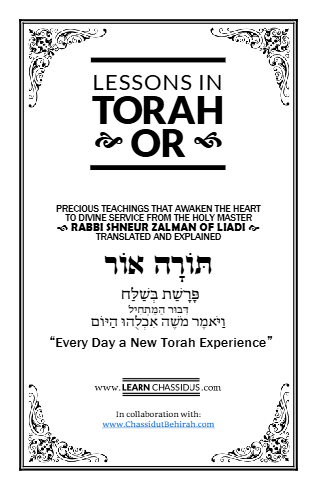
Lessons in Torah Or

that comes down through the spiritual level of the Mazalos which are part of Seder Hishtalshelus (the Orderly Progression of Spiritual Worlds) that descend by way of orderly “cause and effect”. They come from the external dimension of the worlds, and in this aspect, there is no difference between Shabbos and the weekdays, because the external dimension of the worlds has no spiritual ascent on Shabbos, since that ascent is only in the inner dimension.

Like it says: “Because this day (of Shabbos) is a day of rest for Havaya.” The idea of this “resting” (for Havaya) is from “going out in a hairsbreadth revelation”, meaning a rest from descending and becoming limited to the creation of the world and instead reverting to its source above all limitations.

Therefore, the Munn which came down from this level cannot come down on Shabbos, since in order for the Munn to come down from its spiritual source into the actual physical field, it can only happen through intense reduction processes referred to as “the raindrops of the night”, through which this lofty type of divine energy can descend below into the physical world.

Lessons in Torah Or

Whereas on Shabbos there is a “rest” and ascent from all of the above-mentioned types of reductions.

Summary

Q1 What is the reason that the Munn didn’t come down on Shabbos?
Doesn’t Hashem create everything on Shabbos just like He creates everything during the week? Why is the Munn different?

A1 The Munn came from a higher spiritual level than the rest of creation. All other creations exist only from the limited revelation of Hashem as defined by the levels of Hishtalshelus (Orderly Progression of Spiritual Levels), including the levels of the angels and Mazalos. Whereas the Munn came from Hashem’s revelation that is beyond the levels of Hishtalshelus, beyond the levels of how Hashem limits Himself to creation (Havaya). On Shabbos there is a spiritual ascent of the name Havaya, of Hashem’s essential creative power; like a person whose mind is involved in a project and when he finishes his mental energy returns to its source in the person’s essence. But that ascent is only in the inner dimension of the worlds, in the purely spiritual aspect of the worlds in terms of how they relate to Hashem as He exists beyond time and space.

Since the Munn comes from this “inner dimension” of the worlds and comes from beyond Hishtalshelus, it therefore cannot descend on Shabbos. This is because its spiritual life-force that creates it is going back up to its source and is “resting” from coming down through so many levels of limitations needed to produce physical Munn from an infinitely lofty source. However, the other creations that originally derive their life-force from the levels of Hishtalshelus do not require such a process of limiting and condensing of their Light from Hashem to produce their physical existence, and therefore their life-force can come down even on Shabbos and create them.

(We see an example in our conduct on Shabbos: we only need to rest from creative activities that require us to invest our mind into producing something, but we don’t need to “rest” from eating and walking and saying hello to our friends, since these do not require investing mental creative energy to do these actions.)

Q2 Why does the verse specify “eat the Munn today on Shabbos”,? If they ate the Munn every day then why does it imply that eating the Munn is specifically connected to Shabbos?

A2 Shabbos is a day of “rest” for “Havaya”, for Hashem’s essential creative power, that returns to its source in Hashem as He is beyond Hishtalshelus and beyond being a source for creation. When Havaya returns to its source, we are able to receive a revelation of that source in our own souls. In our own soul we are able to experience a taste of the essential pleasure that Hashem has in us and our service, which is the ultimate reason behind creation but is not directly revealed in creation. When we eat the Shabbos meals, we are able to tap into that essential pleasure of Hashem in the physical pleasure of the Shabbos meal (when eaten for that purpose). This is similar to the Munn that was a physical food that expressed a deep pleasure of Hashem in us, a pleasure which is totally beyond the creation of the worlds (the Munn was miraculous food that only existed to show how much Hashem loves us). Because both the Munn and the Shabbos meals come from the same source in Hashem’s essential pleasure in us that is beyond creation, that is why the verse shows that eating the Munn is connected to eating on Shabbos.

Q3 Why does the verse say that Hashem gave us the Munn before we received the Torah because he wanted “to test the Jewish People to see if they will go in the ways of My Torah or not”? The test of the Munn was to see if we will be satisfied with only receiving enough for that day and not to worry about the next day by storing any of the Munn. What connection does that test have to the receiving of the Torah?

A3 Both the Munn and the Torah are expression of Hashem the way He is beyond the source of creation. Only things that exist in time can become old, however something that is beyond time cannot become old. The reason that Munn had to come down from new every day is because it is expressing a level of Hashem that is beyond time, and therefore is never old, but is always new. So too, the Torah is an expression of the essential will and wisdom of Hashem the way He is totally beyond time. So even though the Torah discusses physical things that exist within time, the Torah itself is totally beyond time (and space). Since the Torah is beyond time is cannot ever be old, rather it must be experienced as something new every day, since it is expressing Hashem who is never old and always new. Because the Munn taught us how something can be literally new every day because it’s expressing something timeless and therefore always new, that is why we needed to have that before we received the Torah, so that we will be able to see that Torah as something new every day due to its timeless nature.

Q4 What is the meaning of the verse saying that He is testing them with the Munn “to see if they will go in the ways of My Torah”? It should have said that the test is “to see if they will fulfill the instructions of My Torah”. What is implied by use of the term “going”?

A4 The idea of “going” in the ways of the Torah implies that there is a journey that needs to happen for someone to experience the Torah. What journey is this? It is the journey of prayer, where a person is able to “go out” of his spiritual limitations by teaching his animal soul to love Hashem. This is accomplished by the order of the prayers, where he thinks about the Unity of Hashem and how He is the True Existence until his animal soul will also come to a deep love for Hashem. This is also called the daily “Exodus from Egypt”: Just like the Jewish People overcame their challenges and had belief in Hashem even in Egypt, and that is why they deserved to receive the Torah, so too every day that we overcome the materialistic tendencies of the animal soul by bringing it to love Hashem during the prayers, it is because of this that we are able to really experience the Torah after the prayers. Why is it so that we need to have this journey in order to experience the Torah? One of the explanations is that since the Torah is so lofty, its from Hashem the way He is beyond time and space and Hishtalshelus etc., for it to come down to us requires that the Torah go on a difficult “journey” through intense limitations and condensations in order to reach us. That’s why the letters of the Torah are compared to horses that bring a person to a distant place, so too the letters of the Torah bring Hashem’s Infinite Light all the way down to us. In order for Hashem’s Infinite Light to make its journey, we need to have our journey from below to Above through the letters of the prayers, which have the power to lift us up out of our spiritual limitations and come to connect to Hashem Himself. This is why it says “go in the ways of My Torah”, since to experience the Torah “going down” to us requires us “going up” to Hashem during prayer.

Lessons in the Service of Hashem

  1. On Shabbos we are able to experience a pleasure in connecting to Hashem. Hashem’s main pleasure is in us and our service of Him, and on Shabbos we can come to recognize how much Hashem really cherishes us, and how much we should cherish every opportunity to connect to Hashem through the Torah and Mitzvos. In addition, we can cherish the very fact that we are Jewish, and just like Hashem cherishes and has pleasure in every Jew, we can strive to look at every Jew that way, as a precious treasure of Hashem.
  2. Every day when we learn Torah, we need to look at it something totally new. This comes from looking at the Torah not as mere knowledge and facts, but as the essential expression of Hashem who is totally beyond time and space. Just like Hashem is eternal and unchanging, never old, so too when we learn Torah knowing that it is connecting us to Hashem, it becomes a totally new experience every day. When we look at the Torah for what it really is, something Divine and totally beyond the limitations of this world, then we can really see how every day it is a new Divine experience.
  3. Experiencing the Torah is a journey that depends on us. For us to appreciate the Divine nature of the Torah requires us to first tap into the Divine nature of our own Divine soul. This happens during prayer, when we take the words seriously and reflect on the truth of Hashem’s Unity, we are able to tap into our Divine soul. Through this we will then be able to tap into the Divine nature of the Torah that we study after prayer and experience how every day it is truly something new.

This is similar and comparable to what it says regarding the giving of the Torah: “Havayaָךְתאֵצְּב-You come out to us -מִש ֵּעִירthrough a hairsbreadth revelation,” through the aspect called “hairs”.

This is not the case regarding the divine energy for everything else, example: if someone frequently reflects upon the true greatness of Hashem then they will begin to have a deep feeling of love for Hashem.) We see in this case that the intellect is the “cause” of the emotions, and the specific emotion produced is the “effect” of that intellectual reflection. The same is true between every two spiritual levels that the higher level is the “cause” and the lower level is the “effect”. Similarly, in the spiritual levels of how Hashem’s Light comes down to us, every higher level is the “cause” of the level beneath it which is the “effect”.

Lessons in Torah Or

that comes down through the spiritual level of the Mazalos which are part of Seder Hishtalshelus (the Orderly Progression of Spiritual Worlds) that descend by way of orderly “cause and effect”. They come from the external dimension of the worlds, and in this aspect, there is no difference between Shabbos and the weekdays, because the external dimension of the worlds has no spiritual ascent on Shabbos, since that ascent is only in the inner dimension.

Like it says: “Because this day (of Shabbos) is a day of rest for Havaya.” The idea of this “resting” (for Havaya) is from “going out in a hairsbreadth revelation”, meaning a rest from descending and becoming limited to the creation of the world and instead reverting to its source above all limitations.

Therefore, the Munn which came down from this level cannot come down on Shabbos, since in order for the Munn to come down from its spiritual source into the actual physical field, it can only happen through intense reduction processes referred to as “the raindrops of the night”, through which this lofty type of divine energy can descend below into the physical world.

Lessons in Torah Or

Whereas on Shabbos there is a “rest” and ascent from all of the above-mentioned types of reductions.

Summary

Q1 What is the reason that the Munn didn’t come down on Shabbos?
Doesn’t Hashem create everything on Shabbos just like He creates everything during the week? Why is the Munn different?

A1 The Munn came from a higher spiritual level than the rest of creation. All other creations exist only from the limited revelation of Hashem as defined by the levels of Hishtalshelus (Orderly Progression of Spiritual Levels), including the levels of the angels and Mazalos. Whereas the Munn came from Hashem’s revelation that is beyond the levels of Hishtalshelus, beyond the levels of how Hashem limits Himself to creation (Havaya). On Shabbos there is a spiritual ascent of the name Havaya, of Hashem’s essential creative power; like a person whose mind is involved in a project and when he finishes his mental energy returns to its source in the person’s essence. But that ascent is only in the inner dimension of the worlds, in the purely spiritual aspect of the worlds in terms of how they relate to Hashem as He exists beyond time and space.

Since the Munn comes from this “inner dimension” of the worlds and comes from beyond Hishtalshelus, it therefore cannot descend on Shabbos. This is because its spiritual life-force that creates it is going back up to its source and is “resting” from coming down through so many levels of limitations needed to produce physical Munn from an infinitely lofty source. However, the other creations that originally derive their life-force from the levels of Hishtalshelus do not require such a process of limiting and condensing of their Light from Hashem to produce their physical existence, and therefore their life-force can come down even on Shabbos and create them.

(We see an example in our conduct on Shabbos: we only need to rest from creative activities that require us to invest our mind into producing something, but we don’t need to “rest” from eating and walking and saying hello to our friends, since these do not require investing mental creative energy to do these actions.)

Q2 Why does the verse specify “eat the Munn today on Shabbos”,? If they ate the Munn every day then why does it imply that eating the Munn is specifically connected to Shabbos?

A2 Shabbos is a day of “rest” for “Havaya”, for Hashem’s essential creative power, that returns to its source in Hashem as He is beyond Hishtalshelus and beyond being a source for creation. When Havaya returns to its source, we are able to receive a revelation of that source in our own souls. In our own soul we are able to experience a taste of the essential pleasure that Hashem has in us and our service, which is the ultimate reason behind creation but is not directly revealed in creation. When we eat the Shabbos meals, we are able to tap into that essential pleasure of Hashem in the physical pleasure of the Shabbos meal (when eaten for that purpose). This is similar to the Munn that was a physical food that expressed a deep pleasure of Hashem in us, a pleasure which is totally beyond the creation of the worlds (the Munn was miraculous food that only existed to show how much Hashem loves us). Because both the Munn and the Shabbos meals come from the same source in Hashem’s essential pleasure in us that is beyond creation, that is why the verse shows that eating the Munn is connected to eating on Shabbos.

Q3 Why does the verse say that Hashem gave us the Munn before we received the Torah because he wanted “to test the Jewish People to see if they will go in the ways of My Torah or not”? The test of the Munn was to see if we will be satisfied with only receiving enough for that day and not to worry about the next day by storing any of the Munn. What connection does that test have to the receiving of the Torah?

A3 Both the Munn and the Torah are expression of Hashem the way He is beyond the source of creation. Only things that exist in time can become old, however something that is beyond time cannot become old. The reason that Munn had to come down from new every day is because it is expressing a level of Hashem that is beyond time, and therefore is never old, but is always new. So too, the Torah is an expression of the essential will and wisdom of Hashem the way He is totally beyond time. So even though the Torah discusses physical things that exist within time, the Torah itself is totally beyond time (and space). Since the Torah is beyond time is cannot ever be old, rather it must be experienced as something new every day, since it is expressing Hashem who is never old and always new. Because the Munn taught us how something can be literally new every day because it’s expressing something timeless and therefore always new, that is why we needed to have that before we received the Torah, so that we will be able to see that Torah as something new every day due to its timeless nature.

Q4 What is the meaning of the verse saying that He is testing them with the Munn “to see if they will go in the ways of My Torah”? It should have said that the test is “to see if they will fulfill the instructions of My Torah”. What is implied by use of the term “going”?

A4 The idea of “going” in the ways of the Torah implies that there is a journey that needs to happen for someone to experience the Torah. What journey is this? It is the journey of prayer, where a person is able to “go out” of his spiritual limitations by teaching his animal soul to love Hashem. This is accomplished by the order of the prayers, where he thinks about the Unity of Hashem and how He is the True Existence until his animal soul will also come to a deep love for Hashem. This is also called the daily “Exodus from Egypt”: Just like the Jewish People overcame their challenges and had belief in Hashem even in Egypt, and that is why they deserved to receive the Torah, so too every day that we overcome the materialistic tendencies of the animal soul by bringing it to love Hashem during the prayers, it is because of this that we are able to really experience the Torah after the prayers. Why is it so that we need to have this journey in order to experience the Torah? One of the explanations is that since the Torah is so lofty, its from Hashem the way He is beyond time and space and Hishtalshelus etc., for it to come down to us requires that the Torah go on a difficult “journey” through intense limitations and condensations in order to reach us. That’s why the letters of the Torah are compared to horses that bring a person to a distant place, so too the letters of the Torah bring Hashem’s Infinite Light all the way down to us. In order for Hashem’s Infinite Light to make its journey, we need to have our journey from below to Above through the letters of the prayers, which have the power to lift us up out of our spiritual limitations and come to connect to Hashem Himself. This is why it says “go in the ways of My Torah”, since to experience the Torah “going down” to us requires us “going up” to Hashem during prayer.

Lessons in the Service of Hashem

  1. On Shabbos we are able to experience a pleasure in connecting to Hashem. Hashem’s main pleasure is in us and our service of Him, and on Shabbos we can come to recognize how much Hashem really cherishes us, and how much we should cherish every opportunity to connect to Hashem through the Torah and Mitzvos. In addition, we can cherish the very fact that we are Jewish, and just like Hashem cherishes and has pleasure in every Jew, we can strive to look at every Jew that way, as a precious treasure of Hashem.
  2. Every day when we learn Torah, we need to look at it something totally new. This comes from looking at the Torah not as mere knowledge and facts, but as the essential expression of Hashem who is totally beyond time and space. Just like Hashem is eternal and unchanging, never old, so too when we learn Torah knowing that it is connecting us to Hashem, it becomes a totally new experience every day. When we look at the Torah for what it really is, something Divine and totally beyond the limitations of this world, then we can really see how every day it is a new Divine experience.
  3. Experiencing the Torah is a journey that depends on us. For us to appreciate the Divine nature of the Torah requires us to first tap into the Divine nature of our own Divine soul. This happens during prayer, when we take the words seriously and reflect on the truth of Hashem’s Unity, we are able to tap into our Divine soul. Through this we will then be able to tap into the Divine nature of the Torah that we study after prayer and experience how every day it is truly something new.

PDF Preview