When Was the Mitzvah of Shabbos Given
Parsha Pages | January 22, 2024
Print This Article
View Original PDF

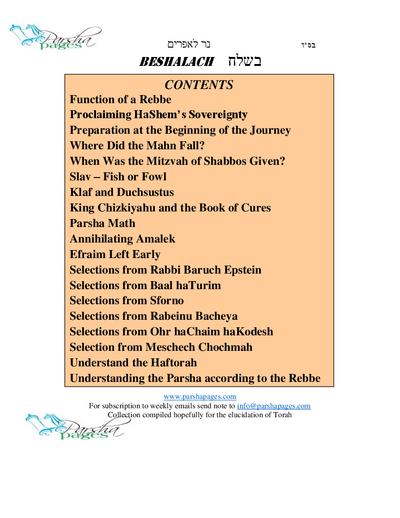
When Was the Mitzvah of Shabbos Given

Parsha Pages | December 10, 2025

Adapted from R. Elchanan Adler's Mitzvas HaShabbos and shiurim he has given on the topic; Compiled by Rabbi Joshua Flug

I. Introduction

This shiur outline is based on R. Elchanan Adler's sefer Mitzvos HaShabbos (available for download here), which discusses when Shabbos was first given. A source packet from a shiur he gave on the topic is available here. There are a number of angles one can take in presenting this shiur:

  • What is the relationship between Matan Torah and our observance of mitzvos?
  • Does Shabbos have a unique status in observance of mitzvos?
  • From a parshanut perspective, how does one understand the various references in the Torah to the observance of Shabbos?
  • What is the relationship between Shabbos and Kedushas Yisrael?
  • How do we understand Shabbos as a מתנה or נחלה?

II. The Basic Issue

  • The Torah states at Har Sinai that we should observe Shabbos כאשר צוך ה' אלקיך. (Devarim 5,12) This implies that Shabbos was already given before Matan Torah.
  • The Gemara comments on this verse that Shabbos was given at Marah. (Shabbos 87a-b)
    • There is a machlokes in the Gemara whether this also includes techumin.
  • The Mechilta has a different source for Shabbos being given at Marah.
    • The Torah states that at Marah, they were given חוק ומשפט. (Shmos 15,22)
    • The Mechilta states that חוק refers to Shabbos. (Mechilta 15,22)
  • Tosafos ask: The implication of the Gemara, Shabbos 118b, is that the first Shabbos that they were commanded to observe was when the מן was given (at מדבר סין also known as אלוש). The מן was given after Marah. Why then, does the Gemara refer to the first Shabbos after theמן as the שבת ראשונה?
    • There is a related question asked about דיינו in the Hagadah. We state: אילו האכילנו את המן ולא נתן את השבת דיינו. Why do mention the מן first if Shabbos was given at Marah?

III. Answers to Tosafos' question

  • Tosafos HaRosh (Shabbos 188b) offers an answer to Tosafos' question. At Marah, Moshe was given the commandment of Shabbos, but he didn't pass it on to the Jewish people until they got to אלוש.
    • There is support to this idea from the Midrash that states that when the מן fell in a double portion, the נשיאים came to Moshe and told him to which he responded "הוא אשר דבר ה'," meaning that Moshe forgot to give over the commandment to collect double. (Medrash Rabbah Shmos 25,14)
    • The Midrash doesn't seem to be a makor because it really refers to the lechem mishneh
    • Ramban has a comment that may answer Tosafos' question. Rashi writes that the mitzvos were given at Marah "שיתעסקו בהם". (Shkmos 15,22)
    • Rambam deduces from this the mitzvos that were given at Marah were not applicable yet and were only given to בני ישראל for learning purposes. (Shmos 15,22)
    • According to Ramban, one can explain that until אלוש, there was no commandment to observe Shabbos, only to learn about it.
    • Netziv (in a number of places) notes that they were given the mitzvah of Shabbos at Marah, but the commandment to observe it wasn't until אלוש. When they were given the Parashas HaMan, they still believed that Shabbos wasn't obligatory until Matan Torah (and even Moshe wasn't sure) and the only reason why the מן had special restrictions for Shabbos was because it was a holy day for G-d (כי קודש היום לה'). G-d then instructed Moshe that the special restrictions for מן was because from this time and on, the Jews must keep Shabbos (ראו כי ה' נתן לכם השבת על כן הוא נתן לכם וגו'). (Beshalach Parsha 6)
  • He adds that there was a misunderstanding when Moshe told them about the מן. They thought that the double portion was referring to the preparation of the מן to eat on שבת and not the collection because they were already observing עונג שבת not מלאכות of שבת. Moshe had to explain them that he was referring to the collection of the מן. (Emek Devar)

IV. What was the nature of the obligation to observe Shabbos after Marah?

  • Tosafos question the opinion that the issur of techumin wasn't given at Marah. How does one explain the pasuk אל יצא איש ממקומו which was said when the מן was given? Tosafos suggest that אל יצא איש ממקומו wasn't said until after Matan Torah and was only written in Parashas Haman because it relates to it. (Shabbos 87b)
    • According to Tosafos, there weren't multiple stages of the giving of Shabbos prior to Matan Torah. Either everything was given at Marah, including techumin, or just melachos were given at Marah and techumin was given after Matan Torah.
    • Ramban (Shabbos 87b) and Ran write that the melachos applied at Marah, but certain aspects such as the issur of mechamer did not. This is why there is a machlokes about techumin.
  • Ramban writes that at Marah, there was only a positive commandment to rest. The לא תעשה of Shabbos was given after Matan Torah. (Hasagos to Sefer haMitzvos Shoresh 14)
  • R. Pinchas HaLevi Horowitz suggests that although Shabbos was given at Marah, the 39 melachos weren't given until Matan Torah. (Panim Yafos Parshas Yisro page 114)
    • He writes that the general rules were given at Marah but not the details
    • Ostensibly, what he means is that the definition of shevisah before Matan Torah was based on what people perceive as labor. After Matan Torah, it was defined by the מלאכת המשכן. [See his comments to Parashas Terumah.]
  • R. Refael Yom Tov Halperin (Oneg Yom Tov) suggests that at Marah, they were only commanded in zechiras Shabbos and not shemiras Shabbos. ((Hakdamah Os 22)
    • The machlokes about techumin is actually the following: the opinion that they were commanded in Shabbos means just zechiras Shabbos and the opinion that they were commanded on techumin is of the opinion that they were also obligated to keep the issur of techumin and hotza'ah.
    • The reason why אלוש is called the שבת ראשונה is that it was the first Shabbos that they had any commandment other than zechiras Shabbos (i.e. according to the opinion that there was no issur of techum, this first Shabbos, they had an issur of collecting the מן.)
  • Rabbeinu Shimshon, in his commentary on the Toras Kohanim raises a question as to whether there was a formal עונש for violating Shabbos before Matan Torah. Perhaps the punishments that we find for collecting the מן were based on lack of emunah and not chilul Shabbos. Even if there were formal punishments, collection of the מן may not constitute an actual melacha.

V. Shabbos as a Matanah (and the issur of a non-Jew to observe Shabbos)

  • Sforno writes that at אלוש Shabbos was considered a מתנה. Beforehand, at Marah, it was just a mitzvah. Now it is also an inheritance- ולא נתתו לגויי הארצות. (16,29)
  • Sfas Emes has a similar idea and explains that before אלוש, they were only able to keep the laws of Shabbos. At אלוש, they were given the ability to come closer to G-d through Shabbos. (Year 643)
    • He also explains that through the מן, the connection between erev Shabbos and Shabbos was established. Shabbos as a מתנה is not only observed on Shabbos itself but by preparing for it.
    • Sfas Emes also answers the question from Dayenu. Dayenu is giving thanks for giving Shabbos as a מתנה (נתן לנו את השבת) and as such, it wasn't until after the מן that this took place.
  • This idea is also reflected in the Midrash which derives the prohibition against a non-Jew observing Shabbos from Parashas HaMan. (Shmos Rabbah 25,15)
    • By contrast, the Gemara seems to see that the prohibition against non-Jews keeping Shabbos is based on a demand that the world stay productive (יומם ולילה לא ישבותו). (Sanhedrin 58b)
  • R. Yehuda ben Yakar writes that the basis for the prohibition for a non-Jew to observe Shabbos is based on the fact that שבת is a נחלה. This didn't take place until after Matan Torah This is why we say
Adapted from R. Elchanan Adler's Mitzvas HaShabbos and shiurim he has given on the topic; Compiled by Rabbi Joshua Flug

I. Introduction

This shiur outline is based on R. Elchanan Adler's sefer Mitzvos HaShabbos (available for download here), which discusses when Shabbos was first given. A source packet from a shiur he gave on the topic is available here. There are a number of angles one can take in presenting this shiur:

  • What is the relationship between Matan Torah and our observance of mitzvos?
  • Does Shabbos have a unique status in observance of mitzvos?
  • From a parshanut perspective, how does one understand the various references in the Torah to the observance of Shabbos?
  • What is the relationship between Shabbos and Kedushas Yisrael?
  • How do we understand Shabbos as a מתנה or נחלה?

II. The Basic Issue

  • The Torah states at Har Sinai that we should observe Shabbos כאשר צוך ה' אלקיך. (Devarim 5,12) This implies that Shabbos was already given before Matan Torah.
  • The Gemara comments on this verse that Shabbos was given at Marah. (Shabbos 87a-b)
    • There is a machlokes in the Gemara whether this also includes techumin.
  • The Mechilta has a different source for Shabbos being given at Marah.
    • The Torah states that at Marah, they were given חוק ומשפט. (Shmos 15,22)
    • The Mechilta states that חוק refers to Shabbos. (Mechilta 15,22)
  • Tosafos ask: The implication of the Gemara, Shabbos 118b, is that the first Shabbos that they were commanded to observe was when the מן was given (at מדבר סין also known as אלוש). The מן was given after Marah. Why then, does the Gemara refer to the first Shabbos after theמן as the שבת ראשונה?
    • There is a related question asked about דיינו in the Hagadah. We state: אילו האכילנו את המן ולא נתן את השבת דיינו. Why do mention the מן first if Shabbos was given at Marah?

III. Answers to Tosafos' question

  • Tosafos HaRosh (Shabbos 188b) offers an answer to Tosafos' question. At Marah, Moshe was given the commandment of Shabbos, but he didn't pass it on to the Jewish people until they got to אלוש.
    • There is support to this idea from the Midrash that states that when the מן fell in a double portion, the נשיאים came to Moshe and told him to which he responded "הוא אשר דבר ה'," meaning that Moshe forgot to give over the commandment to collect double. (Medrash Rabbah Shmos 25,14)
    • The Midrash doesn't seem to be a makor because it really refers to the lechem mishneh
    • Ramban has a comment that may answer Tosafos' question. Rashi writes that the mitzvos were given at Marah "שיתעסקו בהם". (Shkmos 15,22)
    • Rambam deduces from this the mitzvos that were given at Marah were not applicable yet and were only given to בני ישראל for learning purposes. (Shmos 15,22)
    • According to Ramban, one can explain that until אלוש, there was no commandment to observe Shabbos, only to learn about it.
    • Netziv (in a number of places) notes that they were given the mitzvah of Shabbos at Marah, but the commandment to observe it wasn't until אלוש. When they were given the Parashas HaMan, they still believed that Shabbos wasn't obligatory until Matan Torah (and even Moshe wasn't sure) and the only reason why the מן had special restrictions for Shabbos was because it was a holy day for G-d (כי קודש היום לה'). G-d then instructed Moshe that the special restrictions for מן was because from this time and on, the Jews must keep Shabbos (ראו כי ה' נתן לכם השבת על כן הוא נתן לכם וגו'). (Beshalach Parsha 6)
  • He adds that there was a misunderstanding when Moshe told them about the מן. They thought that the double portion was referring to the preparation of the מן to eat on שבת and not the collection because they were already observing עונג שבת not מלאכות of שבת. Moshe had to explain them that he was referring to the collection of the מן. (Emek Devar)

IV. What was the nature of the obligation to observe Shabbos after Marah?

  • Tosafos question the opinion that the issur of techumin wasn't given at Marah. How does one explain the pasuk אל יצא איש ממקומו which was said when the מן was given? Tosafos suggest that אל יצא איש ממקומו wasn't said until after Matan Torah and was only written in Parashas Haman because it relates to it. (Shabbos 87b)
    • According to Tosafos, there weren't multiple stages of the giving of Shabbos prior to Matan Torah. Either everything was given at Marah, including techumin, or just melachos were given at Marah and techumin was given after Matan Torah.
    • Ramban (Shabbos 87b) and Ran write that the melachos applied at Marah, but certain aspects such as the issur of mechamer did not. This is why there is a machlokes about techumin.
  • Ramban writes that at Marah, there was only a positive commandment to rest. The לא תעשה of Shabbos was given after Matan Torah. (Hasagos to Sefer haMitzvos Shoresh 14)
  • R. Pinchas HaLevi Horowitz suggests that although Shabbos was given at Marah, the 39 melachos weren't given until Matan Torah. (Panim Yafos Parshas Yisro page 114)
    • He writes that the general rules were given at Marah but not the details
    • Ostensibly, what he means is that the definition of shevisah before Matan Torah was based on what people perceive as labor. After Matan Torah, it was defined by the מלאכת המשכן. [See his comments to Parashas Terumah.]
  • R. Refael Yom Tov Halperin (Oneg Yom Tov) suggests that at Marah, they were only commanded in zechiras Shabbos and not shemiras Shabbos. ((Hakdamah Os 22)
    • The machlokes about techumin is actually the following: the opinion that they were commanded in Shabbos means just zechiras Shabbos and the opinion that they were commanded on techumin is of the opinion that they were also obligated to keep the issur of techumin and hotza'ah.
    • The reason why אלוש is called the שבת ראשונה is that it was the first Shabbos that they had any commandment other than zechiras Shabbos (i.e. according to the opinion that there was no issur of techum, this first Shabbos, they had an issur of collecting the מן.)
  • Rabbeinu Shimshon, in his commentary on the Toras Kohanim raises a question as to whether there was a formal עונש for violating Shabbos before Matan Torah. Perhaps the punishments that we find for collecting the מן were based on lack of emunah and not chilul Shabbos. Even if there were formal punishments, collection of the מן may not constitute an actual melacha.

V. Shabbos as a Matanah (and the issur of a non-Jew to observe Shabbos)

  • Sforno writes that at אלוש Shabbos was considered a מתנה. Beforehand, at Marah, it was just a mitzvah. Now it is also an inheritance- ולא נתתו לגויי הארצות. (16,29)
  • Sfas Emes has a similar idea and explains that before אלוש, they were only able to keep the laws of Shabbos. At אלוש, they were given the ability to come closer to G-d through Shabbos. (Year 643)
    • He also explains that through the מן, the connection between erev Shabbos and Shabbos was established. Shabbos as a מתנה is not only observed on Shabbos itself but by preparing for it.
    • Sfas Emes also answers the question from Dayenu. Dayenu is giving thanks for giving Shabbos as a מתנה (נתן לנו את השבת) and as such, it wasn't until after the מן that this took place.
  • This idea is also reflected in the Midrash which derives the prohibition against a non-Jew observing Shabbos from Parashas HaMan. (Shmos Rabbah 25,15)
    • By contrast, the Gemara seems to see that the prohibition against non-Jews keeping Shabbos is based on a demand that the world stay productive (יומם ולילה לא ישבותו). (Sanhedrin 58b)
  • R. Yehuda ben Yakar writes that the basis for the prohibition for a non-Jew to observe Shabbos is based on the fact that שבת is a נחלה. This didn't take place until after Matan Torah This is why we say
PDF Preview