All Sevenths Are Beloved—The Role of our Generation
Living Jewish | January 24, 2026
Print This Article
View Original PDF

All Sevenths Are Beloved—The Role of our Generation

Living Jewish | January 30, 2026

In the first Chassidic discourse delivered by the Rebbe on the 10th of Shevat, 5711 (1951), when the Rebbe accepted the mantle of leadership, he drew a parallel between the seven generations—from Avraham to Moshe, that brought the Divine Presence (Shechina) down, and the seven generations of Chabad Chassidus, whose purpose is to prepare the world for the coming of Moshiach.

The number seven is highly significant. It represents the complete cycle of creation—the seventh completes the six that preceded it. We can see this in the process of creation: the world was created in six days, and the seventh day, Shabbat, which is holy to Hashem, completes the cycle.

We can also observe this in the structure of matter: matter itself has six sides—east, west, north, south, up and down—just as the weekdays are six. The seventh represents the Divine force that dwells within the six sides of matter, just as Shabbat represents the holiness of the weekdays.

The Midrash (Vayikra Rabbah 29:11) establishes a principle: “All sevenths are beloved,” and goes on to enumerate a long line of items in which the seventh is especially beloved: Shabbat, the Sabbatical year (Shemitah), the Jubilee year (Yovel, which completes seven Shemitot), the seventh heaven, Chanoch (the seventh generation from Adam), Moshe (the seventh from Avraham), and more.

This number also plays a central role in the rectification of the world after the sins that occurred at the beginning of creation. Regarding the verse (Song of Songs 5:1), “I have come to my garden, my sister, [my] bride,” the Sages say (in Midrash Rabbah) that this was said by Hashem at the time of the giving of the Torah, when the Shechina descended. The Sages clarify: “It does not say ‘to the garden’ here, but ‘to my garden,’” meaning to a place where the Shechina had been before. For the Shechina had already been in this world at the beginning of creation, but because of sin it ascended, until it returned and descended at Mount Sinai.

The Midrash details seven generations that caused the Shechina to ascend. Later, seven tzadikim, over a process lasting seven generations, caused the Shechina to descend: Avraham causes it to descend from the seventh heaven to the sixth, Yitzchak to the fifth, Yaakov to the fourth, Levi to the third, Kehath to the second, Amram to the first heaven, and Moshe brought it down to earth. At Mount Sinai it is said, “And Hashem descended upon Mount Sinai,” and the Shechina returned and descended to this world. Thus we see that the rectification of creation and the return of the Shechina downward is connected specifically to the seventh generation, which completes the work of the generations that preceded it.

This is our generation—the seventh generation—which must complete the work of the previous generations and bring about the redemption in actuality. In the Rebbe’s words:

"This is demanded of each and every one of us, the seventh generation, for all sevenths are beloved. The fact that we are in the seventh generation is not by our choice nor by our effort, and in some matters, possibly not according to our desire. Nevertheless, all sevenths are beloved, for we are in the footsteps of Moshiach, at the completion of the process, and our work is to complete the drawing down of the Shechina—not only the Shechina, but the ultimate Shechina, and specifically in the lower world."

Adapted from Rabbi Menachem Brod, Sichat HaShevuah

On the eve of Rosh Hashanah 5703 (1942), a chassid asked whether the Rebbe truly believed that Moshiach was about to come soon. The Rebbe replied: “We pray, ‘speedily cause the offspring of Your servant David to flourish...’ The order of growth is that first there is sprouting; afterwards a tender sapling begins to grow, and over time it becomes a fruit-bearing tree. The growth already exists!”
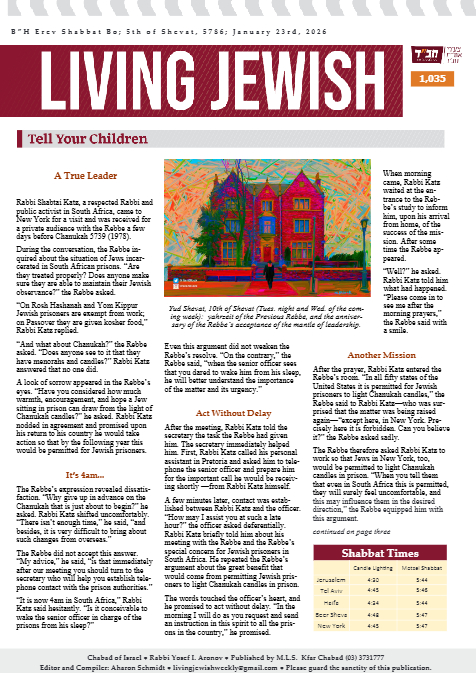
In the first Chassidic discourse delivered by the Rebbe on the 10th of Shevat, 5711 (1951), when the Rebbe accepted the mantle of leadership, he drew a parallel between the seven generations—from Avraham to Moshe, that brought the Divine Presence (Shechina) down, and the seven generations of Chabad Chassidus, whose purpose is to prepare the world for the coming of Moshiach.

The number seven is highly significant. It represents the complete cycle of creation—the seventh completes the six that preceded it. We can see this in the process of creation: the world was created in six days, and the seventh day, Shabbat, which is holy to Hashem, completes the cycle.

We can also observe this in the structure of matter: matter itself has six sides—east, west, north, south, up and down—just as the weekdays are six. The seventh represents the Divine force that dwells within the six sides of matter, just as Shabbat represents the holiness of the weekdays.

The Midrash (Vayikra Rabbah 29:11) establishes a principle: “All sevenths are beloved,” and goes on to enumerate a long line of items in which the seventh is especially beloved: Shabbat, the Sabbatical year (Shemitah), the Jubilee year (Yovel, which completes seven Shemitot), the seventh heaven, Chanoch (the seventh generation from Adam), Moshe (the seventh from Avraham), and more.

This number also plays a central role in the rectification of the world after the sins that occurred at the beginning of creation. Regarding the verse (Song of Songs 5:1), “I have come to my garden, my sister, [my] bride,” the Sages say (in Midrash Rabbah) that this was said by Hashem at the time of the giving of the Torah, when the Shechina descended. The Sages clarify: “It does not say ‘to the garden’ here, but ‘to my garden,’” meaning to a place where the Shechina had been before. For the Shechina had already been in this world at the beginning of creation, but because of sin it ascended, until it returned and descended at Mount Sinai.

The Midrash details seven generations that caused the Shechina to ascend. Later, seven tzadikim, over a process lasting seven generations, caused the Shechina to descend: Avraham causes it to descend from the seventh heaven to the sixth, Yitzchak to the fifth, Yaakov to the fourth, Levi to the third, Kehath to the second, Amram to the first heaven, and Moshe brought it down to earth. At Mount Sinai it is said, “And Hashem descended upon Mount Sinai,” and the Shechina returned and descended to this world. Thus we see that the rectification of creation and the return of the Shechina downward is connected specifically to the seventh generation, which completes the work of the generations that preceded it.

This is our generation—the seventh generation—which must complete the work of the previous generations and bring about the redemption in actuality. In the Rebbe’s words:

"This is demanded of each and every one of us, the seventh generation, for all sevenths are beloved. The fact that we are in the seventh generation is not by our choice nor by our effort, and in some matters, possibly not according to our desire. Nevertheless, all sevenths are beloved, for we are in the footsteps of Moshiach, at the completion of the process, and our work is to complete the drawing down of the Shechina—not only the Shechina, but the ultimate Shechina, and specifically in the lower world."

Adapted from Rabbi Menachem Brod, Sichat HaShevuah

On the eve of Rosh Hashanah 5703 (1942), a chassid asked whether the Rebbe truly believed that Moshiach was about to come soon. The Rebbe replied: “We pray, ‘speedily cause the offspring of Your servant David to flourish...’ The order of growth is that first there is sprouting; afterwards a tender sapling begins to grow, and over time it becomes a fruit-bearing tree. The growth already exists!”

PDF Preview