Between Not Owning and Not Finding
Meshech Chochma | January 18, 2024
Print This Article
View Original PDF

Between Not Owning and Not Finding

Meshech Chochma | December 10, 2025

For a seven-day period, leaven shall not be found in your house. (12:19)

The Meshech Chochmah opens his comment on this verse by noting that there are certain authorities who maintain that bedikas chametz (the search for chametz) before Pesach is a Torah-level requirement.

What is the source for this obligation? It is true that the Torah forbids one to own chametz during the festival, but why should that translate into an obligation to actively search for it – even if one is unaware of having any?

He answers by drawing our attention to the Gemara which, in the course of its discussion of bedikas chametz, cites the verse regarding the finding of Yosef’s cup among the brothers’ possessions:

He searched... and the cup was found in Binyamin’s sack.

This verse teaches us that part of the concept of “finding” something involves having searched for it. As such, when the Torah commands that leaven “shall not be found,” it includes the idea that even if one were to search for it he would not find it. This then necessarily requires that the person search his house, in order to ascertain that no chametz can be found even after a search, and this is the source for those who say that bedikas chametz is a Torah-level requirement.

Based on this, the Meshech Chochmah proceeds to draw our attention to a parallel verse at the end of the parsha regarding ownership of chametz on Pesach, which states:

Leaven shall not be seen [i.e. owned] by you in all your borders.

Comparing these two verses with each other, we note that:

  • Our verse uses the term “shall not be found,” while the later verse mentions it not being “seen” i.e. owned.
  • Our verse specifies “your house”, while the later verse refers to “your borders” i.e. all of your property.

The Gemara states that when it comes to one’s courtyard, there is no requirement to check for chametz; for although it is forbidden to own chametz even in one’s outdoor premises, we rely on the fact that any chametz that was left there would have been eaten by the birds.

Based on this, we can now understand the difference in phraseology between the two verses:

  • Our verse, which states that chametz “may not be found”, and which thereby includes an obligation to search for it, is stated specifically in reference to “your houses”, where such a search is necessary.
  • The later verse, which discusses the prohibition against owning chametz, with no requirement to search for it, is stated with regards to “all your borders,” which includes both indoors and outdoors.

The Meshech Chochmah concludes his comment with the words, “So it appears to me from a standpoint of pshat.” The background to these concluding words is that the Gemara (Pesachim 5b, referenced by the Meshech Chochmah in the course of his discussion), identifies a gezeirah shavah between the prohibitions of “shall not be found” and “shall not be seen,” deriving thereby various laws from one to the other. Nonetheless, the Meshech Chochmah notes that, alongside the Gemara pooling certain laws between the two prohibitions, the extent to which each one remains distinct, as indicated by its specific phraseology, can still inform us of (halachic!) differences between the two from a standpoint of pshat.
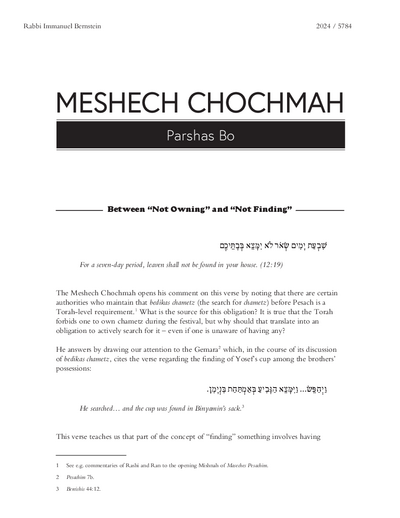
For a seven-day period, leaven shall not be found in your house. (12:19)

The Meshech Chochmah opens his comment on this verse by noting that there are certain authorities who maintain that bedikas chametz (the search for chametz) before Pesach is a Torah-level requirement.

What is the source for this obligation? It is true that the Torah forbids one to own chametz during the festival, but why should that translate into an obligation to actively search for it – even if one is unaware of having any?

He answers by drawing our attention to the Gemara which, in the course of its discussion of bedikas chametz, cites the verse regarding the finding of Yosef’s cup among the brothers’ possessions:

He searched... and the cup was found in Binyamin’s sack.

This verse teaches us that part of the concept of “finding” something involves having searched for it. As such, when the Torah commands that leaven “shall not be found,” it includes the idea that even if one were to search for it he would not find it. This then necessarily requires that the person search his house, in order to ascertain that no chametz can be found even after a search, and this is the source for those who say that bedikas chametz is a Torah-level requirement.

Based on this, the Meshech Chochmah proceeds to draw our attention to a parallel verse at the end of the parsha regarding ownership of chametz on Pesach, which states:

Leaven shall not be seen [i.e. owned] by you in all your borders.

Comparing these two verses with each other, we note that:

  • Our verse uses the term “shall not be found,” while the later verse mentions it not being “seen” i.e. owned.
  • Our verse specifies “your house”, while the later verse refers to “your borders” i.e. all of your property.

The Gemara states that when it comes to one’s courtyard, there is no requirement to check for chametz; for although it is forbidden to own chametz even in one’s outdoor premises, we rely on the fact that any chametz that was left there would have been eaten by the birds.

Based on this, we can now understand the difference in phraseology between the two verses:

  • Our verse, which states that chametz “may not be found”, and which thereby includes an obligation to search for it, is stated specifically in reference to “your houses”, where such a search is necessary.
  • The later verse, which discusses the prohibition against owning chametz, with no requirement to search for it, is stated with regards to “all your borders,” which includes both indoors and outdoors.

The Meshech Chochmah concludes his comment with the words, “So it appears to me from a standpoint of pshat.” The background to these concluding words is that the Gemara (Pesachim 5b, referenced by the Meshech Chochmah in the course of his discussion), identifies a gezeirah shavah between the prohibitions of “shall not be found” and “shall not be seen,” deriving thereby various laws from one to the other. Nonetheless, the Meshech Chochmah notes that, alongside the Gemara pooling certain laws between the two prohibitions, the extent to which each one remains distinct, as indicated by its specific phraseology, can still inform us of (halachic!) differences between the two from a standpoint of pshat.

PDF Preview