Hashem's Hardening of Paroah's Heart
Zera Shimshon | January 29, 2025
Print This Article
View Original PDF

Hashem's Hardening of Paroah's Heart

Zera Shimshon | June 27, 2025

And Hashem told Moshe; Come to Paroah because I have hardened his heart and the heart of his servants in order that I will put these signs in his midst. And in order that you will relate in the ears of your children and your children's children how I make mockery in Mitzrayim and My signs that I brought upon them and they will know that I am Hashem.

After all the makkos, except for makkas bechoros, the killing of the Egyptian first born, it is written that the reason Paroah did not send out Bnei Yisroel was because his heart was either strengthened or hardened. Regarding the first five plagues, dom- blood, tz'fardayah- frogs, keenim- lice, ah’rove- wild animals, and devver- an epedemic, it is written that Paroah hardened his own heart and regarding the next plagues it is written that Hashem hardened Paroah’s heart.

Regarding the plague of arbeh- locust, however there is an addition. Not only is it written after the plague that Hashem strengthened Paroah’s heart, but before the makka, at the time that Hashem told Moshe He was going to send the locust, it is written, "v'ani hichbadti ess leeboh"- and I hardened his heart. Zera Shimshon asks, why is it written in first person, ani- I and not in the third person, Hashem, like it is written in the other places?

Zera Shimshon answers, the reason for this is because in this possuk Hashem is speaking directly to Moshe and was relating to Moshe what He did. In the all the other places the Torah is relating what happened so it is written in the third person.

The question still is; why did Hashem chose specifically here between the ax makko of ax bahrad and ax arbeh to explain what He did?

Zera Shimshon explains that Hashem was concerned at this time that Moshe might have some questions and Hashem wanted to answer them even before Moshe asked them.

One question that may have bothered Moshe was that during the plague of bahrod- hail, it is written (in the end of last week's parsha; Shemos 9/32), that all of crops in the fields were destroyed except the wheat stalks and the spelt. When Moshe warned Paroah about the next makka of arbeh He told him that the arbeh will destroy all of the crops that were left over from the bahrad, meaning the wheat and spelt. Hashem was concerned that Moshe might question why Hashem left over the wheat and spelt stalks if in the next plague, Hashem would destroy them! Why didn't Hashem just destroy them in the plague of bahrad? Rashi explains that it was really a miracle, but why the miracle?

Hashem therefore told Moshe that He did this in order to keep Paroah alive to be able to demonstrate more signs in their midst. How is this?
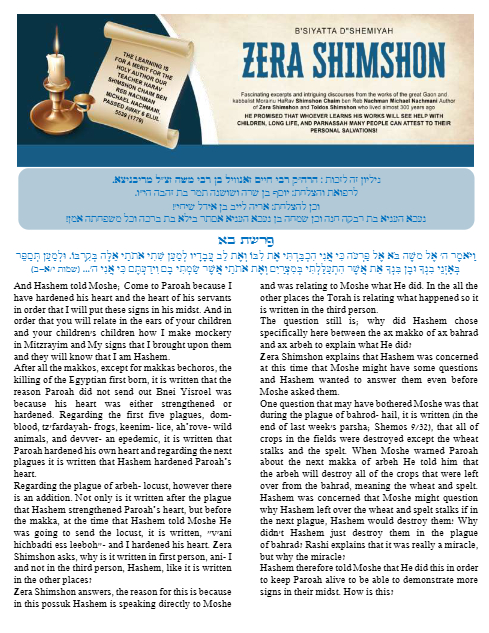

And Hashem told Moshe; Come to Paroah because I have hardened his heart and the heart of his servants in order that I will put these signs in his midst. And in order that you will relate in the ears of your children and your children's children how I make mockery in Mitzrayim and My signs that I brought upon them and they will know that I am Hashem.

After all the makkos, except for makkas bechoros, the killing of the Egyptian first born, it is written that the reason Paroah did not send out Bnei Yisroel was because his heart was either strengthened or hardened. Regarding the first five plagues, dom- blood, tz'fardayah- frogs, keenim- lice, ah’rove- wild animals, and devver- an epedemic, it is written that Paroah hardened his own heart and regarding the next plagues it is written that Hashem hardened Paroah’s heart.

Regarding the plague of arbeh- locust, however there is an addition. Not only is it written after the plague that Hashem strengthened Paroah’s heart, but before the makka, at the time that Hashem told Moshe He was going to send the locust, it is written, "v'ani hichbadti ess leeboh"- and I hardened his heart. Zera Shimshon asks, why is it written in first person, ani- I and not in the third person, Hashem, like it is written in the other places?

Zera Shimshon answers, the reason for this is because in this possuk Hashem is speaking directly to Moshe and was relating to Moshe what He did. In the all the other places the Torah is relating what happened so it is written in the third person.

The question still is; why did Hashem chose specifically here between the ax makko of ax bahrad and ax arbeh to explain what He did?

Zera Shimshon explains that Hashem was concerned at this time that Moshe might have some questions and Hashem wanted to answer them even before Moshe asked them.

One question that may have bothered Moshe was that during the plague of bahrod- hail, it is written (in the end of last week's parsha; Shemos 9/32), that all of crops in the fields were destroyed except the wheat stalks and the spelt. When Moshe warned Paroah about the next makka of arbeh He told him that the arbeh will destroy all of the crops that were left over from the bahrad, meaning the wheat and spelt. Hashem was concerned that Moshe might question why Hashem left over the wheat and spelt stalks if in the next plague, Hashem would destroy them! Why didn't Hashem just destroy them in the plague of bahrad? Rashi explains that it was really a miracle, but why the miracle?

Hashem therefore told Moshe that He did this in order to keep Paroah alive to be able to demonstrate more signs in their midst. How is this?

PDF Preview


