Identifying As a Baal Teshuvah
Wonders | January 17, 2024
Print This Article
View Original PDF

Identifying As a Baal Teshuvah

Wonders | December 10, 2025

Fourth Reading: Identifying As a Ba’al Teshuvah

“And he left Pharaoh’s presence in hot anger”

Bo: A Slap in the Face

After Moses informed Pharaoh of the upcoming plague of the firstborn and the exodus from Egypt that would follow on its heels, the Torah says, “And he left Pharaoh’s presence in hot anger.” In the Talmud, Reish Lakish explains this verse in an extraordinary manner: “He slapped him and left.” Moses did not simply leave angrily. He drew near to Pharaoh, slapped him in the face, turned around, and left. Can you imagine that? Reish Lakish imagined it well enough, and apparently imagined himself doing it; otherwise, the source of his comment is not clear.

According to this explanation, Moses gradually gained more and more confidence and daring in the face of the evil Pharaoh until the grand finale—a stinging, categorical slap in the face. Now that Moses is free of the remnants of his apprehension of Pharaoh, Israel can leave Egypt.

In the Talmud, Rabbi Yochanan seems to disagree with Reish Lakish, saying that Moses should have shown “respect for the kingdom” from start to finish. But in our generation, a generation of ba’alei teshuvah, returnees to God, we can certainly identify with Reish Lakish, who was also a ba’al teshuvah. Reish Lakish understands that to defeat evil, we sometimes must give it a resounding slap in the face.

One of the most interesting and thought-provoking principles of gematria that we use is that in every Torah portion, there is a phrase whose numerical value is 913, the value of the Torah’s first word, “in the beginning” (יתׁאשֵרְּב). In parashat Bo, this phrase is “And he left Pharaoh’s presence in hot anger” (ףָי אִרֳחׇּה בֹעְרַם פִּעֵא מֵצֵּיַו). We may surmise that the resounding slap to Pharaoh’s face signaled the beginning of the redemption.

Beyond Identity

An encounter with a gentile king does not touch on issues of identity. Moses’ identity as an Egyptian subject did not compete with his identity as a Jew. Nonetheless, it was difficult to ignore Pharaoh’s power. “If a king declares that he will uproot a mountain, he will uproot the mountain. He will never retract [his word]!”

In the face of a king’s threats, we must summon up infinite willpower and defy him against all odds. This should be to such an extent that we are prepared for self-sacrifice. Having reached this level, we have already defeated our adversary. If he has no option but to carry out his threat, he becomes powerless over us. Even a simple Jew can tap into this infinite power of will. The despotic king can do nothing more than gnash his teeth.

(excerpted from Rabbi Ginsburgh’s class of 21 Tevet, 5772)
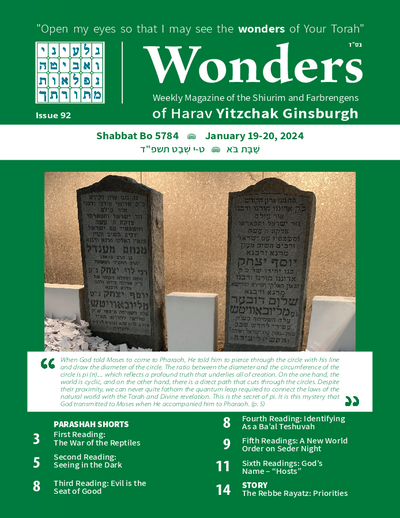
Fourth Reading: Identifying As a Ba’al Teshuvah

“And he left Pharaoh’s presence in hot anger”

Bo: A Slap in the Face

After Moses informed Pharaoh of the upcoming plague of the firstborn and the exodus from Egypt that would follow on its heels, the Torah says, “And he left Pharaoh’s presence in hot anger.” In the Talmud, Reish Lakish explains this verse in an extraordinary manner: “He slapped him and left.” Moses did not simply leave angrily. He drew near to Pharaoh, slapped him in the face, turned around, and left. Can you imagine that? Reish Lakish imagined it well enough, and apparently imagined himself doing it; otherwise, the source of his comment is not clear.

According to this explanation, Moses gradually gained more and more confidence and daring in the face of the evil Pharaoh until the grand finale—a stinging, categorical slap in the face. Now that Moses is free of the remnants of his apprehension of Pharaoh, Israel can leave Egypt.

In the Talmud, Rabbi Yochanan seems to disagree with Reish Lakish, saying that Moses should have shown “respect for the kingdom” from start to finish. But in our generation, a generation of ba’alei teshuvah, returnees to God, we can certainly identify with Reish Lakish, who was also a ba’al teshuvah. Reish Lakish understands that to defeat evil, we sometimes must give it a resounding slap in the face.

One of the most interesting and thought-provoking principles of gematria that we use is that in every Torah portion, there is a phrase whose numerical value is 913, the value of the Torah’s first word, “in the beginning” (יתׁאשֵרְּב). In parashat Bo, this phrase is “And he left Pharaoh’s presence in hot anger” (ףָי אִרֳחׇּה בֹעְרַם פִּעֵא מֵצֵּיַו). We may surmise that the resounding slap to Pharaoh’s face signaled the beginning of the redemption.

Beyond Identity

An encounter with a gentile king does not touch on issues of identity. Moses’ identity as an Egyptian subject did not compete with his identity as a Jew. Nonetheless, it was difficult to ignore Pharaoh’s power. “If a king declares that he will uproot a mountain, he will uproot the mountain. He will never retract [his word]!”

In the face of a king’s threats, we must summon up infinite willpower and defy him against all odds. This should be to such an extent that we are prepared for self-sacrifice. Having reached this level, we have already defeated our adversary. If he has no option but to carry out his threat, he becomes powerless over us. Even a simple Jew can tap into this infinite power of will. The despotic king can do nothing more than gnash his teeth.

(excerpted from Rabbi Ginsburgh’s class of 21 Tevet, 5772)

PDF Preview