Paroah's Interpretation and Hashem's Strengthening
Paroah noticed the oddness of the wheat and spelt stalks surviving and gave his own fascinating interpretation of this. Paroah reasoned that since at the time of Creation Hashem chose not to rule the world purely with Justice because the world would not be able to survive if Hashem ruled with justice alone; therefore, Hashem combined Mercy with Justice. This lead Paroah to think the reason Hashem didn't destroy the wheat and spelt was because He couldn’t ruin everything in the field because that would be pure justice without any mercy. This in turn lead Paroah to conclude that in the same fashion Hashem would not destroy him. Paroah therefore didn't feel any need to send out Bnei Yisroel from Mitzrayim and he reneged on what he said before that he would give permission for Bnei Yisroel to leave.
This in turn caused Hashem to bring more plagues to Mitzrayim in order for Bnei Yisroel to tell their sons and their son's son that I made a mockery of Mitzrayim..."!
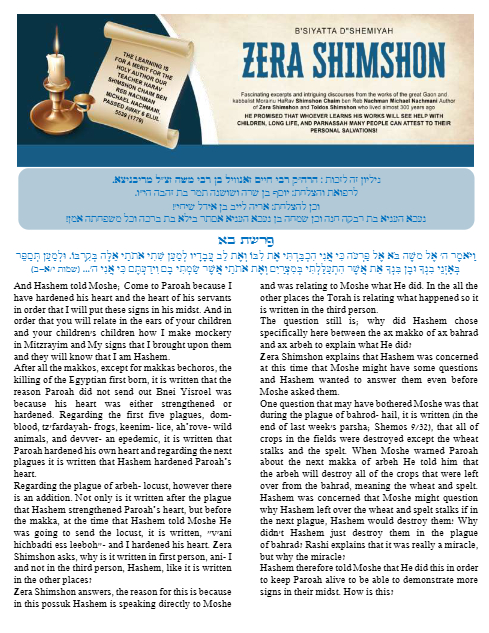
Zera Shimshon explains another question that Moshe might have had; how was Paroah able to withstand all the makkos and afflictions? Why didn't he just fall apart because of everything that was going on during the makkos. Hashem's answer was, "v'ani hichbadti ess leeboh"- and I hardened his heart. Zera Shimshon explains that it doesn't mean that Hashem made Paroah stubborn like the standard translation but, on the contrary, he made his heart strong so he wouldn't break! This is similar to what Chazal say in Mesechta Sanhedrin (100b) that Hashem gives strength to the wicked to withstand their punishment.
This idea that Hashem did not take away the free choice of Paroah but Hashem gave Paroah the strength to continue answers the well-known question of the Rambam; how can it be that Paroah did not have the free choice to do teshuva for all the pain he inflicted on Bnei Yisroel.
According to the above, the answer is simple; Hashem never took away Paroah’s free choice but rather Hashem gave Paroah the strength to carry on!
To summarize. Zera Shimshon asked why does Hashem say "I hardened his heart", in the first person, only between the plague of ax bahrad and ax arbeh while in all the other places it is written in the third person, and Hashem hardened Paroah's heart?
He answers that Hashem related to Moshe what He did while in the other places it was the Torah related what Hashem did, hence it was written in the third person.
Zera Shimshon gives two reasons why Hashem explained to Moshe specifically between these two makkos that He hardened Paroah's heart in order to bring more plagues on the Egyptians. One reason was without this reason it makes no sense why Hashem saved the wheat and spelt from destruction during the plague of bahrad- hail.
The second reason is that Zera Shimshon gives a novel translation of, "v'ani hichbadti ess leeboh"- and I hardened his heart. It doesn't mean that he made Paroah stubborn but it means that he made him brave and strong not to break. Hashem said this now because the plague of ax bahrad was more severe than the previous plagues and Hashem was concerned that Moshe might question how could it be that Paroah didn't just fall apart from the pain of it all.