Remembering the Exodus from Mitzrayim in Our Daily Life
Havineini | January 24, 2026
Print This Article
View Original PDF

Remembering the Exodus from Mitzrayim in Our Daily Life

Havineini | January 30, 2026

The Ribbono shel Olam has given us a mitzvah of מצרים יציאת זכירת, commanding us to remember it every day. What does a Yid say? I will purchase a siddur and underline this section in red. Stop! Mitzvah d’Oraisa! I will even notate some special kavannos from the Zohar regarding this.

No. This isn’t considered the proper hiddur mitzvah, doing the mitzvah properly. Because the definition of זכירה is to internalize the idea with such deep emotion so that you’re still under its impression hours later. When you need to draw on the ideas of מצרים יציאת in your daily life, you will be able to draw on them!

How We Know...

The Torah commands us to begin every day by internalizing this idea with great emotion and to connect with its deeper meaning. How do we know if we performed the mitzvah properly? It’s if you live under its impression hours later. If it left an imprint on your soul, this means that when you recited these pesukim, you were overtaken by them.

If a person moves on and forgets about it, it means that there are many other things in his life that occupy far more space in his mind and emotions than this. You said the words—because you must—but it was superficial. They didn’t overtake you. They didn’t penetrate your soul.

Daily Reminders

When we were commanded to perform this mitzvah, it means that the Ribbono shel Olam wanted us to become emotional as we recall those events. You should meditate so strongly on what these pesukim mean that you become emotional. Why is this so important? Because I am going to test you today in this matter!

Each and every day, we experience a challenge, a nisayon, in matters related to יציאת מצרים. And this is why it’s so important to invoke that event so often. We need these reminders for our very existence as Yidden! We’re commanded to remember it twice every single day—to be moved to emotion over it twice every day... for it to permeate our nefesh twice every single day in way that it will accompany us!

One may ask, how will I know whether I have attained the right emotion over this? Are there “degrees of emotion”? Can we check our emotional levels with a monitor if we have felt מצרים יציאת properly?! Says the Ribbono shel Olam, as a matter of fact, yes. We will know later in the day. When you experience a difficult or challenging situation, and you’ll need to draw on your reserves, then we’ll know very well if you have internalized Yetziyas Mitzrayim.

Exile Blazes the Trail to Redemption

Remembering that Your Galus Is Perfectly Designed

Why, indeed, is this remembrance so important? Why does the Ribbono shel Olam want this so much for us? The Ramban (end of Parashas Bo) explains why so many of the mitzvos—sippur Yetziyas Mitzrayim, succah, tefillin, Shabbos, and others—were given to us as a remembrance of מצרים יציאת... we mamash must live with it! The reason for this, says the Ramban, is that remembering Yetziyas Mitzrayim enables us to internalize that the Ribbono shel Olam oversees and supervises every single detail in creation with precision—today, just as He did back then.

Furthermore, say the sefarim hakedoshim, the mitzvah of מצרים יציאת זכירת illuminates the personal galus of every of every Yid. We often find ourselves in a state of darkness, not knowing how things will turn out. It seems that we will incur great aggravation and disappointment, and we can’t seem to avoid it. This is a state of galus, nothing less. Says the Ribbono shel Olam: אחרת בגלות עמהם אהיה ,זו בגלות עמהם אהיה, I will be with them in this galus, and I will be with them in future exiles! It is all from Me. It’s all calculated with precision.

Everything Is from Above, Even When You Think You’re at Fault

This Yid becomes alarmed and fearful. “I made a mistake. I was warned not to make this move, and I thought I was smarter....” He’s filled with regret, and he resigns himself to suffering the consequences. “The aggravation and the humiliation will be incredible,” he says to himself. “I was warned not to invest money there, and I thought I knew better than everyone.”

This Yid must know that this, too, is directly from Hashem! The great tzaddikim, the Talmidei Ba’al Shem Tov, taught us that even if we made a mistake, even if you have “caused a situation” with your own two hands, this is also from Above! You must understand that galus and darkness are a preparation for redemption—even if you don’t see a way out, and you only seem to be descending further into the abyss and darkness.

A Feeling That Must Overshadow All Others

Sometimes, a person feels that he’s living through a catastrophe. In the last two weeks, the situation only deteriorated day by day. Everyone around him is espousing feelings and sentiments that run contrary to serenity, peace of mind, and basic emunah and bitachon—the environment is poisonous. The entire world of nature and teva tells him that he messed up, and he’s going to pay the price. This “reality” overtakes his emotions.

Says the Ribbono shel Olam: The emotions of מצרים יציאת זכירת—a time when we were taught that everything is calculated, everything is with a precise reason, and that all exiles lead directly to redemption—must trump and overtake all other emotions! These emotions and thoughts must be stronger than whatever you’re experiencing. This isn’t some byproduct to the mitzvah—this is the mitzvah!

The Memory of Miriam

We all understand that the mitzvah to remember what happened to Miriam in the desert isn’t just to evoke a memory—but it is designed to squash the temptation to speak lashon hara. This isn’t added by sifrei mussar; it’s the essence of the mitzvah.

Imagine an entire group of people sitting around speaking negatively about you. You’re incensed... you’re beside yourself, and you want to tell these people regarding the one leading the conversation: “Do you know this guy? Do you know some of his history?!”

Why do you want to say all this? Because you’re completely overtaken emotionally... your feelings are percolating! And this is why you so badly want to give back.... But this is precisely why we’re enjoined to remember the story of Miriam—to remember that speaking lashon hara will never bring you anything good, and we never lose by listening to the Ribbono shel Olam. If we speak ill of another Yid, we distance ourselves from the Source of good, and it’s not good for the Shechinah or for you.

This is the essence of this mitzvah—that the Torah and its commands overtake all our emotions and desires. If the mitzvah were only a dry act of remembering a long-ago story, what was gained here if you don’t remember it when it counts most? The purpose is for that memory to be here for you when you experience the inevitable challenge: to be able to say “no!” If it’s not proper, I will run from it as from a fire.

Serenity in the Memory

Similarly, regarding מצרים יציאת זכירת: Sometimes, a person will say, “I couldn’t daven a word today! I simply couldn’t concentrate or focus.” Why not? “Ah... you can’t imagine what I’m going through. I have no choice but to say the words... but I can’t bring my mind to concentrate on their meaning.”

Says the Ribbono shel Olam: You’re right. You’re going through a terrible time. But in the middle of your davening, you will say שמע קריאת, and you will speak about יציאת מצרים—the entire purpose of which is to bring you calmness and serenity amid your darkest times! This is a time to distract ourselves from what we’re going through and instead meditate upon this message. Chassidim of yore would meditate before davening for this very reason: to clear their minds so the message of מצרים יציאת could penetrate.

Godliness in the Darkness

The purpose of remembering Yetziyas Mitzrayim is for the memory of those events to overtake us in our personal difficult situation. Even if we can’t completely calm ourselves, it must dial down our anxiety and worry significantly. We must study these pesukim carefully, in such a way that they overtake us emotionally. Remember and reiterate that Hashem brought us here for our own good and best interest. Remember what the Ba’al Shem Tov taught: אויביך הנה כי יאבדו אויביך הנה כי ,’ה, if you remember that your enemies and adversaries are also from Hashem, then your enemies and adversaries will vanish!

In fact, sometimes, when we analyze just how great and complicated our dilemma is, we appreciate that such a thing could only have been designed by Hashem. There’s certainly Elokus therein. And why did He design it thus? Because He wants you to come to the recognition that מלבדו עוד אין, there’s no one but Him! I don’t see how I can ever proceed and extricate myself from this problem. No, you can’t. But the Ribbono shel Olam has taken us out of the depths of Mitzrayim, and He continues to orchestrate all events in the world. He places us into galus in order to later redeem us; exile is only the first step in the process of redemption.

Road to Redemption

When we see a beautifully paved road that spans miles upon miles, with multiple wide lanes in each direction, we never think about why the government decided to invest in building this road system—and later they would decide where the road should lead to... perhaps they’d build a city or a park at the end so the road will have a destination.

No one thinks this way, because everyone knows that it works the other way around. There’s a city some distance away, and the problem is that it’s difficult to get there. The solution is to build a comfortable road so we can get there faster and easier.

Darkness by Design

The very same thing transpires with every galus that we experience. Your redemption was always prepared for you—long before the galus came. The geulah was here long before the galus ever was. But how will we access that blessed redemption? We must first attain lots of emunah, many nisyonos and challenges, and much humility and submission. Says the Aisbishter, “I will create a road. I’ll place the person into galus, and this will help him attain these crucial components for geulah.”

But the Yid doesn’t see it in the darkness... he doesn’t understand how this dark road could ever lead him to redemption. But this is itself part of the process. If we could see it right away, it wouldn’t awaken any of these qualities and kirvas Elokim within us. It is precisely the darkness that builds our vessels of emunah and humility—and it is these very vessels that will lead us directly to redemption.
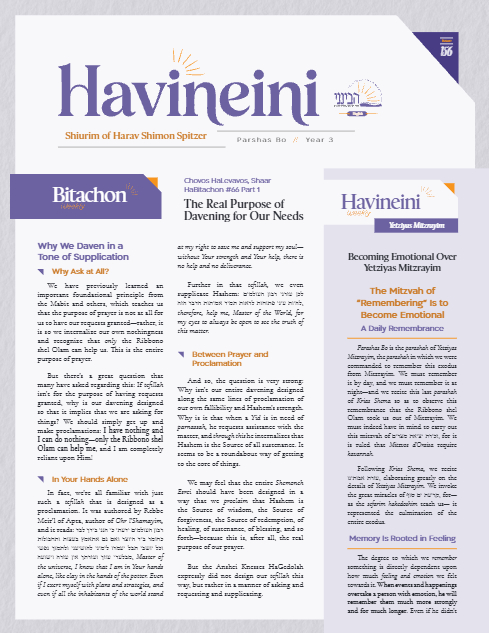

The Ribbono shel Olam has given us a mitzvah of מצרים יציאת זכירת, commanding us to remember it every day. What does a Yid say? I will purchase a siddur and underline this section in red. Stop! Mitzvah d’Oraisa! I will even notate some special kavannos from the Zohar regarding this.

No. This isn’t considered the proper hiddur mitzvah, doing the mitzvah properly. Because the definition of זכירה is to internalize the idea with such deep emotion so that you’re still under its impression hours later. When you need to draw on the ideas of מצרים יציאת in your daily life, you will be able to draw on them!

How We Know...

The Torah commands us to begin every day by internalizing this idea with great emotion and to connect with its deeper meaning. How do we know if we performed the mitzvah properly? It’s if you live under its impression hours later. If it left an imprint on your soul, this means that when you recited these pesukim, you were overtaken by them.

If a person moves on and forgets about it, it means that there are many other things in his life that occupy far more space in his mind and emotions than this. You said the words—because you must—but it was superficial. They didn’t overtake you. They didn’t penetrate your soul.

Daily Reminders

When we were commanded to perform this mitzvah, it means that the Ribbono shel Olam wanted us to become emotional as we recall those events. You should meditate so strongly on what these pesukim mean that you become emotional. Why is this so important? Because I am going to test you today in this matter!

Each and every day, we experience a challenge, a nisayon, in matters related to יציאת מצרים. And this is why it’s so important to invoke that event so often. We need these reminders for our very existence as Yidden! We’re commanded to remember it twice every single day—to be moved to emotion over it twice every day... for it to permeate our nefesh twice every single day in way that it will accompany us!

One may ask, how will I know whether I have attained the right emotion over this? Are there “degrees of emotion”? Can we check our emotional levels with a monitor if we have felt מצרים יציאת properly?! Says the Ribbono shel Olam, as a matter of fact, yes. We will know later in the day. When you experience a difficult or challenging situation, and you’ll need to draw on your reserves, then we’ll know very well if you have internalized Yetziyas Mitzrayim.

Exile Blazes the Trail to Redemption

Remembering that Your Galus Is Perfectly Designed

Why, indeed, is this remembrance so important? Why does the Ribbono shel Olam want this so much for us? The Ramban (end of Parashas Bo) explains why so many of the mitzvos—sippur Yetziyas Mitzrayim, succah, tefillin, Shabbos, and others—were given to us as a remembrance of מצרים יציאת... we mamash must live with it! The reason for this, says the Ramban, is that remembering Yetziyas Mitzrayim enables us to internalize that the Ribbono shel Olam oversees and supervises every single detail in creation with precision—today, just as He did back then.

Furthermore, say the sefarim hakedoshim, the mitzvah of מצרים יציאת זכירת illuminates the personal galus of every of every Yid. We often find ourselves in a state of darkness, not knowing how things will turn out. It seems that we will incur great aggravation and disappointment, and we can’t seem to avoid it. This is a state of galus, nothing less. Says the Ribbono shel Olam: אחרת בגלות עמהם אהיה ,זו בגלות עמהם אהיה, I will be with them in this galus, and I will be with them in future exiles! It is all from Me. It’s all calculated with precision.

Everything Is from Above, Even When You Think You’re at Fault

This Yid becomes alarmed and fearful. “I made a mistake. I was warned not to make this move, and I thought I was smarter....” He’s filled with regret, and he resigns himself to suffering the consequences. “The aggravation and the humiliation will be incredible,” he says to himself. “I was warned not to invest money there, and I thought I knew better than everyone.”

This Yid must know that this, too, is directly from Hashem! The great tzaddikim, the Talmidei Ba’al Shem Tov, taught us that even if we made a mistake, even if you have “caused a situation” with your own two hands, this is also from Above! You must understand that galus and darkness are a preparation for redemption—even if you don’t see a way out, and you only seem to be descending further into the abyss and darkness.

A Feeling That Must Overshadow All Others

Sometimes, a person feels that he’s living through a catastrophe. In the last two weeks, the situation only deteriorated day by day. Everyone around him is espousing feelings and sentiments that run contrary to serenity, peace of mind, and basic emunah and bitachon—the environment is poisonous. The entire world of nature and teva tells him that he messed up, and he’s going to pay the price. This “reality” overtakes his emotions.

Says the Ribbono shel Olam: The emotions of מצרים יציאת זכירת—a time when we were taught that everything is calculated, everything is with a precise reason, and that all exiles lead directly to redemption—must trump and overtake all other emotions! These emotions and thoughts must be stronger than whatever you’re experiencing. This isn’t some byproduct to the mitzvah—this is the mitzvah!

The Memory of Miriam

We all understand that the mitzvah to remember what happened to Miriam in the desert isn’t just to evoke a memory—but it is designed to squash the temptation to speak lashon hara. This isn’t added by sifrei mussar; it’s the essence of the mitzvah.

Imagine an entire group of people sitting around speaking negatively about you. You’re incensed... you’re beside yourself, and you want to tell these people regarding the one leading the conversation: “Do you know this guy? Do you know some of his history?!”

Why do you want to say all this? Because you’re completely overtaken emotionally... your feelings are percolating! And this is why you so badly want to give back.... But this is precisely why we’re enjoined to remember the story of Miriam—to remember that speaking lashon hara will never bring you anything good, and we never lose by listening to the Ribbono shel Olam. If we speak ill of another Yid, we distance ourselves from the Source of good, and it’s not good for the Shechinah or for you.

This is the essence of this mitzvah—that the Torah and its commands overtake all our emotions and desires. If the mitzvah were only a dry act of remembering a long-ago story, what was gained here if you don’t remember it when it counts most? The purpose is for that memory to be here for you when you experience the inevitable challenge: to be able to say “no!” If it’s not proper, I will run from it as from a fire.

Serenity in the Memory

Similarly, regarding מצרים יציאת זכירת: Sometimes, a person will say, “I couldn’t daven a word today! I simply couldn’t concentrate or focus.” Why not? “Ah... you can’t imagine what I’m going through. I have no choice but to say the words... but I can’t bring my mind to concentrate on their meaning.”

Says the Ribbono shel Olam: You’re right. You’re going through a terrible time. But in the middle of your davening, you will say שמע קריאת, and you will speak about יציאת מצרים—the entire purpose of which is to bring you calmness and serenity amid your darkest times! This is a time to distract ourselves from what we’re going through and instead meditate upon this message. Chassidim of yore would meditate before davening for this very reason: to clear their minds so the message of מצרים יציאת could penetrate.

Godliness in the Darkness

The purpose of remembering Yetziyas Mitzrayim is for the memory of those events to overtake us in our personal difficult situation. Even if we can’t completely calm ourselves, it must dial down our anxiety and worry significantly. We must study these pesukim carefully, in such a way that they overtake us emotionally. Remember and reiterate that Hashem brought us here for our own good and best interest. Remember what the Ba’al Shem Tov taught: אויביך הנה כי יאבדו אויביך הנה כי ,’ה, if you remember that your enemies and adversaries are also from Hashem, then your enemies and adversaries will vanish!

In fact, sometimes, when we analyze just how great and complicated our dilemma is, we appreciate that such a thing could only have been designed by Hashem. There’s certainly Elokus therein. And why did He design it thus? Because He wants you to come to the recognition that מלבדו עוד אין, there’s no one but Him! I don’t see how I can ever proceed and extricate myself from this problem. No, you can’t. But the Ribbono shel Olam has taken us out of the depths of Mitzrayim, and He continues to orchestrate all events in the world. He places us into galus in order to later redeem us; exile is only the first step in the process of redemption.

Road to Redemption

When we see a beautifully paved road that spans miles upon miles, with multiple wide lanes in each direction, we never think about why the government decided to invest in building this road system—and later they would decide where the road should lead to... perhaps they’d build a city or a park at the end so the road will have a destination.

No one thinks this way, because everyone knows that it works the other way around. There’s a city some distance away, and the problem is that it’s difficult to get there. The solution is to build a comfortable road so we can get there faster and easier.

Darkness by Design

The very same thing transpires with every galus that we experience. Your redemption was always prepared for you—long before the galus came. The geulah was here long before the galus ever was. But how will we access that blessed redemption? We must first attain lots of emunah, many nisyonos and challenges, and much humility and submission. Says the Aisbishter, “I will create a road. I’ll place the person into galus, and this will help him attain these crucial components for geulah.”

But the Yid doesn’t see it in the darkness... he doesn’t understand how this dark road could ever lead him to redemption. But this is itself part of the process. If we could see it right away, it wouldn’t awaken any of these qualities and kirvas Elokim within us. It is precisely the darkness that builds our vessels of emunah and humility—and it is these very vessels that will lead us directly to redemption.

PDF Preview