Seven and Three
Parsha Pages | January 31, 2025
Print This Article
View Original PDF

Seven and Three

Parsha Pages | June 27, 2025

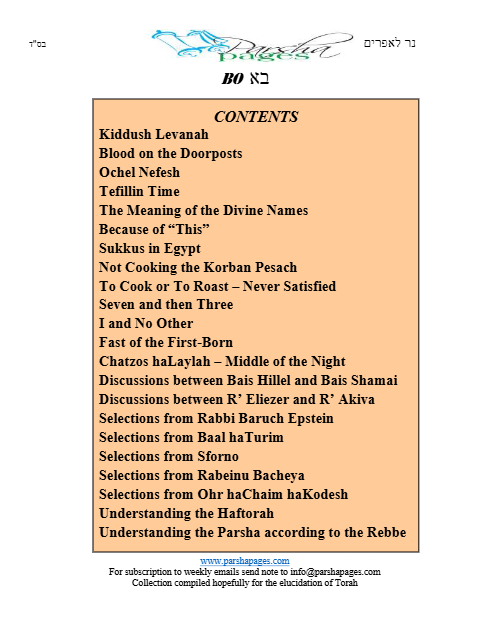
Why are the ten plagues not all in one Parsha? Once they are divided, why specifically seven and three?

Abarbanel explains that after the 7th plague we find for the first time that Paroh's servants exhibited great fear, "Ad mosai yi'h'yeh zeh lonu l'mokeish shalach es ho'anoshim" (verse 7), even BEFORE the plague came.

Alternatively, Abarbanel suggests that from this plague onwards we find some compromise on Paroh's part, as he partially agrees, only questioning who would be the participants in the celebrations and sacrificing.

  1. The plague of arbeh was chosen to begin Parshas Bo with because it begins the makkos for which Pharaoh began to fear the plagues and negotiate with Moshe before the plague started.
  2. All the last three makkos took place in the dark. The locusts "darkened the land of Egypt" with their sheer mass. Choshech, clearly. Makkos Bechoros was at exactly midnight (although it would have been full moon, so it probably wasn't completely dark).

Tosfos Hasho'leim offers that Moshe thought that there would only be seven plagues, and therefore the previous parsha comes to an end after seven plagues. This is quite puzzling, as Hashem told Moshe that the grand finale would be the plague of smiting of the firstborn. Perhaps, since Moshe saw that Paroh was contrite and stated, "Chotosi hapo'am Hashem haTzadik vaani v'ami horsho'im" (9:27), he felt that now Paroh would surely send them out to freedom. Although Hashem foretold of the smiting of the firstborn, since each person is given free will, perhaps there would be no need for the last three plagues. Hashem therefore told Moshe that He hardened Paroh's heart and there would be a need for BO, mathematically three, for three more plagues.

The Baal HaTurim (9:33) says that after the plague of Hail the Jewish nation no longer suffered from the burdens of Egyptian oppression and thus, the three following plagues (#8-#10) were different since the Jews were no longer under the oppression.

According to the Zohar, the Ten Plagues correspond to the Ten Utterances that created the world which are further reflected in the Ten Sefiros.

Only seven of the ten Sefiros are manifest in our physical world. These are חג "נהי : ת "ם חסד – Loving Kindness, גבורה /דין - Strict Justice, תפארת – the balance between Chesed and Din, נצח – Victory/Eternity, הוד – Subservience/Gratitude, יסוד – the balance between all the Middos, מלכות – Kingship. These seven Ma’amaros are termed ‘Middos’ because they comprise the character of a person.

The other three Ma’amaros are heavenly in nature. They will be incorporated into this physical world only with the initiation of the heavenly era of Mashiach. These are חכמה – Knowledge, בינה – Understanding, and כתר – Desire/Intuition, the most sublime of all the Middos. These three Sefiros are referred to as ‘Mochin’ – intelligence – because these are manifest in the mind of a person.

Why are the ten plagues not all in one Parsha? Once they are divided, why specifically seven and three?

Abarbanel explains that after the 7th plague we find for the first time that Paroh's servants exhibited great fear, "Ad mosai yi'h'yeh zeh lonu l'mokeish shalach es ho'anoshim" (verse 7), even BEFORE the plague came.

Alternatively, Abarbanel suggests that from this plague onwards we find some compromise on Paroh's part, as he partially agrees, only questioning who would be the participants in the celebrations and sacrificing.

  1. The plague of arbeh was chosen to begin Parshas Bo with because it begins the makkos for which Pharaoh began to fear the plagues and negotiate with Moshe before the plague started.
  2. All the last three makkos took place in the dark. The locusts "darkened the land of Egypt" with their sheer mass. Choshech, clearly. Makkos Bechoros was at exactly midnight (although it would have been full moon, so it probably wasn't completely dark).

Tosfos Hasho'leim offers that Moshe thought that there would only be seven plagues, and therefore the previous parsha comes to an end after seven plagues. This is quite puzzling, as Hashem told Moshe that the grand finale would be the plague of smiting of the firstborn. Perhaps, since Moshe saw that Paroh was contrite and stated, "Chotosi hapo'am Hashem haTzadik vaani v'ami horsho'im" (9:27), he felt that now Paroh would surely send them out to freedom. Although Hashem foretold of the smiting of the firstborn, since each person is given free will, perhaps there would be no need for the last three plagues. Hashem therefore told Moshe that He hardened Paroh's heart and there would be a need for BO, mathematically three, for three more plagues.

The Baal HaTurim (9:33) says that after the plague of Hail the Jewish nation no longer suffered from the burdens of Egyptian oppression and thus, the three following plagues (#8-#10) were different since the Jews were no longer under the oppression.

According to the Zohar, the Ten Plagues correspond to the Ten Utterances that created the world which are further reflected in the Ten Sefiros.

Only seven of the ten Sefiros are manifest in our physical world. These are חג "נהי : ת "ם חסד – Loving Kindness, גבורה /דין - Strict Justice, תפארת – the balance between Chesed and Din, נצח – Victory/Eternity, הוד – Subservience/Gratitude, יסוד – the balance between all the Middos, מלכות – Kingship. These seven Ma’amaros are termed ‘Middos’ because they comprise the character of a person.

The other three Ma’amaros are heavenly in nature. They will be incorporated into this physical world only with the initiation of the heavenly era of Mashiach. These are חכמה – Knowledge, בינה – Understanding, and כתר – Desire/Intuition, the most sublime of all the Middos. These three Sefiros are referred to as ‘Mochin’ – intelligence – because these are manifest in the mind of a person.

PDF Preview