The Importance of Mesiras Nefesh
By Daniel Keren
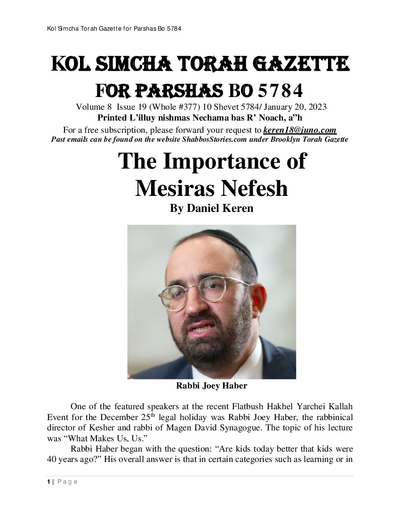
One of the featured speakers at the recent Flatbush Hakhel Yarchei Kallah Event for the December 25th legal holiday was Rabbi Joey Haber, the rabbinical director of Kesher and rabbi of Magen David Synagogue. The topic of his lecture was “What Makes Us, Us.”
Rabbi Haber began with the question: “Are kids today better that kids were 40 years ago?” His overall answer is that in certain categories such as learning or in one’s connection to Yiddishkeit, the kids of today are better. But, when it comes to the middot (character trait) of respect, it is possible that young people today are not as good as the kids of 40 years ago.
On the other hand, younger people today are in many ways more challenged that we were 30, 40 or 50 years ago. The major challenge, Rabbi Haber said, that our children have today is that of mastering mesiras nefesh (the character trait of self-sacrifice) when the need arises.
Challenges to the Life and Dignity of Yehuda
Rabbi Haber noted that we find six important issues that confronted Yehuda as recorded in the last parshas of Sefer Bereishis. Each of those important incidents in the life of Yehuda were challenges to his life and his dignity.
For example, when the episode of Tamar arose, he could have ignored her plea to identify the person to whom the deposit items belonged and was the father of her as yet unborn twin children. Rabbi Haber said that it was this and the other five issues of mesiras nefesh that Yehuda undertook that made him to be worthy that his descendants (the royal house of Dovid) were worthy to have the blessing of being king over the Jewish nation.
Rabbi Haber in his Hakhel lecture said that today you cannot find in Lakewood a Kollel yungerman who doesn’t have a leased car. In the old days those in Kollel used to drive old beaten-up station wagons that you had to tie a rope in order to make sure that the car bumper didn’t fall off. Our children today are missing the important quality of self-sacrifice.
Willing to Make Such a Difficult Commitment
When Yehuda told his father that he would guarantee his Olam Habah (portion in the World to Come) by promising to bring Binyomin back, Yehuda had no way of knowing that he would indeed be able to bring his younger brother back because the Viceroy was a “crazy” unpredictable personality. Yet Yehuda was willing to make such a commitment because of his commitment to try and bring back food so that his father would not starve.
Rabbi Haber said that the challenge for a husband today is to sacrifice what he wants to do in order to help his wife whether it is physical or emotional and requires a lot of time. Many marriages are severely challenged because of this lack of mesiras nefesh.
Even in the realm of chesed (kindness), all too often we get caught up in getting attention for good deeds. Do we avoid those acts of chesed that are not going to get us the appropriate attention that we privately crave for?
Leadership is dependent on one’s ability to make a commitment even when you don’t know how you are going to be able to carry out that promise. This is the essence of mesiras nefesh that any true leader must have.
Another important aspect of leadership is the ability to give of oneself for others without any though of what one can get for oneself.
Rabbi Haber concluded with the thought that what we are built on are not the people who are the most famous or the most influential, but rather with those of us who are willing to exhibit mesiras nefesh when the occasion arises. And that is why the descendant of Yehuda will be the Moshiach that we all look forward to.
Reprinted from the Januay 11, 2023 edition of The Jewish Connection.