The Ohr Hachaim haKodesh
Parsha Pages | January 31, 2025
Print This Article
View Original PDF

The Ohr Hachaim haKodesh

Parsha Pages | June 27, 2025

“In order that you tell your son” (10:2).

The Ohr HaChaim HaKodosh explains that the primary purpose of the makkos was not to take revenge upon or punish Paro; rather, the pasuk testifies that their purpose was to instill emuna in the hearts of Bnei Yisrael in an eternal, unforgettable manner. The fact that these makkos occurred in the very heart of Egypt within Paro’s kingdom would ensure that their memory would never fade.

The Ohr HaChaim bases this concept on a Maamar Chazal in Chullin 75b, where we learn about a ben pekua (an animal found in the uterus of its slaughtered mother and is considered one of her limbs and therefore does not need to be separately slaughtered). The ben pekua has two clear signs that ensure that everyone remembers where it comes from and why it does not need shechita, so that no one will suspect those who eat it of transgressing the prohibition of consuming non-kosher meat that was not properly schechted.

Similarly, here in Mitzrayim, the Ohr HaChaim posits that we required two wondrous events in order to instill emuna in Klal Yisrael so that they would never forget their faith and belief in Hashem. The first one is that the makkos occurred in such a way that all forms of creation: earth, air, fire, water and all the animals would be affected. However, this alone would not suffice. In addition, Hashem ensured that the makkos would strike Paro, his regime and his nation in such a way that no nation had ever suffered such a miraculous, disastrous series of events. These two wondrous ingredients were essential to instill an enduring emuna, as the pasuk says, lemaan tesaper be’oznei bincha – “in order that you retell (these events) to your son” to instill in the next generation the same rock-hard, never-ending faith and belief.

Without these two wondrous points, the matter would never be permanently locked into our national memory. The pasuk continues, counting the two points, “The fact that I [Hashem] punished Mitzrayim” – Hashem severely punished them in a supernatural manner through ten plagues, each of which was comprised of four or five elements, something unheard of in terms of suffering. But this wonder alone would not be enough to remember, and so the pasuk continues, “and My signs”, referring to the signs Hashem performed. This was the second wonder needed; together these two wonders would ensure our emuna that viydatem ki ani Hashem – “you will know that I am Hashem!”

In the sefer Me’or Chaim, Rav Moshe Franco quotes the Ohr HaChaim’s deroshos in Livorno and adds details to how Rav Chaim ben Attar explained how each of the makkos demonstrated Hashem’s mastery over a different element of nature: water was struck when the Nile was transformed into blood, the earth with a plague of lice, everyone saw the strength of Hashem in the hail (which was fiery ice) and when Hashem commanded the plague of locusts, He demonstrated His mastery over the wind and the air. The sun and moon were proven to be non-divine and powerless through the plague of darkness, in order that no one should worship the celestial bodies. [Above we mentioned mastery over the animals, demonstrated in the plagues of frogs, wild animals and cattle plague.] Finally, the death of the firstborn proves how only Hashem is master over people, knowing their most intimate secrets – who is truly the firstborn.

“The swarm of locusts went up over the entire land of Egypt, and rested within all the broders of Egypt in a very sever manner. Before it, there was never such a locust swarm; and after it, there will never be one like it.

The Ohr haChaim in his sefer Pri Toar relates that in his hometown the swarm of locusts descended upon their fields every two or three years and the people of the town were accustomed to eating the locust.

When the Ohr haChaim grew up and became the leading halachic authority, one year during the swarming of the locust, he decreed that it was forbidden to eat the locust. Everyone followed the decree except for one person who did not wish to refrain from eating locust. It was shown to him that he was eating the locust was as if he was eating creeping crawling insects.

Once it became known the Ohr haChaim had made such a decree not to eat the locust all the halahic authorities of the country also agreed and publicized the prohibition. Then it has been related that after that year the locust did not return for over twenty years.
“In order that you tell your son” (10:2).

The Ohr HaChaim HaKodosh explains that the primary purpose of the makkos was not to take revenge upon or punish Paro; rather, the pasuk testifies that their purpose was to instill emuna in the hearts of Bnei Yisrael in an eternal, unforgettable manner. The fact that these makkos occurred in the very heart of Egypt within Paro’s kingdom would ensure that their memory would never fade.

The Ohr HaChaim bases this concept on a Maamar Chazal in Chullin 75b, where we learn about a ben pekua (an animal found in the uterus of its slaughtered mother and is considered one of her limbs and therefore does not need to be separately slaughtered). The ben pekua has two clear signs that ensure that everyone remembers where it comes from and why it does not need shechita, so that no one will suspect those who eat it of transgressing the prohibition of consuming non-kosher meat that was not properly schechted.

Similarly, here in Mitzrayim, the Ohr HaChaim posits that we required two wondrous events in order to instill emuna in Klal Yisrael so that they would never forget their faith and belief in Hashem. The first one is that the makkos occurred in such a way that all forms of creation: earth, air, fire, water and all the animals would be affected. However, this alone would not suffice. In addition, Hashem ensured that the makkos would strike Paro, his regime and his nation in such a way that no nation had ever suffered such a miraculous, disastrous series of events. These two wondrous ingredients were essential to instill an enduring emuna, as the pasuk says, lemaan tesaper be’oznei bincha – “in order that you retell (these events) to your son” to instill in the next generation the same rock-hard, never-ending faith and belief.

Without these two wondrous points, the matter would never be permanently locked into our national memory. The pasuk continues, counting the two points, “The fact that I [Hashem] punished Mitzrayim” – Hashem severely punished them in a supernatural manner through ten plagues, each of which was comprised of four or five elements, something unheard of in terms of suffering. But this wonder alone would not be enough to remember, and so the pasuk continues, “and My signs”, referring to the signs Hashem performed. This was the second wonder needed; together these two wonders would ensure our emuna that viydatem ki ani Hashem – “you will know that I am Hashem!”

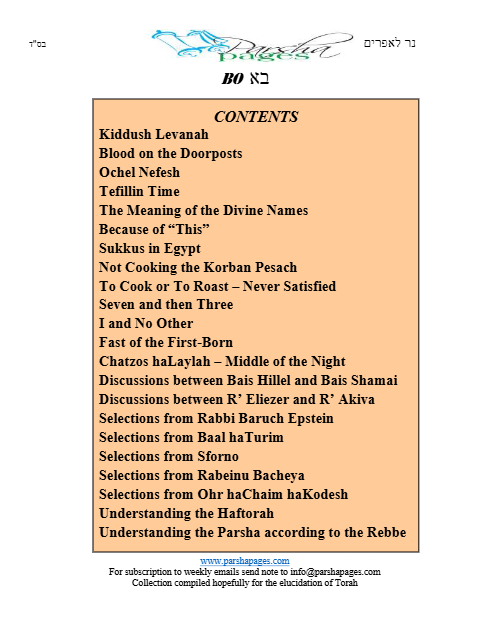
In the sefer Me’or Chaim, Rav Moshe Franco quotes the Ohr HaChaim’s deroshos in Livorno and adds details to how Rav Chaim ben Attar explained how each of the makkos demonstrated Hashem’s mastery over a different element of nature: water was struck when the Nile was transformed into blood, the earth with a plague of lice, everyone saw the strength of Hashem in the hail (which was fiery ice) and when Hashem commanded the plague of locusts, He demonstrated His mastery over the wind and the air. The sun and moon were proven to be non-divine and powerless through the plague of darkness, in order that no one should worship the celestial bodies. [Above we mentioned mastery over the animals, demonstrated in the plagues of frogs, wild animals and cattle plague.] Finally, the death of the firstborn proves how only Hashem is master over people, knowing their most intimate secrets – who is truly the firstborn.

“The swarm of locusts went up over the entire land of Egypt, and rested within all the broders of Egypt in a very sever manner. Before it, there was never such a locust swarm; and after it, there will never be one like it.

The Ohr haChaim in his sefer Pri Toar relates that in his hometown the swarm of locusts descended upon their fields every two or three years and the people of the town were accustomed to eating the locust.

When the Ohr haChaim grew up and became the leading halachic authority, one year during the swarming of the locust, he decreed that it was forbidden to eat the locust. Everyone followed the decree except for one person who did not wish to refrain from eating locust. It was shown to him that he was eating the locust was as if he was eating creeping crawling insects.

Once it became known the Ohr haChaim had made such a decree not to eat the locust all the halahic authorities of the country also agreed and publicized the prohibition. Then it has been related that after that year the locust did not return for over twenty years.

PDF Preview