The Rabbi of Leipnik and the Lost Envelope
Inspired by a Story | January 22, 2026
Print This Article
View Original PDF

The Rabbi of Leipnik and the Lost Envelope

Inspired by a Story | January 30, 2026

Over two hundred years ago lived a peddler in Leipnik by the name of Yossel. Yossel would travel round to the neighboring towns and villages with his bags of odds and ends trying to make a meager living.

One day when walking between two villages a train passed by. The train wasn't a passenger train, it was the mail train that delivered letters from the city to the local post offices.

As the train passed by two envelopes flew out. Yossel went up to the envelopes and picked them up. One was an ordinary envelope but the other had inside thirty thousand marks. Yossel went to the local post office and returned the ordinary letter and took the envelope with the money back home.

He excitedly told his wife that they had become rich and they could now live happily ever after.

But his wife wasn't very impressed. She gave him a big lecture how his behavior was very incorrect.

"Easy for you to talk," said Yossel to his wife. "You're home all week in our warm little house spending the money I work so hard to earn. Besides have you any clue how tough it is going from village to village in the hot summer with the sun baking down or during winter plodding through the snow shivering in the cold."

Yossel hid the envelope under the floor and started trying to think how to use his wealth sensibly.

But as we can all imagine the missing fortune never went unnoticed. The mail postal service made inquiries and one of those who were suspected was Yossel, after all he had found one letter. His house was searched but the money wasn't found. Even so he was arrested and taken into custody. The non Jews started talking and accusing all Jews to be thieves. As if non-Jews never steal and Yossel was only a suspect.

The mail service offered a prize of five thousand marks for the one that returns the envelope.

In the meantime Yossels wife was very scared that their house would be searched again. She took the envelope to the Rabbis house. She looked through his window and saw he was studying. She wasn’t sure what to do. So she took the envelope, threw it into the Rabbis study and quickly disappeared.

The Rabbi heard a strange noise. He looked around and saw an envelope on the floor. He looked and immediately understood what had happened.

The Rabbi was in a dilemma. On one hand the money had to be returned but on the other hand if he, the Rabbi would return it, it would be the talk of town and the whole country that the Jews are dishonest.

The Rabbi's Solution

The Rabbi had to gather his thoughts together. He put the envelope in his pocket, went outside and started taking a walk. As he was walking in the street deep in thought he saw coming towards him the local priest.

And then it hit him. He had a brainwave. He greeted the priest and said, "I have a question for you. Is it true that when discussing things with a priest in confidence, the priest is obliged to keep the discussion confidential and a secret?"

"That is correct," replied the priest.

"If so," said the Rabbi "I am giving you this envelope with the found money. Please go and hand it to the postal service and tell them that it was given to you confidently in order to take the reward on the finders behalf."

"And what will happen to the five thousand marks reward," asked the priest?

"Look there is a Jew in prison called Yossel. Lets give him the money so he can open up a business and earn an income and he won't need to go around peddling anymore," replied the Rabbi.

The priest agreed, Yossel was released from prison, the libel disappeared and all of Leipniks Jews rejoiced.

The Lesson of Kiddush Hashem

Now let us understand the depth behind the idea of the Rabbi of Leipnik Rabbi Baruch Frankel.

The Rabbi looked for a way to avoid Chillul Hashem - desecration of Hashem’s name.

Pharaoh made a decree that all the Jewish babies should be thrown into the water. Chazal tell us that Pharaoh knew that after the Mabul - the flood in the times of Noach; Hashem made a promise that he would never bring again a Mabul. Pharaoh also knew that Hashem punishes Mida keneged mida - a punishment which is connected to the sin, tit for tat. (Chazal explain how every plague was in return for something similar the Egyptians did to the Jews).

Therefore Pharaoh made an interesting calculation. He decreed to throw the Jewish babies into the water but Hashem wouldn't be able to punish him with water because of the promise.

Chazal explain that the promise of Hashem was only for a world Mabul but he could still punish a single country. And in the end the Egyptians drowned in the water. But for some reason Pharaoh never thought that.

The question is what did Pharaoh think? Did he really believe that Hashem wouldn't punish him at all or that Hashem couldn't find any alternative punishment?

The answer is Pharaoh made another calculation.

Chazal tell us that for desecration of Hashem's name there are two options of repentance. Either by making a Kiddush Hashem sanctifying Hashem's name or by dying.

The Jews in Egypt served Avoda Zara - idol worship. Even though it was due to the terrible times they were suffering but it was still a Chillul Hashem. So Pharaoh decided to kill the Jewish babies as their punishment and repentance and held that if so he wasn't going to get punished.

But Hashem had other plans. Hashem told the Jews to take a sheep for the Korban Pesach and tie it to their bed posts for a few days. The sheep was the idol of the Egyptians. This Mitzva needed great Mesirus nefesh and spiritual strength to take the Egyptian's idol and slaughtering it. By fulfilling this Mitzvah they made a great Kiddush Hashem and rectified their sin of Chillul Hashem of idol worship. So Pharaoh's calculation was messed up by Hashem and therefore was severely punished with all the plagues and the death of the firstborns.

As Jews wherever we go and whatever we do we are being watched by others. If our behavior is inappropriate then we desecrate Hashem’s name. However when we behave properly as appropriate for a Jew then not only are we are sanctifying Hashem’s name but at the same time rectifying our sin of Chillul Hashem.
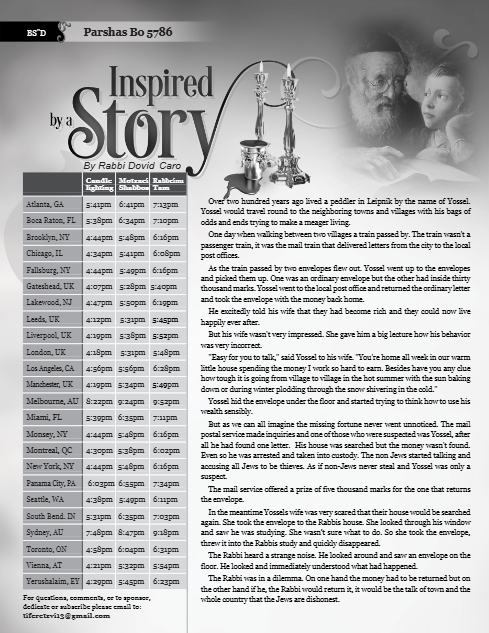

Over two hundred years ago lived a peddler in Leipnik by the name of Yossel. Yossel would travel round to the neighboring towns and villages with his bags of odds and ends trying to make a meager living.

One day when walking between two villages a train passed by. The train wasn't a passenger train, it was the mail train that delivered letters from the city to the local post offices.

As the train passed by two envelopes flew out. Yossel went up to the envelopes and picked them up. One was an ordinary envelope but the other had inside thirty thousand marks. Yossel went to the local post office and returned the ordinary letter and took the envelope with the money back home.

He excitedly told his wife that they had become rich and they could now live happily ever after.

But his wife wasn't very impressed. She gave him a big lecture how his behavior was very incorrect.

"Easy for you to talk," said Yossel to his wife. "You're home all week in our warm little house spending the money I work so hard to earn. Besides have you any clue how tough it is going from village to village in the hot summer with the sun baking down or during winter plodding through the snow shivering in the cold."

Yossel hid the envelope under the floor and started trying to think how to use his wealth sensibly.

But as we can all imagine the missing fortune never went unnoticed. The mail postal service made inquiries and one of those who were suspected was Yossel, after all he had found one letter. His house was searched but the money wasn't found. Even so he was arrested and taken into custody. The non Jews started talking and accusing all Jews to be thieves. As if non-Jews never steal and Yossel was only a suspect.

The mail service offered a prize of five thousand marks for the one that returns the envelope.

In the meantime Yossels wife was very scared that their house would be searched again. She took the envelope to the Rabbis house. She looked through his window and saw he was studying. She wasn’t sure what to do. So she took the envelope, threw it into the Rabbis study and quickly disappeared.

The Rabbi heard a strange noise. He looked around and saw an envelope on the floor. He looked and immediately understood what had happened.

The Rabbi was in a dilemma. On one hand the money had to be returned but on the other hand if he, the Rabbi would return it, it would be the talk of town and the whole country that the Jews are dishonest.

The Rabbi's Solution

The Rabbi had to gather his thoughts together. He put the envelope in his pocket, went outside and started taking a walk. As he was walking in the street deep in thought he saw coming towards him the local priest.

And then it hit him. He had a brainwave. He greeted the priest and said, "I have a question for you. Is it true that when discussing things with a priest in confidence, the priest is obliged to keep the discussion confidential and a secret?"

"That is correct," replied the priest.

"If so," said the Rabbi "I am giving you this envelope with the found money. Please go and hand it to the postal service and tell them that it was given to you confidently in order to take the reward on the finders behalf."

"And what will happen to the five thousand marks reward," asked the priest?

"Look there is a Jew in prison called Yossel. Lets give him the money so he can open up a business and earn an income and he won't need to go around peddling anymore," replied the Rabbi.

The priest agreed, Yossel was released from prison, the libel disappeared and all of Leipniks Jews rejoiced.

The Lesson of Kiddush Hashem

Now let us understand the depth behind the idea of the Rabbi of Leipnik Rabbi Baruch Frankel.

The Rabbi looked for a way to avoid Chillul Hashem - desecration of Hashem’s name.

Pharaoh made a decree that all the Jewish babies should be thrown into the water. Chazal tell us that Pharaoh knew that after the Mabul - the flood in the times of Noach; Hashem made a promise that he would never bring again a Mabul. Pharaoh also knew that Hashem punishes Mida keneged mida - a punishment which is connected to the sin, tit for tat. (Chazal explain how every plague was in return for something similar the Egyptians did to the Jews).

Therefore Pharaoh made an interesting calculation. He decreed to throw the Jewish babies into the water but Hashem wouldn't be able to punish him with water because of the promise.

Chazal explain that the promise of Hashem was only for a world Mabul but he could still punish a single country. And in the end the Egyptians drowned in the water. But for some reason Pharaoh never thought that.

The question is what did Pharaoh think? Did he really believe that Hashem wouldn't punish him at all or that Hashem couldn't find any alternative punishment?

The answer is Pharaoh made another calculation.

Chazal tell us that for desecration of Hashem's name there are two options of repentance. Either by making a Kiddush Hashem sanctifying Hashem's name or by dying.

The Jews in Egypt served Avoda Zara - idol worship. Even though it was due to the terrible times they were suffering but it was still a Chillul Hashem. So Pharaoh decided to kill the Jewish babies as their punishment and repentance and held that if so he wasn't going to get punished.

But Hashem had other plans. Hashem told the Jews to take a sheep for the Korban Pesach and tie it to their bed posts for a few days. The sheep was the idol of the Egyptians. This Mitzva needed great Mesirus nefesh and spiritual strength to take the Egyptian's idol and slaughtering it. By fulfilling this Mitzvah they made a great Kiddush Hashem and rectified their sin of Chillul Hashem of idol worship. So Pharaoh's calculation was messed up by Hashem and therefore was severely punished with all the plagues and the death of the firstborns.

As Jews wherever we go and whatever we do we are being watched by others. If our behavior is inappropriate then we desecrate Hashem’s name. However when we behave properly as appropriate for a Jew then not only are we are sanctifying Hashem’s name but at the same time rectifying our sin of Chillul Hashem.

PDF Preview