Women and Tefillin
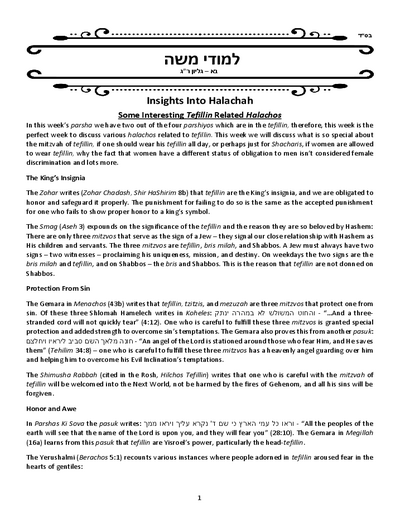
Since time immemorial, the widely accepted practice in the Torah-observant community is that women do not wear tefillin. Historically, though, we find rare exceptions.
The Gemara in Eruvin (96a) notes that Michal, daughter of Shaul HaMelech and wife of Dovid HaMelech, used to put on tefillin. Already in Talmudic times, there was a dispute whether her behavior was condoned by the Sages of her era. The Yerushalmi understands that they criticized it, and Tosfos (Eruvin 96a quotes the Pesikta, Chapter 22 and the Gra, Orach Chaim 38:3) explain that the Bavli also seems to indicate this.
The Maharshal explains (Kiddushin 1:64) that even according to the opinions that the Sages did condone her behavior, it was due to Michal’s extraordinary piousness and the fact that she was a princess and queen, and also had no children to tend to that she was able to maintain purity of body and thought when wearing tefillin. However, other women do not have this ability.
The Kol-Bo (21, quoted in Beis Yosef Orach Chaim 38) rules that women are explicitly prohibited from wearing tefillin. The Rema (Orach Chaim 38:3) follows this opinion. The Chida writes (Birkei Yosef 38:1) that ladies cannot retain proper concentration even during davening, as a woman’s thoughts during tefillah generally resemble a man’s daytime thoughts — which prevent him from donning tefillin all day long.
Another reason mentioned in the Chida (Shiurei Berachah, Yoreh Deah 182:2) refers to the biblical prohibition against crossdressing. The Torah states: “A man’s attire shall not be on a woman, nor may a man wear a woman’s garment, because whoever does these [things] is an abomination to the L-rd, your G-d.” (Devorim 22:5). The Targum Yonason ben Uziel, in his elucidated translation of the Torah, sees this as precluding a woman from wearing a tallis or tefillin, since they are male apparel.
Related Articles