Avraham’s Approach to Finding a Wife for Yitzchak
מגדל אור | November 12, 2025
Print This Article
View Original PDF

Avraham’s Approach to Finding a Wife for Yitzchak

מגדל אור | December 08, 2025

“Rather, to my homeland and my birthplace shall you go, and you shall take a wife for my son, for Yitzchak.” (Beraishis 24:4)

Avraham undertook the search for a wife for his son, one of the specific mitzvos a father is tasked with, according to the Gemara in Kiddushin. He called Eliezer, his trusted servant, and made him pledge to go to Avraham’s homeland to find a wife for Yitzchak. He would not allow his holy son to marry one of the Canaanite girls, and made Eliezer swear to this effect.

What’s strange about this conversation is that Avraham left it rather open-ended as to the identity of the appropriate bride. The previous parsha ended with the announcement that his brother Nachor had a grandchild named Rivka born to his family. This was the proper match for Yitzchak as Rashi explains over there. If so, why didn’t Avraham simply tell Eliezer to go find Rivka and bring her back for Yitzchak? Why leave it up to chance and hope that Eliezer finds the right person?

Perhaps it was Avraham following his characteristic belief that people can be mistaken and Hashem is in control. When he heard that Rivka was born, everyone assumed that she was the right match for his son. Though he likely believed it could be true, he wasn’t ready to rely on human insight alone.

Even if she was born to be Yitzchak’s wife, her upbringing might have changed the trajectory of her behavior and she was no longer suited for him. Therefore, Avraham wasn’t content to merely send Eliezer to his family to bring back Rivka. Instead, he opened the door for Hashem to play His role, by forcing Eliezer to pray, and to consider what type of girl would be suitable as a wife of Yitzchak and a daughter-in-law of Avraham. She had to have the qualities that would mesh with those which Eliezer witnessed and facilitated in his master’s home.

Avraham’s whole approach to life was that Hashem created and runs the world, and we are merely players on the world stage. He decried the claims people made that they made themselves great, and turned solely to Hashem. When he gave food to travelers, he said, “Thank the One from Whose food you have eaten. It is not me, but Hashem.”

Over and over, Avraham repeated the mantra of Hashem knowing what was best for him and all Mankind.

Therefore, when it came to finding an appropriate wife for Yitzchak, Avraham stepped back and allowed Hashem to make the Shidduch. What we see, and what Hashem sees, may be very different, and the wise man will defer to Hashem’s will every time.

A childless couple came to their Rebbe in tears. They had been married for many years and wanted a child desperately. The Rebbe heard their pleas, and felt very bad for them, but said “I’m so sorry, but I can’t help you. I see that you are not destined to have children.”

The husband, a devout follower of the Rebbe, was crushed, but accepted his lot with faith. Not so his wife. Incensed, she said, “Let’s get out of here. We don’t need a Rebbe who tells us we can’t have children. We will go daven to Hashem on our own and we’ll see that He will answer us!”

Indeed, the couple was answered just a few months later when they found out the woman was expecting a child. The Rebbe was right when he said he could not help them, because it was not the Rebbe’s prayers they needed, but their own.

©2025 – J. Gewirtz
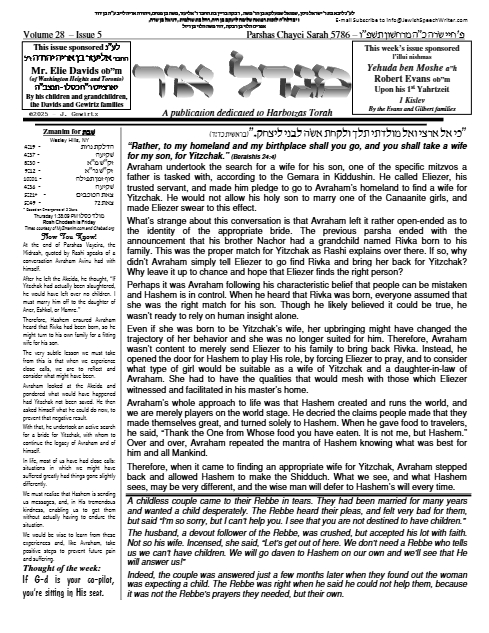
“Rather, to my homeland and my birthplace shall you go, and you shall take a wife for my son, for Yitzchak.” (Beraishis 24:4)

Avraham undertook the search for a wife for his son, one of the specific mitzvos a father is tasked with, according to the Gemara in Kiddushin. He called Eliezer, his trusted servant, and made him pledge to go to Avraham’s homeland to find a wife for Yitzchak. He would not allow his holy son to marry one of the Canaanite girls, and made Eliezer swear to this effect.

What’s strange about this conversation is that Avraham left it rather open-ended as to the identity of the appropriate bride. The previous parsha ended with the announcement that his brother Nachor had a grandchild named Rivka born to his family. This was the proper match for Yitzchak as Rashi explains over there. If so, why didn’t Avraham simply tell Eliezer to go find Rivka and bring her back for Yitzchak? Why leave it up to chance and hope that Eliezer finds the right person?

Perhaps it was Avraham following his characteristic belief that people can be mistaken and Hashem is in control. When he heard that Rivka was born, everyone assumed that she was the right match for his son. Though he likely believed it could be true, he wasn’t ready to rely on human insight alone.

Even if she was born to be Yitzchak’s wife, her upbringing might have changed the trajectory of her behavior and she was no longer suited for him. Therefore, Avraham wasn’t content to merely send Eliezer to his family to bring back Rivka. Instead, he opened the door for Hashem to play His role, by forcing Eliezer to pray, and to consider what type of girl would be suitable as a wife of Yitzchak and a daughter-in-law of Avraham. She had to have the qualities that would mesh with those which Eliezer witnessed and facilitated in his master’s home.

Avraham’s whole approach to life was that Hashem created and runs the world, and we are merely players on the world stage. He decried the claims people made that they made themselves great, and turned solely to Hashem. When he gave food to travelers, he said, “Thank the One from Whose food you have eaten. It is not me, but Hashem.”

Over and over, Avraham repeated the mantra of Hashem knowing what was best for him and all Mankind.

Therefore, when it came to finding an appropriate wife for Yitzchak, Avraham stepped back and allowed Hashem to make the Shidduch. What we see, and what Hashem sees, may be very different, and the wise man will defer to Hashem’s will every time.

A childless couple came to their Rebbe in tears. They had been married for many years and wanted a child desperately. The Rebbe heard their pleas, and felt very bad for them, but said “I’m so sorry, but I can’t help you. I see that you are not destined to have children.”

The husband, a devout follower of the Rebbe, was crushed, but accepted his lot with faith. Not so his wife. Incensed, she said, “Let’s get out of here. We don’t need a Rebbe who tells us we can’t have children. We will go daven to Hashem on our own and we’ll see that He will answer us!”

Indeed, the couple was answered just a few months later when they found out the woman was expecting a child. The Rebbe was right when he said he could not help them, because it was not the Rebbe’s prayers they needed, but their own.

©2025 – J. Gewirtz

PDF Preview