Empty Prayers
Toras Avigdor - Junior | November 17, 2024
Print This Article
View Original PDF

Empty Prayers

Toras Avigdor - Junior | June 27, 2025

And Avraham is telling us here the same thing is when it comes to our tefillos for other people. When you’re praying for your fellow man, Hakadosh Baruch Hu listens to how sincere this prayer is. Is it b’emes? Do you really mean it? Do you really want your fellow man to be rich? Do you really want him to be healthy and live long?

Here is a woman praying for her husband. She takes out the techinah and she prays for him. After all, every woman needs a husband. She needs a man in the house and her children need a father. So she asks Hashem to give him long healthy years.

But she does her best to try to make him sick too. There are many women like that. You think there aren't women who kill their husbands? Not with a gun, not with weapons – with her mouth. Plenty of women have killed their husbands by bothering them, belittling them.

Many times you suddenly hear that this and this man passed away. It’s a surprise. He was sick? Wasn’t he healthy? People don’t realize that he died from aggravation. That’s not mentioned in the obituary and of course when she comes to collect the insurance nothing is said about that. She’s dressed in black, and she’s weeping. She killed him – what’s she weeping about? He didn’t take out a big enough insurance policy for me! That’s why she’s weeping.

Prayers of the Devil

Husbands have killed wives also. I know a man like that who used to torment his wife. She got sick. He made her physically sick with his words and finally she passed away. On her deathbed he came to her and asked her for forgiveness. She said she can’t forgive him. And I don’t blame her. He was a devil. He was a frum devil; an Orthodox devil. He davened for his wife but he contradicted it with his actions.

So you have to see to it that your spouse, your children, your mother and father, are made healthy by your acts. Beside your tefillah — absolutely you have to pray – but you should also participate in it; whatever you can do you must do.

Here's a lady who after she lights the Shabbos candles says a techinah and she prays for the health of her family. She’s praying for their health, for their safety. But then she goes into her room to get something and she leaves her children alone with the fire. And now there’s an accident chalilah and a child is burned. It happened. Burned to death!

Don't tell me it was an accident. Accidents shmaccidents. It's somebody's fault. You’re praying for your children? Very good. But back it up with l’maaseh. You have no business doing anything except watching your child when there is a flame that's exposed.

Knives, Windows and Ladders

A father davens in shul for his children but in the house he’s holding a knife in his hands as he's walking from one room to another – he walks out of the doorway with a knife with the point foremost. It contradicts his prayers for the family's health.

Or let's say your grandchildren are coming to visit you. Someday you'll have a lot of children and grandchildren and you allow your windows to remain open. So what are you telling me you're praying for your grandchildren. You're praying against your grandchildren. If a child falls out of the window, it's somebody's fault. If a child falls into a washing machine and gets killed chas veshalom, it's somebody's fault. Don't tell me the telephone rang, the doorbell rang. All empty excuses, all contradictions to your tefillos. Your job is the child.

If there are things on the stairs that can send a person for a ride, it’s a contradiction to your tefillos. The Torah says that. Open the Gemara you big davener: עָה ָם רְעו זֶה סֻל בֵיתֶך מִים בְ א תָשִׂים דָ וְל – What does it mean that it’s forbidden to spill blood in your home? It means you shouldn’t have a wobbly ladder in the house (Bava Kama 46a). So stairs are a ladder and things left on the steps make for a wobbly stairway. And this is being transgressed constantly. They don't care for safety! So how could they say they're praying to Hakadosh Baruch Hu for life and health? That’s calling out in truth?

The Best Prayer

The answer is you don’t mean business. Of course you do; your davening is not just idle prattling of an unthinking mind. Absolutely you mean it, but it’s not enough. That’s not the best way to daven.

What’s the best way? Avraham Avinu, he’s teaching us the model for us to follow: Pigu, do what you can. Be mishtadel for your fellow Jew. Besides that, pigu – pray for that person. But don't rely on praying before you try to do what you can. That’s called true prayer; that’s called בֶ אֱ מֶ ת יִ קְ רָ אֻ ה ו, calling out in truth. That’s called caring for your fellow Jew – when it’s preceded by action, by efforts on his behalf.
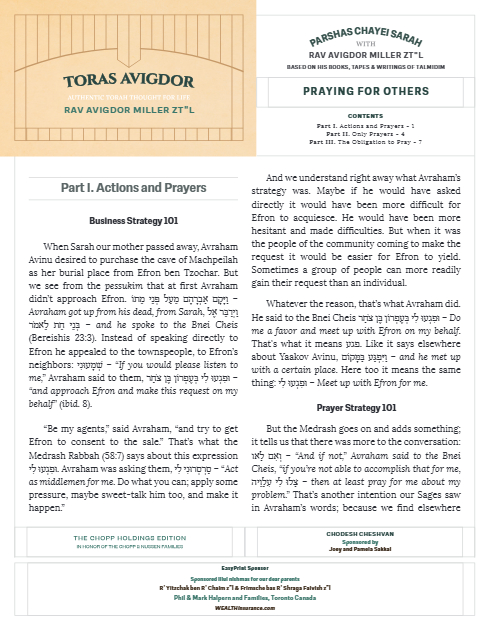
And Avraham is telling us here the same thing is when it comes to our tefillos for other people. When you’re praying for your fellow man, Hakadosh Baruch Hu listens to how sincere this prayer is. Is it b’emes? Do you really mean it? Do you really want your fellow man to be rich? Do you really want him to be healthy and live long?

Here is a woman praying for her husband. She takes out the techinah and she prays for him. After all, every woman needs a husband. She needs a man in the house and her children need a father. So she asks Hashem to give him long healthy years.

But she does her best to try to make him sick too. There are many women like that. You think there aren't women who kill their husbands? Not with a gun, not with weapons – with her mouth. Plenty of women have killed their husbands by bothering them, belittling them.

Many times you suddenly hear that this and this man passed away. It’s a surprise. He was sick? Wasn’t he healthy? People don’t realize that he died from aggravation. That’s not mentioned in the obituary and of course when she comes to collect the insurance nothing is said about that. She’s dressed in black, and she’s weeping. She killed him – what’s she weeping about? He didn’t take out a big enough insurance policy for me! That’s why she’s weeping.

Prayers of the Devil

Husbands have killed wives also. I know a man like that who used to torment his wife. She got sick. He made her physically sick with his words and finally she passed away. On her deathbed he came to her and asked her for forgiveness. She said she can’t forgive him. And I don’t blame her. He was a devil. He was a frum devil; an Orthodox devil. He davened for his wife but he contradicted it with his actions.

So you have to see to it that your spouse, your children, your mother and father, are made healthy by your acts. Beside your tefillah — absolutely you have to pray – but you should also participate in it; whatever you can do you must do.

Here's a lady who after she lights the Shabbos candles says a techinah and she prays for the health of her family. She’s praying for their health, for their safety. But then she goes into her room to get something and she leaves her children alone with the fire. And now there’s an accident chalilah and a child is burned. It happened. Burned to death!

Don't tell me it was an accident. Accidents shmaccidents. It's somebody's fault. You’re praying for your children? Very good. But back it up with l’maaseh. You have no business doing anything except watching your child when there is a flame that's exposed.

Knives, Windows and Ladders

A father davens in shul for his children but in the house he’s holding a knife in his hands as he's walking from one room to another – he walks out of the doorway with a knife with the point foremost. It contradicts his prayers for the family's health.

Or let's say your grandchildren are coming to visit you. Someday you'll have a lot of children and grandchildren and you allow your windows to remain open. So what are you telling me you're praying for your grandchildren. You're praying against your grandchildren. If a child falls out of the window, it's somebody's fault. If a child falls into a washing machine and gets killed chas veshalom, it's somebody's fault. Don't tell me the telephone rang, the doorbell rang. All empty excuses, all contradictions to your tefillos. Your job is the child.

If there are things on the stairs that can send a person for a ride, it’s a contradiction to your tefillos. The Torah says that. Open the Gemara you big davener: עָה ָם רְעו זֶה סֻל בֵיתֶך מִים בְ א תָשִׂים דָ וְל – What does it mean that it’s forbidden to spill blood in your home? It means you shouldn’t have a wobbly ladder in the house (Bava Kama 46a). So stairs are a ladder and things left on the steps make for a wobbly stairway. And this is being transgressed constantly. They don't care for safety! So how could they say they're praying to Hakadosh Baruch Hu for life and health? That’s calling out in truth?

The Best Prayer

The answer is you don’t mean business. Of course you do; your davening is not just idle prattling of an unthinking mind. Absolutely you mean it, but it’s not enough. That’s not the best way to daven.

What’s the best way? Avraham Avinu, he’s teaching us the model for us to follow: Pigu, do what you can. Be mishtadel for your fellow Jew. Besides that, pigu – pray for that person. But don't rely on praying before you try to do what you can. That’s called true prayer; that’s called בֶ אֱ מֶ ת יִ קְ רָ אֻ ה ו, calling out in truth. That’s called caring for your fellow Jew – when it’s preceded by action, by efforts on his behalf.

PDF Preview