Teshuvah Regarding Mishloach Manos Between Choson and Kallah
למודי משה | November 13, 2025
Print This Article
View Original PDF

Teshuvah Regarding Mishloach Manos Between Choson and Kallah

למודי משה | December 08, 2025

R' Yehuda Chezner shlita (Sha’arei Yemei HaPurim, end of sefer siman 9) writes: Nowadays, where it is not customary to perform kiddushin with sivloinus, one may send to his kallah mishlo’ach manos and there is nothing to worry about.

2) In regard to the special din of the Rema :

First Opinion: The sefer Ta’amei HaMinhagim (938, Kuntros Acharon): תגר קרא על מה שנתחדש שהחתן נותן בעצמו המתנות לכלה שאין זה מן הראוי כמבואר ברמ''א – “Bemoans the new custom of the chosan himself giving gifts to the kallah as doing so is unfitting as is clear from the Rema.” The Kitzur Hilchos Purim, and R’ Avigdor Nebenzahl shlita both maintain that the issur of the Rema is still in place, and even if the metzius [reality] has changed, the din remains the same. Consequently, the mother of the chosan may give it to the kallah, however, the chosan himself shouldn’t give mishlo’ach manos directly to the kallah.

Second Opinion: On the other hand, I heard in the name of R’ Ezriel Auerbach shlita, and in the name of R’ Tzvi Cheshin in the name of R’ Shlomah Fisher shlita, that it is permissible for the chosan to give mishlo’ach manos directly to his kallah, as the Rema was talking about a time when giving mishlo’ach manos and gifts to the kallah was irregular, however, nowadays it is common to do so, therefore, there is no concern of the sivloinus serving as kiddushin. However, R’ Ezriel Auerbach adds: The chosan shouldn’t pass it directly from his hands to her’s.

R' Yehudah Chesner adds (Sha’arei Yemei Purim, end of sefer siman 9) that it is allowed as the Rema never mentions ארוסתו – a woman one plans to marry, and all he says is a widow, where there is no connection between the two of them.

Additionally, when it comes to mishlo’ach manos everyone knows it is not being sent to serve as kiddushin, and even if the chosan adds jewelry people still know he doesn’t mean kiddushin, and he is just doing what is customary for a chosan to do for his kallah. (Based on this argument, it would be forbidden to send a ring, as that is a normal way of carrying out kiddushin.)

R' Yechezkel Aharon Schwartz (Ho’erusin Ve’hanisuin pg. 112, he’orah 86) writes it is permissible [although it is better for the chosan to send it with his mother]. He compares it to the Shulchan Aruch (there) which says that one may send matonas l’evyonim to a poor woman. The Mishnah Berurah (s.k. 27) explains that by money there is no worry of sivloinus, additionally, it is being given דרך צדקה ולא דרך סבלונות – as a means of tzedokah and not as sivloinus. R’ Schwartz writes that just like we can say it is being given דרך צדקה ולא דרך סבלונות, similarly, we can say דרך של חתן וכלה ליתן זה לזה ולא בתורת קידושין – it is being sent as a means of what a chosan and kallah do for each other, and not as kiddushin.

3) In regard to the issue of חשש שאלת שלום לאשה – the prohibition of sending a greeting to a woman

I heard in the name of R’ Avigdor Nebenzahl shlita, and R’ Ezriel Auerbach shlita that it is not a problem. R’ Nissim Karelitz zt”l (Chut Shoni pg. 56) also writes that it is permissible. They all base themselves on the Gemara in Kiddushin which says that in some places the minhag was that they would be מסבלי והדר מקדשי – first send gifts, and then perform kiddushin. The question is, why aren’t we concerned for the prohibition of שאלת שלום לאשה? It must be that if one has been on shidduchim with a girl and he then greets her with the intention of getting married to her, it is allowed.

To explain this, I heard in the name of R’ Tzvi Cheshin, that the prohibition of greeting a woman is because we don’t want them to become too friendly, and Chazal went out their way to maintain a distance between a man and a woman. When giving a woman a present with no reason it creates an undesirable relationship between them. However, if there is a reason for giving the gift, i.e. so that they start to get on with each other so that when they are married things are easier, then there is no problem of sending a greeting.
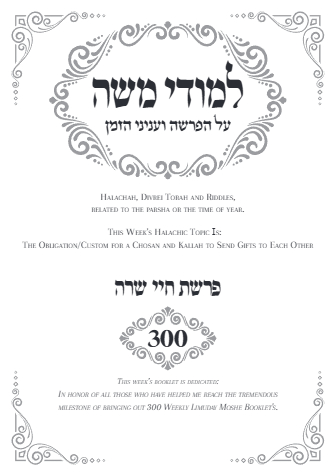
R' Yehuda Chezner shlita (Sha’arei Yemei HaPurim, end of sefer siman 9) writes: Nowadays, where it is not customary to perform kiddushin with sivloinus, one may send to his kallah mishlo’ach manos and there is nothing to worry about.

2) In regard to the special din of the Rema :

First Opinion: The sefer Ta’amei HaMinhagim (938, Kuntros Acharon): תגר קרא על מה שנתחדש שהחתן נותן בעצמו המתנות לכלה שאין זה מן הראוי כמבואר ברמ''א – “Bemoans the new custom of the chosan himself giving gifts to the kallah as doing so is unfitting as is clear from the Rema.” The Kitzur Hilchos Purim, and R’ Avigdor Nebenzahl shlita both maintain that the issur of the Rema is still in place, and even if the metzius [reality] has changed, the din remains the same. Consequently, the mother of the chosan may give it to the kallah, however, the chosan himself shouldn’t give mishlo’ach manos directly to the kallah.

Second Opinion: On the other hand, I heard in the name of R’ Ezriel Auerbach shlita, and in the name of R’ Tzvi Cheshin in the name of R’ Shlomah Fisher shlita, that it is permissible for the chosan to give mishlo’ach manos directly to his kallah, as the Rema was talking about a time when giving mishlo’ach manos and gifts to the kallah was irregular, however, nowadays it is common to do so, therefore, there is no concern of the sivloinus serving as kiddushin. However, R’ Ezriel Auerbach adds: The chosan shouldn’t pass it directly from his hands to her’s.

R' Yehudah Chesner adds (Sha’arei Yemei Purim, end of sefer siman 9) that it is allowed as the Rema never mentions ארוסתו – a woman one plans to marry, and all he says is a widow, where there is no connection between the two of them.

Additionally, when it comes to mishlo’ach manos everyone knows it is not being sent to serve as kiddushin, and even if the chosan adds jewelry people still know he doesn’t mean kiddushin, and he is just doing what is customary for a chosan to do for his kallah. (Based on this argument, it would be forbidden to send a ring, as that is a normal way of carrying out kiddushin.)

R' Yechezkel Aharon Schwartz (Ho’erusin Ve’hanisuin pg. 112, he’orah 86) writes it is permissible [although it is better for the chosan to send it with his mother]. He compares it to the Shulchan Aruch (there) which says that one may send matonas l’evyonim to a poor woman. The Mishnah Berurah (s.k. 27) explains that by money there is no worry of sivloinus, additionally, it is being given דרך צדקה ולא דרך סבלונות – as a means of tzedokah and not as sivloinus. R’ Schwartz writes that just like we can say it is being given דרך צדקה ולא דרך סבלונות, similarly, we can say דרך של חתן וכלה ליתן זה לזה ולא בתורת קידושין – it is being sent as a means of what a chosan and kallah do for each other, and not as kiddushin.

3) In regard to the issue of חשש שאלת שלום לאשה – the prohibition of sending a greeting to a woman

I heard in the name of R’ Avigdor Nebenzahl shlita, and R’ Ezriel Auerbach shlita that it is not a problem. R’ Nissim Karelitz zt”l (Chut Shoni pg. 56) also writes that it is permissible. They all base themselves on the Gemara in Kiddushin which says that in some places the minhag was that they would be מסבלי והדר מקדשי – first send gifts, and then perform kiddushin. The question is, why aren’t we concerned for the prohibition of שאלת שלום לאשה? It must be that if one has been on shidduchim with a girl and he then greets her with the intention of getting married to her, it is allowed.

To explain this, I heard in the name of R’ Tzvi Cheshin, that the prohibition of greeting a woman is because we don’t want them to become too friendly, and Chazal went out their way to maintain a distance between a man and a woman. When giving a woman a present with no reason it creates an undesirable relationship between them. However, if there is a reason for giving the gift, i.e. so that they start to get on with each other so that when they are married things are easier, then there is no problem of sending a greeting.

PDF Preview