The Secret Relationship
BET Journal | November 10, 2023
Print This Article
View Original PDF

The Secret Relationship

BET Journal | December 31, 2025

In this week’s Torah portion. Abraham negotiates a deal with a man named Efron and ends up paying an enormous amount of money (400 large and pure silver) for a field in Hebron, at whose edge was the “machpalah cave,” or the “double cave,” a cave suited for the burial of couples side-by-side of each other.

Indeed, as the Bible relates, all of the patriarchs and matriarchs of Israel (other than Rachel) – Sarah and Abraham, Rebecca and Isaac, Leah and Jacob – were buried in that cave. The edifice constructed upon it remains till today one of the holiest sites in Judaism and is also held in high esteem by Muslims. Immediately following this story, the Bible continues to relate the long dramatic story of how Isaac meets and marries his soul-mate Rebecca. This is the section in Torah known as “the portion of relationships,” and is read in many Jewish Sephardic communities on the Sabbath before a wedding in the community.

Entering the Cave

Jewish law (Tractate Kiddushin 2a) compares the betrothal of every bride and groom with Abraham’s purchase of the “cave.” Superficially, this comes across as very weird. Yet there is a profoundly moving message being communicated here. When a groom places the ring on the finger of his bride, the Torah is informing him, that he is not only marrying his spouse on a conscious level; he is also entering into an eternal relationship with her. In marriage, they are accessing together the “cave” buried in the deep chambers of their souls, where their relationship is timeless and permanent.

The chupah (the wedding canopy) is not only a union of two people; it is also a reunion of two halves that were once one.

This also explains the juxtaposition of Sarah’s burial and the story of Isaac and Rebecca’s marriage. At first glance, the sequence seems to be in poor taste. Upon deeper reflection, though, the implicit message is clear. Before you get married you must know that you are marrying your eternal partner. Divorce is not an option. You must be resolute that no argument, fight, or crisis will ever tear you two apart. Your relationship is essential. Your core self and your spouse’s core self are one. Abraham’s treatment of Sarah after her demise served as a defining lesson to Isaac and Rebecca for how to treat their own marriage.

These two, as the Bible relates, had plenty of arguments; some of these arguments had dramatic historical implications. But never did these differences of opinion manage to tear them apart. Never did Isaac and Rebecca lose their loyalty and trust to each other. Why? Because they never forgot the connection that defined their relationship “beneath the ground,” in the subconscious layers of their souls.

The Metaphor

The human marriage has always been a metaphor for the marriage between man and G-d. This marriage, too, operates on two levels. At times your relationship with G-d is “above the ground,” exposed and revealed. It is conscious, exciting and enriching. But what do you do at a moment of a moral or spiritual “downer?” How do you react to a condition of shallowness, alienation and despair? What do you do when you feel that your marriage with G-d is soul-less and lifeless? When you are not even sure He exists?

At such a moment you have to remember the “cave-like relationship,” the fact that you and G-d possesses a hidden relationship that may be invisible, but is always present. This is the hidden spark of G-dliness and inspiration etched within the deep caves of your soul that could never be extinguished. It is not as exciting and captivating as the relationship above ground, but it is eternal.

Rabbi YY Jacobson

Womens Shiur Tuesday 9:30am (18 Main)
Chassidus Shiur Monday & Thursday 7:45am (18 Main)
Shabbos: Friday Night – before Barchu (20 Upstairs)
Morning 9:00 (20 Upstairs)
After Davening 12:00pm (20 Upstairs)
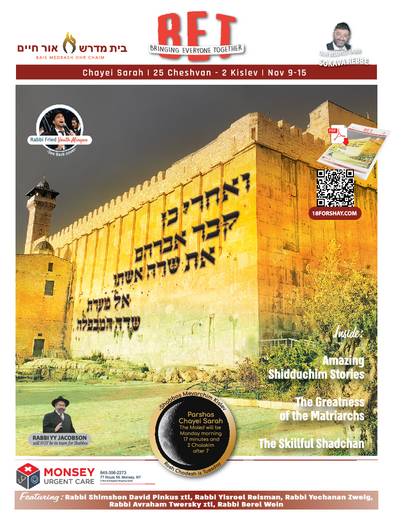
In this week’s Torah portion. Abraham negotiates a deal with a man named Efron and ends up paying an enormous amount of money (400 large and pure silver) for a field in Hebron, at whose edge was the “machpalah cave,” or the “double cave,” a cave suited for the burial of couples side-by-side of each other.

Indeed, as the Bible relates, all of the patriarchs and matriarchs of Israel (other than Rachel) – Sarah and Abraham, Rebecca and Isaac, Leah and Jacob – were buried in that cave. The edifice constructed upon it remains till today one of the holiest sites in Judaism and is also held in high esteem by Muslims. Immediately following this story, the Bible continues to relate the long dramatic story of how Isaac meets and marries his soul-mate Rebecca. This is the section in Torah known as “the portion of relationships,” and is read in many Jewish Sephardic communities on the Sabbath before a wedding in the community.

Entering the Cave

Jewish law (Tractate Kiddushin 2a) compares the betrothal of every bride and groom with Abraham’s purchase of the “cave.” Superficially, this comes across as very weird. Yet there is a profoundly moving message being communicated here. When a groom places the ring on the finger of his bride, the Torah is informing him, that he is not only marrying his spouse on a conscious level; he is also entering into an eternal relationship with her. In marriage, they are accessing together the “cave” buried in the deep chambers of their souls, where their relationship is timeless and permanent.

The chupah (the wedding canopy) is not only a union of two people; it is also a reunion of two halves that were once one.

This also explains the juxtaposition of Sarah’s burial and the story of Isaac and Rebecca’s marriage. At first glance, the sequence seems to be in poor taste. Upon deeper reflection, though, the implicit message is clear. Before you get married you must know that you are marrying your eternal partner. Divorce is not an option. You must be resolute that no argument, fight, or crisis will ever tear you two apart. Your relationship is essential. Your core self and your spouse’s core self are one. Abraham’s treatment of Sarah after her demise served as a defining lesson to Isaac and Rebecca for how to treat their own marriage.

These two, as the Bible relates, had plenty of arguments; some of these arguments had dramatic historical implications. But never did these differences of opinion manage to tear them apart. Never did Isaac and Rebecca lose their loyalty and trust to each other. Why? Because they never forgot the connection that defined their relationship “beneath the ground,” in the subconscious layers of their souls.

The Metaphor

The human marriage has always been a metaphor for the marriage between man and G-d. This marriage, too, operates on two levels. At times your relationship with G-d is “above the ground,” exposed and revealed. It is conscious, exciting and enriching. But what do you do at a moment of a moral or spiritual “downer?” How do you react to a condition of shallowness, alienation and despair? What do you do when you feel that your marriage with G-d is soul-less and lifeless? When you are not even sure He exists?

At such a moment you have to remember the “cave-like relationship,” the fact that you and G-d possesses a hidden relationship that may be invisible, but is always present. This is the hidden spark of G-dliness and inspiration etched within the deep caves of your soul that could never be extinguished. It is not as exciting and captivating as the relationship above ground, but it is eternal.

Rabbi YY Jacobson

Womens Shiur Tuesday 9:30am (18 Main)
Chassidus Shiur Monday & Thursday 7:45am (18 Main)
Shabbos: Friday Night – before Barchu (20 Upstairs)
Morning 9:00 (20 Upstairs)
After Davening 12:00pm (20 Upstairs)

PDF Preview