Haftorah of the Week Chukas
Questions on the Sidra | July 09, 2024
Print This Article
View Original PDF

Haftorah of the Week Chukas

Questions on the Sidra | June 27, 2025

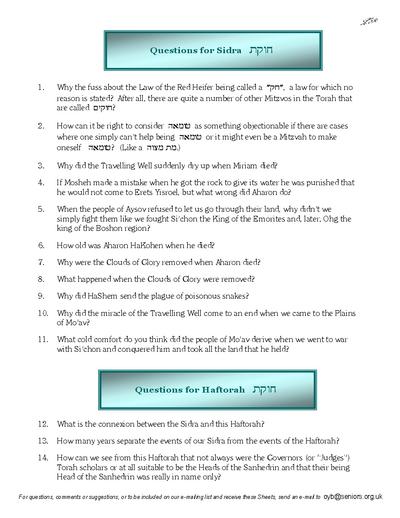
This week’s Haftorah is taken from the Book of Shoftim, Chapter 14 verses 1 — 33.

1. The connexion between the Sidra and the Haftorah is quite evident. In the Sidra is the report of how the Jewish People, on their way at last to the Promised Land, had made peaceful overtures to the peoples on the east side of the River Yardayn, asking for their permission to pass through the territory they held there (which they had taken from the Ammonite and Mo’avite peoples in a previous war). Not only was our request turned down with scorn but indeed we were provoked to war by Si’chon, the king of the Emorites and then by Og, the king of the Boshon region. With HaShem’s help, we had vanquished these kings and their fighting-men. The peoples of Ammon and Mo’av were able to take some comfort from the fact that their conquerors had not occupied their lands for long. For as a result of their battle with us, all the territory held by Si’chon and Og had passed into our possession.

2. This Week’s Haftorah speaks of an episode in our history that occurred almost exactly three hundred years after our Redemption from Egypt. It was a time when the Jewish people were preoccupied with building up their homesteads in their new Land. Sadly, however, many had neglected the Torah and Mitzvos. From this, there followed a decline into idolworship and a general imitation of the pagan cults of the peoples of the region. This in turn brought HaShem’s anger upon the Jewish Nation and they suffered a great deal at the hands of their warlike neighbours.

3. The Ammonites and Mo’avites were always anything but peaceful towards the Jewish Nation that shared borders with them along what remained to them of their lands. On many occasions, the Ammonites sent marauding bands into the Jewish country, killing the inhabitants or taking them captive, and destroying the Jewish settlements. The persistent and repeated incursions by the Ammonites (and the Mo’avites) over the years, sometimes deep into the country, wrought havoc among the Jewish people.

4. At that time in our history we had no king (it would be almost a hundred years later that Sha’ul, the first Jewish king, would be crowned) and now it became necessary to appoint a leader who would unite the Jewish people into a strong force to counter the invading Ammonites. The Ammonites had mustered a large army of fighting-men at Gil’od (today’s Khirbet Jel’ad) and the Jewish people were gathered at Mitzpoh (possibly the same as Rammos Gil’od in the Gil’od region, and today’s Tel Ramith). For their leader, the people set their sights upon Yiftach, of the town of Gil’od, a brave warrior who, although not a Torah-scholar by any means, was a leader of men.

5. Yiftach’s brothers considered him an outsider (he was born to their father’s other wife) and he had been effectively banished by them and had gone to live elsewhere, there gathering around him a band of likewise disaffected men. When the elders of the people came to him to ask him to lead them against the Ammonites, Yiftach chided them for their previous behaviour towards him. He insisted that if he was to lead them now, they first must acknowledge him as their leader, for he must be able to speak and act in the name of the whole People. To this they all agreed and Yiftach then beseeched HaShem for His help, for the people were in grave danger and they did repent of their ways.

6. Yiftach then sent messengers to the king of the people of Ammon, seeking peace. “What argument have you against us,” he asked, “that you come against us to wage war in our country?” In reply, the Ammonite king demanded that the Jewish people shall return the lands to the east of the River Yardayn which they had taken on their way out from Egypt to Eretz Yisroel. Yiftach replied that the Jewish People did not take any land from the people of Ammon (or Mo’av, either, for that matter). Indeed, we had skirted round the lands of Edom, of Mo’av and of Ammon for we were not allowed to take the territory that was given by HaShem to these Shemite peoples. However, continued Yiftach, when Si’chon the king of the Emorites came out, unprovoked, to do battle with us, we vanquished him and took possession of all the territory that he held, including that land which the Emorites had previously taken from Ammon. “HaShem gave us the land held by the Emorites — would you demand that we give it back to you? Your land is what your god Khemosh has given you, and what HaShem our G-d has given us we will keep. And in any case, how come that your people did not object all these three hundred years — why didn’t you try to get the lands back till now? Your claim is a false claim and nothing but an attempt to justify your incursions into our county. I pray you to desist from your invasion of our country.”

7. But the king of Ammon did not desist and Yiftach led his men round and fought the people of Ammon on their own territory. HaShem gave him victory over the Ammonites and they were humbled before the Jewish people for a number of years.

8. Before the battle, however, Yiftach had carelessly made a vow to HaShem, saying that if HaShem would grant him victory, the first thing that would come out from his house on his return would be given up to HaShem. When he returned victorious, it was his only child, his daughter, who came out to greet him. Being ignorant of Torah Law, which categorically forbids human sacrifice in any case and furthermore does not permit one person’s vow to control another person’s life, and being more acquainted with the pagan cults of the time, Yiftach thought that his vow was binding upon him and his daughter. In addition, because of his stubbornness and pride (“I am the leader of the Nation”) Yiftach refused to come to the Torah Elder of the time — Pinchos ben Elozzor ben Aharon HaKohen was still alive — to seek guidance. His daughter was indeed banished and she had to live out her life in isolation. (Pinchos, too, was blamed for this waste of a young life (he said: “Yiftach needs me more than I need him — let him come to me!”) and shortly afterwards he lost the ... that he had.) Later on, too, Yiftach’s heavy-handedness led to civil war with the Tribe of Ephrayyim and the needless loss of 42,000 lives.

9. While Yiftach was leader he was the nominal President of the Sanhedrin (he and his Beis Din are the tenth link in the Chain of Tradition which started with Mosheh our Teacher at Sinai) and he held this position for seven years, during which time there was peace with Ammon. (The next link, the eleventh, in the Chain of Tradition was the Beis Din headed by Bo’az who was a Torah scholar of great repute and a righteous man. In his old age, Bo’az married Rus and from their child was descended Dovid HaMelech. Rus was blessed with great longevity and merited to see not only Dovid as king, but even his son, Shlomoh, next to whose own throne there was another, reserved for this righteous proselyte from the people of Mo’av, “the mother of royalty.” But before the Davidic dynasty, the noble and righteous Sha’ul would be anointed by Shmuel HaNovvi, in the year 2880 after Creation, and he was to reign for two years.)

10. Yiftach died in 2788 and was buried in the towns of Gil’od. Although he was a brave fighter and a valiant man, he is held up for us as an example of a leader who was ignorant in Torah. His leadership reflects the teaching of our Chachommim, of blessed memory, that each generation is granted the leaders it deserves. And yet, with all that, our Chachommim teach also that if it is the Will of HaShem that such a one should be the Nation’s leader, we are to honour him and treat him with respect (even if we cannot always obey him) for “Yiftach in his generation is as Shmuel in his generation, and we are to accord him respect.”

This week’s Haftorah is taken from the Book of Shoftim, Chapter 14 verses 1 — 33.

1. The connexion between the Sidra and the Haftorah is quite evident. In the Sidra is the report of how the Jewish People, on their way at last to the Promised Land, had made peaceful overtures to the peoples on the east side of the River Yardayn, asking for their permission to pass through the territory they held there (which they had taken from the Ammonite and Mo’avite peoples in a previous war). Not only was our request turned down with scorn but indeed we were provoked to war by Si’chon, the king of the Emorites and then by Og, the king of the Boshon region. With HaShem’s help, we had vanquished these kings and their fighting-men. The peoples of Ammon and Mo’av were able to take some comfort from the fact that their conquerors had not occupied their lands for long. For as a result of their battle with us, all the territory held by Si’chon and Og had passed into our possession.

2. This Week’s Haftorah speaks of an episode in our history that occurred almost exactly three hundred years after our Redemption from Egypt. It was a time when the Jewish people were preoccupied with building up their homesteads in their new Land. Sadly, however, many had neglected the Torah and Mitzvos. From this, there followed a decline into idolworship and a general imitation of the pagan cults of the peoples of the region. This in turn brought HaShem’s anger upon the Jewish Nation and they suffered a great deal at the hands of their warlike neighbours.

3. The Ammonites and Mo’avites were always anything but peaceful towards the Jewish Nation that shared borders with them along what remained to them of their lands. On many occasions, the Ammonites sent marauding bands into the Jewish country, killing the inhabitants or taking them captive, and destroying the Jewish settlements. The persistent and repeated incursions by the Ammonites (and the Mo’avites) over the years, sometimes deep into the country, wrought havoc among the Jewish people.

4. At that time in our history we had no king (it would be almost a hundred years later that Sha’ul, the first Jewish king, would be crowned) and now it became necessary to appoint a leader who would unite the Jewish people into a strong force to counter the invading Ammonites. The Ammonites had mustered a large army of fighting-men at Gil’od (today’s Khirbet Jel’ad) and the Jewish people were gathered at Mitzpoh (possibly the same as Rammos Gil’od in the Gil’od region, and today’s Tel Ramith). For their leader, the people set their sights upon Yiftach, of the town of Gil’od, a brave warrior who, although not a Torah-scholar by any means, was a leader of men.

5. Yiftach’s brothers considered him an outsider (he was born to their father’s other wife) and he had been effectively banished by them and had gone to live elsewhere, there gathering around him a band of likewise disaffected men. When the elders of the people came to him to ask him to lead them against the Ammonites, Yiftach chided them for their previous behaviour towards him. He insisted that if he was to lead them now, they first must acknowledge him as their leader, for he must be able to speak and act in the name of the whole People. To this they all agreed and Yiftach then beseeched HaShem for His help, for the people were in grave danger and they did repent of their ways.

6. Yiftach then sent messengers to the king of the people of Ammon, seeking peace. “What argument have you against us,” he asked, “that you come against us to wage war in our country?” In reply, the Ammonite king demanded that the Jewish people shall return the lands to the east of the River Yardayn which they had taken on their way out from Egypt to Eretz Yisroel. Yiftach replied that the Jewish People did not take any land from the people of Ammon (or Mo’av, either, for that matter). Indeed, we had skirted round the lands of Edom, of Mo’av and of Ammon for we were not allowed to take the territory that was given by HaShem to these Shemite peoples. However, continued Yiftach, when Si’chon the king of the Emorites came out, unprovoked, to do battle with us, we vanquished him and took possession of all the territory that he held, including that land which the Emorites had previously taken from Ammon. “HaShem gave us the land held by the Emorites — would you demand that we give it back to you? Your land is what your god Khemosh has given you, and what HaShem our G-d has given us we will keep. And in any case, how come that your people did not object all these three hundred years — why didn’t you try to get the lands back till now? Your claim is a false claim and nothing but an attempt to justify your incursions into our county. I pray you to desist from your invasion of our country.”

7. But the king of Ammon did not desist and Yiftach led his men round and fought the people of Ammon on their own territory. HaShem gave him victory over the Ammonites and they were humbled before the Jewish people for a number of years.

8. Before the battle, however, Yiftach had carelessly made a vow to HaShem, saying that if HaShem would grant him victory, the first thing that would come out from his house on his return would be given up to HaShem. When he returned victorious, it was his only child, his daughter, who came out to greet him. Being ignorant of Torah Law, which categorically forbids human sacrifice in any case and furthermore does not permit one person’s vow to control another person’s life, and being more acquainted with the pagan cults of the time, Yiftach thought that his vow was binding upon him and his daughter. In addition, because of his stubbornness and pride (“I am the leader of the Nation”) Yiftach refused to come to the Torah Elder of the time — Pinchos ben Elozzor ben Aharon HaKohen was still alive — to seek guidance. His daughter was indeed banished and she had to live out her life in isolation. (Pinchos, too, was blamed for this waste of a young life (he said: “Yiftach needs me more than I need him — let him come to me!”) and shortly afterwards he lost the ... that he had.) Later on, too, Yiftach’s heavy-handedness led to civil war with the Tribe of Ephrayyim and the needless loss of 42,000 lives.

9. While Yiftach was leader he was the nominal President of the Sanhedrin (he and his Beis Din are the tenth link in the Chain of Tradition which started with Mosheh our Teacher at Sinai) and he held this position for seven years, during which time there was peace with Ammon. (The next link, the eleventh, in the Chain of Tradition was the Beis Din headed by Bo’az who was a Torah scholar of great repute and a righteous man. In his old age, Bo’az married Rus and from their child was descended Dovid HaMelech. Rus was blessed with great longevity and merited to see not only Dovid as king, but even his son, Shlomoh, next to whose own throne there was another, reserved for this righteous proselyte from the people of Mo’av, “the mother of royalty.” But before the Davidic dynasty, the noble and righteous Sha’ul would be anointed by Shmuel HaNovvi, in the year 2880 after Creation, and he was to reign for two years.)

10. Yiftach died in 2788 and was buried in the towns of Gil’od. Although he was a brave fighter and a valiant man, he is held up for us as an example of a leader who was ignorant in Torah. His leadership reflects the teaching of our Chachommim, of blessed memory, that each generation is granted the leaders it deserves. And yet, with all that, our Chachommim teach also that if it is the Will of HaShem that such a one should be the Nation’s leader, we are to honour him and treat him with respect (even if we cannot always obey him) for “Yiftach in his generation is as Shmuel in his generation, and we are to accord him respect.”

PDF Preview