Sidra of the Week Chukas
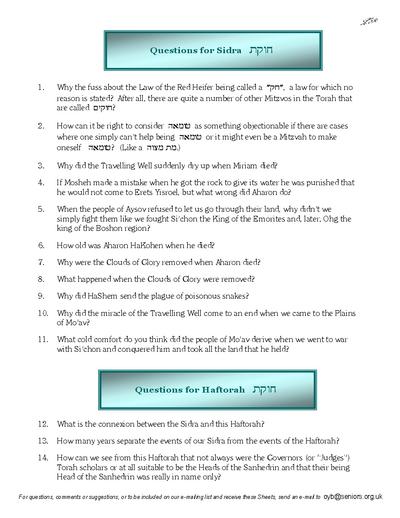
1. The Sidra begins with the Law of the Red Heifer. This Law is held up for us by the Torah as the epitome of a "חק" (a Mitzvah for which no reason is stated) and together with all the laws of Tum’oh and Taharoh it is obeyed for no other reason than because HaShem has commanded it. That’s not to say that there is no reason for this Law: on the contrary, many reasons are put forward, but the Law of the Red Heifer, more than any other, is the prime example of a Law which demands our unquestioning obedience because whatever rationale or symbolism is read into it, there always remain unresolved paradoxes which defy ordinary human logic and understanding. Ultimately, therefore, it is a command of HaShem and it is not for us to question His orders, no matter what anyone might say.
2. In common with all laws of Tum’oh and Taharoh, HaShem has commanded the Law of the Red Heifer only to us, His Chosen People. We alone are affected by the conditions of Tum’oh and Taharoh, whether the Tum’oh is brought about by things external (like coming into contact with something Tommay) or whether brought about by conditions in ourselves (that is, a condition of Tum’oh which results from the body itself).
The translation of the word “Tum’oh” commonly given as “unclean” is particularly unfortunate. “Unclean” gives the impression of physical or hygienic uncleanliness, and this is manifestly untrue. Strictly speaking, the word “Tum’oh” cannot always be taken to mean “spiritual uncleanliness” either, because this too implies blame or censure, as if the person is worthy of reproach for being “Tum’oh,” and this is obviously not always the case. (Indeed, sometimes it is a Mitzvah to make oneself Tommay.) “Tum’oh” in fact is best understood as a spiritual condition to which various laws apply and concerning which the Torah commands a special process of “Taharoh.” In the more severe kinds of Tum’oh, this Taharoh process involves the use of the ashes of the Red Heifer and the intricate laws of the preparation of these ashes make up the first section of this Sidra.
As with all the laws of the Torah of HaShem, but especially the חוקים (laws for which no reason is stated) we humans can be guided in our proper observance of them, and enjoy the resulting benefits, only by following what HaShem has decreed in His Torah and by carefully complying with the teachings of our Chachommim, of blessed memory. HaShem, in His Infinite Wisdom, is the Only One Who knows His Own Essence, and it is He Who called us into being to be His Own People, to come close to Him in holiness by living our lives in accordance with His holy Torah. In this Torah, HaShem has revealed to us which conditions will promote this, our spiritual fulfilment, and our purpose, and which will hinder it, and although no blame or criticism is implied in the condition of Tum’oh as such, nevertheless it is a condition or state which does not allow one to attain closeness to HaShem. (Obviously, one is blameless for one’s state of Tum’oh only if it results innocently or naturally. The same cannot be said about Tum’oh which is brought about by deliberate disobedience of HaShem’s law.) In any case, in His Infinite Wisdom, HaShem has ordained that the conditions of Tum’oh are to be avoided, and that we are to aspire to a condition of Taharoh.
3. Having wandered in the Wilderness for nearly forty years until all the unworthy generation had died, as HaShem had decreed [see SIDRA OF THE WEEK : שלח לך] the Jewish People now comprised only those who merited to take possession of Eretz Yisroel. At this point, Miriam, the sister of Aharon and Mosheh, died, and the miraculous Well, which had travelled with us through the Wilderness all these forty years, suddenly dried up, for it was in the merit of Miriam that HaShem provided us with water in such a supernatural way. As the spectre of death by thirst rose in their minds, the people implored Mosheh to bring forth water once again as he had done shortly after we had left Egypt. But as the people’s anxiety and impatience grew, Mosheh — with Aharon at his side — became angry with them. Thus, when the miracle of the Travelling Well was renewed (in the merit of Mosheh and Aharon) its effect was somewhat diminished: the lesson of HaShem’s Providence was not as great as it could have been. The consequences are immediate: HaShem tells Mosheh and Aharon that because of this lapse, they will not be allowed to bring the Jewish People into Eretz Yisroel.
4. We were encamped south of Eretz Yisroel and almost ready, at last, to enter the Land. Mosheh our Teacher then sent messengers to King Haddar of Edom asking him to grant us his permission to pass through his country into Eretz Yisroel. Despite our brotherly message, Edom refused to give us his permission — and threatened us with the sword if we should attempt to pass through his country — and we were obliged to turn back from the land of Edom.
5. Following the Pillar of Cloud, we again set forward on our travels, this time towards Mount Hor (possibly today’s Jebel Nebi Harun, or, according to others, Jebel Madura, or according to yet others, today’s Jebel Akkar) for it was here that HaShem commanded that Aharon shall die. Mosheh was ordered to take Aharon up Mount Hor, together with his son Elozzor who was to succeed his father as Kohen Ga’dol. And so, following the instructions of Mosheh, Aharon died there on the mountain, in the same manner as his sister Miriam, blissfully and at peace like few mortals experience. He was 123 years old.
6. With the passing of Aharon, the Clouds of Glory that surrounded our Camp were removed, for it was in the merit of Aharon that we were favoured with this special sign of HaShem’s protection. Thinking that the Jewish People would now be an easy prey, the Kenaanites of the south attacked us. In answer to our prayer, HaShem helped us and we vanquished them in battle.
7. Weary from our travels and disappointed at the hostility of our brother Edom — the Promised Land, Eretz Yisroel, seemed so near yet so far — we again succumbed to complaining against the leadership of Mosheh our Teacher. Immediately, HaShem sent His punishment in the form of monstrous venomous snakes — symbol of the vile tongue. Realizing our fault, we repented, and HaShem commanded Mosheh to make a copper snake and display it upon a high pole to the people who had been bitten so that they shall look up to heaven in prayer to HaShem to be healed. This would bring the people to realize that HaShem is the One Who heals and protects and to remember not to complain against His instructions, given through His servant Mosheh our Teacher.
8. We then set forward again (once again surrounded by the Clouds of Glory, restored to us in the merit of Mosheh) and we travelled round the land of Edom, for HaShem did not allow us to take his land, until we came to the territory of Si’chon the king of the Emorites. In the past, this land had belonged to the people of Mo’av but Si’chon had conquered Mo’av in a previous war and the land of Mo’av had passed into the possession of Si’chon. Now, here in this land (much of it designated today as the Hashemite Kingdom of Jordan) the miraculous Travelling Well was no longer needed, for we were no more in the arid Wilderness. As it merged with the streams of that region, Mosheh and the Elders, together with the Jewish People, sing the valedictory Song of the Well, praising HaShem for this miracle of water for the past forty years and indeed for all His miracles that He had wrought for us. (See the separate sheets for the translation of this poem.)
9. Mosheh again sent messengers, this time to Si’chon, asking for his permission to pass through the territory under his rule. But in reply, Si’chon — quite unprovoked — came out to do battle with us at Yahatz (possibly today’s Jalul of Khirbet el-Teim) and with the help of HaShem, we vanquished him, taking all that territory that he had previously taken from Mo’av. Thus, the territory of Mo’av (which, like that of Edom, we were not permitted by HaShem to take directly from them) now to passed into our possession. About these battles the recounters of sagas tell how the mighty Emorites, who had so decisively defeated Mo’av, were themselves conquered.
10. We were progressing up the east side of Eretz Yisroel towards Yericho when Og, the fearsome king of the Boshon region (generally taken to be today’s Golan Heights) came out with all his people to do battle with us. HaShem assured Mosheh that we need not fear him either and as a result of our victory over him, his territory too passed into our possession. Setting up our Camp in the Plains of Mo’av, across the River Yardayn opposite to Yericho, we waited for orders from HaShem.
At last, we were ready to pass into Eretz Yisroel proper, the Promised Land.
For the explanation of the Haftorah of חוקת please go to HAFTORAHS.