The Avodah System
The Shmuz | July 01, 2025
Print This Article
View Original PDF

The Avodah System

The Shmuz | December 10, 2025

There is a third system of davening that functions in a very different manner than the first two. Chazal tell us that HASHEM said to Moshe, “I will teach you something that you will need to know as the leader of this nation. There will be times when the Jewish people will be in trouble, and even their own merit and the merit of the Avos will not help them. When this happens, you are to call out the thirteen attributes of HASHEM. Say the words, ‘HASHEM, HASHEM Kel rachum v’chanun. . .’ and I will forgive their sins.”

The question is: how does this work? The Klal Yisroel didn’t change via that tefillah. They didn’t become more worthy because of it, and if it is just an issue of arousing HASHEM’s mercy, why those specific words said in that specific manner?

The answer to this is that HASHEM created certain systems of avodah that affect the world. Just as there are laws of nature and physical actions that affect the world, so too HASHEM created an upper world, and various actions affect it. In the time of the Bais HaMikdash, if a person lived through a Yom Kippur, the korbonos of that day brought him forgiveness. Even if he wasn’t attuned to what was going on, even if he wasn’t in Yersuhalayim, and even if he slept through the entire day, just the fact that he was alive while the Kohain Gadol did the avodah brought him a certain level of forgiveness for his sins.

However, there are certain rules to the system. The process is demanding and exact. Any deviation and it doesn’t work. Much like an otherwise-perfect radio can’t function if it is missing just one transistor, so too in the avodah. Any missing detail and the system doesn’t function.

This seems to be the answer to this Rashi. The Amalekim were very sophisticated in their knowledge of the upper world; they were known as baalei kishuf. They were aware of the powerful functioning of the upper world, and they did their best to interrupt the Jews’ use of that system. They tried to trick the Jews so that they would daven incorrectly and thereby negate the third system of tefillah, which might have made all the difference as to whether the tefillah worked.

Even though the Jews davened with kavannah and HASHEM knew what they meant, that tefillah would not have carried the full power because it was inaccurate and couldn’t utilize the third system of davening.

This concept is very relevant to us. While we strive to make our davening passionate and vibrant, the reality is that there will be occasions when we will find it difficult to concentrate or to feel any real emotional connection to HASHEM. It is at those times that we need to remember that Chazal used a highly defined system to create the tefillos that we say. Their effect is well beyond anything that we can imagine. While it is not the ultimate goal in davening, just mouthing the words can have a huge impact and change our destiny.
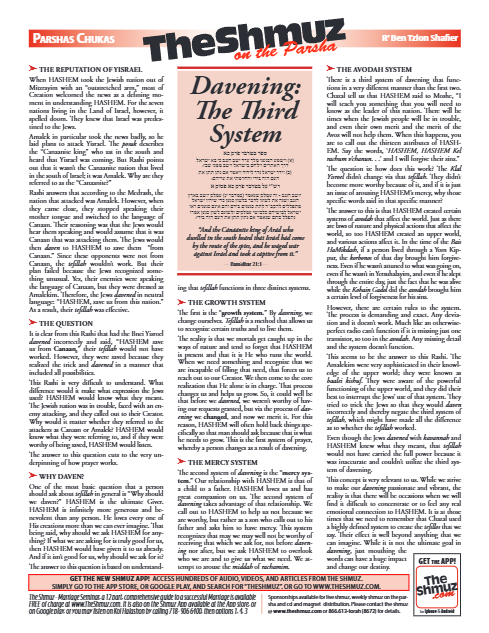

There is a third system of davening that functions in a very different manner than the first two. Chazal tell us that HASHEM said to Moshe, “I will teach you something that you will need to know as the leader of this nation. There will be times when the Jewish people will be in trouble, and even their own merit and the merit of the Avos will not help them. When this happens, you are to call out the thirteen attributes of HASHEM. Say the words, ‘HASHEM, HASHEM Kel rachum v’chanun. . .’ and I will forgive their sins.”

The question is: how does this work? The Klal Yisroel didn’t change via that tefillah. They didn’t become more worthy because of it, and if it is just an issue of arousing HASHEM’s mercy, why those specific words said in that specific manner?

The answer to this is that HASHEM created certain systems of avodah that affect the world. Just as there are laws of nature and physical actions that affect the world, so too HASHEM created an upper world, and various actions affect it. In the time of the Bais HaMikdash, if a person lived through a Yom Kippur, the korbonos of that day brought him forgiveness. Even if he wasn’t attuned to what was going on, even if he wasn’t in Yersuhalayim, and even if he slept through the entire day, just the fact that he was alive while the Kohain Gadol did the avodah brought him a certain level of forgiveness for his sins.

However, there are certain rules to the system. The process is demanding and exact. Any deviation and it doesn’t work. Much like an otherwise-perfect radio can’t function if it is missing just one transistor, so too in the avodah. Any missing detail and the system doesn’t function.

This seems to be the answer to this Rashi. The Amalekim were very sophisticated in their knowledge of the upper world; they were known as baalei kishuf. They were aware of the powerful functioning of the upper world, and they did their best to interrupt the Jews’ use of that system. They tried to trick the Jews so that they would daven incorrectly and thereby negate the third system of tefillah, which might have made all the difference as to whether the tefillah worked.

Even though the Jews davened with kavannah and HASHEM knew what they meant, that tefillah would not have carried the full power because it was inaccurate and couldn’t utilize the third system of davening.

This concept is very relevant to us. While we strive to make our davening passionate and vibrant, the reality is that there will be occasions when we will find it difficult to concentrate or to feel any real emotional connection to HASHEM. It is at those times that we need to remember that Chazal used a highly defined system to create the tefillos that we say. Their effect is well beyond anything that we can imagine. While it is not the ultimate goal in davening, just mouthing the words can have a huge impact and change our destiny.

PDF Preview