The Miracles of Arnon and the Power of Torah
Torah Papers | July 12, 2024
Print This Article
View Original PDF

The Miracles of Arnon and the Power of Torah

Torah Papers | June 25, 2025

וַתִּקְצַר נֶפֶשׁ־הָעָם בַּדָּרֶךְ – the people’s temper became short on the way. The Chizkuni explains, they grew impatient because the sun was scorching them, as the clouds of glory departed with Aharon's death. Until now, they were used to walking with air conditioning but suddenly, the clouds disappeared, the sun was beating down on them, snakes and scorpions appeared, and they had to climb and descend hills. They weren’t used to this! But what did they want from the water and the bread? They had Miriam's well, and the manna continued to fall!

One thing can be proven here. When a person isn’t satisfied with something, they start shooting in all directions! For example, when one comes home on a hot day and sees the air conditioner is broken, suddenly the whole house is one big disaster zone! "It's so hot in here! Look how dirty the windows are! The furniture is dilapidated! Even the food has no taste! I need to get out of here!” When the Ananei HaKavod disappeared, Bnei Yisrael started complaining about everything, including the water and the manna, referring to the miserable food they suddenly loathed.

The Kli Yakar and Ohr HaChaim Hakadosh write similarly, saying the people complained about the manna and water, as both were spiritual and light, and light things are good for those at rest but not for travelers. Heavier food is better for travelers because it takes longer to digest and provides sustained energy, whereas the spiritual manna digests quickly, leaving them hungry and weary. Hence, they called it miserable food.

The question arises, why did Hakadosh Baruch Hu send serpents specifically? Rashi explains: Let the serpent, which was punished for slander, come and punish those who spoke slander. Let the serpent, which enjoys the same taste in all its food, come and punish the ungrateful, who have one food changing into many tastes for them.

Let's address another point, and from there we will begin to tie up our loose ends. The Torah recounts the continuation of Bnei Yisrael’s journey:

They traveled from Ovot and camped in the wasteland passes in the wilderness, facing Moav, eastward of the sun. They traveled from there and camped in the valley of Zered. They traveled from there and camped opposite Arnon, in the wilderness, extending from the Emorite border; Arnon being the Moav border between Moav and the Emorite. Concerning this will be told in the Book of the Wars of Hashem, “He gave at the Reeds (Sea) and the valleys of Arnon. And the spillage in the valleys when it turned to dwell at Ar, and then leaned on the border of Moav. From there, to the well; this is the well of which Hashem said to Moshe, ‘Gather the people and I will give them water.’” It was then that Yisrael sang this song : “Arise, O well, sing to it!

Read through these Pesukim. Bnei Yisrael passed by the boundary of Arnon, and what happened there? Rashi explains regarding this special stop in their journey, that the miracles that took place there will be retold in the סֵפֶר מִלְחֲמֹת ה. Degel Machaneh Ephraim writes, אֶת־וָהֵב בְּסוּפָה means by way of unity in the recitation of Shema – the letters of וְאָהַבְתָּ – the love of Hakadosh Baruch Hu can be seen in סוּפָה. And where is סוּפָה? Yam Suf! What happened there? The Egyptians chased after Bnei Yisrael, the sea split, and our enemies all drowned! The Gemara (Pesachim 118b) tells us what followed:

The Jewish people of that generation, during the Exodus, were of little faith. What is the meaning of “But they were rebellious at the sea”? This teaches that the Jews rebelled against Moshe at that time, and said: Perhaps, just as we are ascending from one side of the sea, so too the Egyptians are ascending from the other side, and we will not be saved.

Hakadosh Baruch Hu said to the ministering angel of the sea: Spew out the dead Egyptians onto dry land, but the sea said before Him: Master of the Universe, is there a servant whose master gives him a gift and then takes it from him? Since the dead Egyptians were given to me for my fish to eat, how can G-d retract His gift? He said to the sea: I will give you one and a half times their number. Although I am taking them back now, I will give you one and a half times as many people. The sea said: Ribbono Shel Olam, can a servant issue a claim against his master for a gift promised to him? Who will be my guarantor? Hakadosh Baruch Hu replied: The Kishon River will be My guarantor. Immediately, the sea spewed out the Egyptians onto the land, and the Jewish people came and saw that they were dead.

Chazal say, the Egyptians died only on the seashore and not in the sea, as each Egyptian received what he deserved. Had they died in the sea, they would not have been recognizable, as a dead person changes color. Hakadosh Baruch Hu wanted each and every member of Bnei Yisrael to see the Egyptian who beat him and who took his child. The Midrash says (Yalkut Shimoni, Beshalach 240), each member of Bnei Yisrael took his dog and placed his foot on the neck of an Egyptian and said to the dog, “Eat from this hand that enslaved me, eat from these limbs that did not have mercy on me.” Bnei Yisrael then said, “You performed all these miracles for us, we too will not be ungrateful. What do we have to say? Songs and praises.” They then proceeded to sing: אָז יָשִׁיר־מֹשֶׁה וּבְנֵי יִשְׂרָאֵל.

Hakadosh Baruch Hu prepared the splitting of Yam Suf during Creation, and the miracles that took place there also took place at the valleys of Arnon. Rashi explains:

As the mountains were high, the valley deep and narrow, and the mountains so close to one another that a man could stand upon the mountain on one side and speak to his fellow on the other mountain, and the road passed through the valley, the Amorites said: When the Israelites are about to enter the land by passing through the valley we will come out of the mountain caves above them and will kill them by arrows and stone missiles. Now those caves were in the mountains on the Moabite side, and on the mountain that was on the Amorite side there were, opposite those caves, projections like horns and breasts jutting out. When Israel were on the point of passing, the mountain that was located in the land of Israel was set in tremor as a handmaid that goes forth to receive her mistress, and moved nearer to the mountain of Moab, and these pointed projections penetrated into the caves and killed the Amorites who were hidden in them.

The Gemara speaks of crossing these streams (Berachot 54a):

One who sees the crossings of the Red Sea; and the crossings of the Jordan; and the crossings of the streams of Arnon; the hailstones of Elgavish on the descent of Beit Ḥoron; the rock that Og, King of Bashan, sought to hurl upon Israel; and the rock upon which Moshe sat when Yehoshua waged war against Amalek; and Lot’s wife; and the wall of Yericho that was swallowed up in its place. On all of these miracles one must give thanks and offer praise before G-d.

The Gemara (Berachot 54b) then brings an interesting point. Unlike the Midrash quoted by Rashi, which states the mountains converged and killed all the Amorites, the Gemara offers a different version of what occurred: There were two lepers in Sufa, Et and Hev – אֶת ו'הֵב – who were walking at the rear of the camp of Bnei Yisrael. As the nation approached, the Emorites prepared caves for themselves to hide in, planning to attack and kill Bnei Yisrael as they passed. But they did not know that the Aron preceded Bnei Yisrael and would flatten mountains before them. When the Aron came, the mountains adhered one to another and crushed all inside, with their blood flowing down to the streams of Arnon. When Et and Hev reached the scene after Bnei Yisrael crossed, they saw the blood emerging from between the mountains, and ran to tell the rest of Bnei Yisrael what had happened. Bnei Yisrael were completely unaware of it as they passed through and responded with a song of praise.

Just as the miracles of Yam Suf are recounted, so too should the great miracles of the valleys of Arnon be recounted. Just as Bnei Yisrael sang a song at Yam Suf, they sang a song at the valleys of Arnon. The following question can be asked, however. If Bnei Yisrael had the clouds of glory that leveled the path for them, why didn't they level these mountains before the people arrived? Why were the above miracles – whether initiated by a tremor or the Aron – needed?

The Ohr HaChaim explains that the particular cloud (from the multiple Ananei HaKavod) that leveled the path for Bnei Yisrael and killed the snakes did not return after Aharon's passing. The cloud that directed their journeys remained absent during these final journeys and they instead traveled by Moshe's instructions: עַתָּה קֻמוּ וְעִבְרוּ לָכֶם אֶת־נַחַל זָרֶד – Now rise up and get you over the stream of Zered.”

Let’s return to the miracles of the mountains coming together to crush the Amorites prior to Bnei Yisrael crossing Nachalei Arnon. Who revealed to them the great miracle that occurred? Chazal say, it was none other than the בְּאֵר – the well! How did the well do so? According to Rashi, Hakadosh Baruch Hu asked, “Who will inform My children of these miracles?” The parable says: You gave bread to a child, inform his mother. After they passed through the valley, the mountains returned to their place, and the בְּאֵר descended into the valley, bringing up the blood and limbs of the slain, carrying them around the camp for all to see. The well brought up all the bodies! Suddenly, Bnei Yisrael saw the bodies and exclaimed, "It is unbelievable how Hakadosh Baruch Hu protects us!" This is what we recite in Hallel: וֹיִם שַׁבְּחוּהוּ כָּל הַלְלוּ אֶת ה' כָּל גהָ אֻמִּים – Praise the Lord, all nations! Extol Him, all people! And why issue this praise? כִּי גָבַר עָלֵינוּ חַסְדּוֹ – For His lovingkindness has prevailed over us. The leaders of all the nations praise Hakadosh Baruch Hu: וֹיִם שַׁבְּחוּהוּ כָּל הָאֻמִּים הַלְלוּ אֶת ה' כָּל ג – and only they can praise Him in such a way, because only they appreciate just how many times they attempt, but fail to, destroy Am Yisrael! כִּי גָבַר עָלֵינוּ חַסְדּוֹ – we don’t see the vast majority of these plans, nor how Hakadosh Baruch Hu quashes them, but the nations themselves sure do! But it is us who should be offering praise to Hakadosh Baruch Hu, not them! Upon seeing this miracle at Nachalei Arnon, Bnei Yisrael understood the what took place ahead of their arrival and the kindness shown to them. The בְּאֵר that disappeared with Miriam's passing is the same well that revealed the kindness and caring of Hakadosh Baruch Hu at Arnon!

In whose merit did this miracle occur? The Alsheich HaKadosh provides a profound insight. Hakadosh Baruch Hu wanted to reveal to Bnei Yisrael a fundamental principle: "In a few months, you will enter into Eretz Yisrael, where there will be no more clouds of glory. There will be nothing tangible to protect you from enemies, heat, or rain. What will protect you there is one thing alone – the Torah!" Even when Moshe Rabbeinu is not present, Aharon HaKohen is not present, and Miriam is not present – the Torah will protect you!

The Alsheich expands on this idea, saying that through what happened with Moav and the Amorites, via well and the Aron, עַל־כֵּן יֵאָמַר בְּסֵפֶר מִלְחֲמֹת ה' – it becomes apparent that wars are conducted by Hakadosh Baruch Hu through the Torah. The Aron led and executed this war, causing the mountains to crush the Amorites over a span of seven miles. By engaging in Torah, wars are made for Bnei Yisrael. And why was the בְּאֵר specifically the one to reveal this miracle? The answer is simple. The well symbolizes the Torah, and the word בְּאֵר appears in the Torah 48 times, corresponding to the 48 ways Torah is acquired (Kinyanei Torah).

Because of the Aron wars are made, but it would not have been revealed except by the בְּאֵר that brought up the blood and limbs and revealed the Aron’s actions to Bnei Yisrael. Therefore, עַל־כֵּן יֵאָמַר בְּסֵפֶר – it is said in the Book, i.e., the written Torah; מִלְחֲמֹת ה' – wars of Hashem, i.e., the Oral Torah. Do not think that the Oral Torah is something outside the written Torah and disconnected. Know that in the Book – i.e., the written Torah – all the Oral Torah is found. Except it is sealed and only through the “wars of the Lord” – i.e., the debates of the Gemara – the truth is revealed. The written Torah cannot reveal its interpretations except through the Oral Torah and the principles by which the Torah is expounded.

Let's see how true this is. We recite in Hallel:

What alarmed you, O sea, that you fled; Yardan, that you ran backward; mountains, that you skipped like rams; hills, like sheep? Tremble, O earth, at the presence of the Lord, at the presence of the G-d of Yaacov.

Chazal explain (Bereishit Rabbah 5:5) that Hakadosh Baruch Hu made a condition with the sea that it would split before Bnei Yisrael when necessary. The Midrash (Shemot Rabbah 21:6) also says that Moshe Rabbeinu challenged being commanded to reach out and split the sea, citing several verses that imply the sea has a perpetual boundary and would never split or dry out. He asked how the sea could split if Hakadosh Baruch Hu Himself said it would never do so! Hakadosh Baruch Hu reminded him that the sea was set up to split in such a way from the very beginning of Creation. Moshe proceeded, but the sea initially resisted splitting, claiming seniority over Moshe, as it was created on the third day whereas man was only created three days later. Hakadosh Baruch Hu intervened by placing His hand over Moshe's, causing the sea to split.

The Ohr HaChaim raises a wonderful question regarding this condition of the sea, noting the sea's resistance despite the condition – or stipulation – placed upon it during Creation. He compares this to the story of a body of water being split found in the Gemara (Chullin 7a). Rabbi Pinchas ben Yair was on a mission to redeem captives. He came across the Ginai River and said to it: "Ginai, split your waters for me so that I can cross." The river replied: "You are going to perform the will of your Creator, and I am also doing the will of my Creator by flowing. Furthermore, even if I split, you are uncertain if you will succeed in redeeming the captives, while I am certainly doing the will of my Creator by continuing to flow. Therefore, it is not appropriate for me to split for you!" Rabbi Pinchas said to the river: "If you do not split, I will decree that no water will ever flow through you again." The river then split for him. There was a man with Rabbi Pinchas who was carrying wheat for Pesach matzah, and Rabbi Pinchas said to the river: "Split for him as well, for he is engaged in a mitzvah." The river split for the wheat carrier as well. Next in line, there was an Arab merchant accompanying them. Rabbi Pinchas said to the river: "Split for him too, so that he does not say, 'Is this how they treat those who accompany them – they just leave them behind?' This would be a Chilul Hashem." The river split for the Arab merchant as well.

The Ohr HaChaim asks a strong question on the challenge of Moshe Rabbeinu regarding the sea never drying out or splitting. Chazal derived the word לְאֵיתָנוֹ that a condition was placed upon it during Creation. This word is found in the Pasuk describing Moshe holding his arm out over the sea in the morning and having it return to its normal state after Bnei Yisrael had passed through: וַיָּשָׁב הַיָּם לְאֵיתָנוֹ לִפְנוֹת בֹּקֶר. The word לְאֵיתָנוֹ, they say, points to לִתְנָאוֹ הָרִאשׁוֹן – to its original condition. But it is difficult to understand this learning, as the condition should have been mentioned at the time of the sea actually splitting, and not hours later when it was about to return to its usual state. Perhaps the Pasuk informs us that after it returned, it became known that it was a condition set by Hakadosh Baruch Hu and not a sudden decree of its destruction or the arrival of its end to cease existing. Although the condition was known, seeing the wonder that the water dried up and became dry land, and even the standing water became stone walls, the people might have believed it had reached its end as well. When it returned to its original state, they recognized it was the original condition being applied.

The question of the Ohr HaChaim requires the need to understand the nature of the condition or stipulation placed on the sea. If it was for Bnei Yisrael, then why did the sea initially resist? Moreover, we see that it split against its will for individuals, as in the case of Rabbi Pinchas ben Yair, so if it was conditioned only for Bnei Yisrael, what power did Rabbi Pinchas have to override the laws of Creation and have it split again? The Ohr HaChaim answers that the condition was part of the stipulations that Hakadosh Baruch Hu set for all of Creation to be subservient to the Torah and those who labor in it; and to do all these holy individuals decree upon them. Therefore, we find that righteous individuals have at times ruled over the heavens, earth, stars, sun, and moon. It was not only for Bnei Yisrael but for all who adhere to the Torah. Hence, we see that it split for Rabbi Pinchas ben Yair and those accompanying him, for the sea feared him.

Rav Yechezkel Abramsky says (Chazon Yechezkel), as soon as some of the Kohanim’s feet were dipped in the Jordan River, the waters stood still, demonstrating to us the power of the Torah. Observe the difference between the splitting of Yam Suf and the drying up of the Yarden for Bnei Yisrael to cross. At Yam Suf, it split only after Nachshon ben Aminadav jumped into the sea and said: הוֹשִׁיעֵנִי אֱ-לֹהִים כִּי בָאוּ מַיִם עַד נָפֶשׁ – Save me, O G-d, for the waters have come up to my soul. But at the Yarden, it was enough for the Kohanim carrying the Aron to dip their feet in the water for the river to dry up. Before receiving the Torah and saying נַעֲשֶׂה וְנִשְׁמָע, they had no other merit for the sea to split but the merit of self-sacrifice for Hakadosh Baruch Hu’s word: דַּבֵּר אֶל־בְּנֵי־יִשְׂרָאֵל וְיִסָּעוּ. And with the power of faith in this command, Nachshon jumped into the sea, and Hakadosh Baruch Hu split it. But when they came to the Yarden, they already had the great merit of Har Sinai and receiving the Torah. Therefore, as soon as the Kohanim carrying the Aron dipped their feet in the waters, the waters moved away, and the Kohanim stood on dry land in the middle of the river until all of Bnei Yisrael had crossed.

Rav Yerachmiel Kram z"l, in V'Talmudo B'yado, provides a wonderful insight. ַרְדֵּן יִסֹּב לְאָחוֹר הַיָּם רָאָה וַיָּנֹס – Why did the sea witness and flee, and why did the Yarden turn back? The reason is: מִלִּפְנֵי אֱלוֹהַּ יַעֲקֹב. But why the division between two phenomenon and two causes? The reason is very simple.

הַיָּם רָאָה וַיָּנֹס – מִלִּפְנֵי אָדוֹן חוּלִי אָרֶץ. ַרְדֵּן יִסֹּב לְאָחוֹר – מִלִּפְנֵי אֱלוֹהַּ יַעֲקֹב. The sea witnessed and fled at the presence of Hakadosh Baruch Hu, whereas the Yarden turned back at the presence of the G-d of Yaacov. At Yam Suf, before the Torah was given, the sea fled from the Master of all the earth – Hakadosh Baruch Hu. But why did the Yarden turn back? It was on account of the presence of the G-d of Yaacov, because the Kohanim came with the Aron on their shoulders and touched the water with their feet. Why is it specifically Yaacov that reflects the Kohanim with the Aron? Because Yaacov symbolizes the holy Torah, as it is said: תִּתֵּן אֱמֶת לְיַעֲקֹב.

We learn that what protected us throughout all generations and what protects us today is the holy Torah. The holy Torah, which we strive to explain every detail and every point. The Torah says in this week's Parsha: זֹאת הַתּוֹרָה אָדָם כִּי יָמוּת בְּאֹהֶל – This is the law; When a person dies in a tent. The Gemara asks (Berachot 63b), how do we know that the words of Torah endure only in one who kills himself for it – i.e., through total...
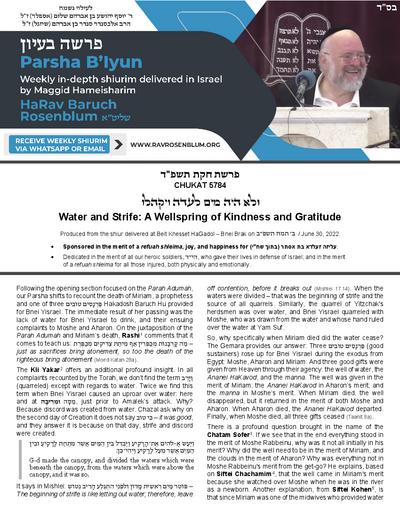

וַתִּקְצַר נֶפֶשׁ־הָעָם בַּדָּרֶךְ – the people’s temper became short on the way. The Chizkuni explains, they grew impatient because the sun was scorching them, as the clouds of glory departed with Aharon's death. Until now, they were used to walking with air conditioning but suddenly, the clouds disappeared, the sun was beating down on them, snakes and scorpions appeared, and they had to climb and descend hills. They weren’t used to this! But what did they want from the water and the bread? They had Miriam's well, and the manna continued to fall!

One thing can be proven here. When a person isn’t satisfied with something, they start shooting in all directions! For example, when one comes home on a hot day and sees the air conditioner is broken, suddenly the whole house is one big disaster zone! "It's so hot in here! Look how dirty the windows are! The furniture is dilapidated! Even the food has no taste! I need to get out of here!” When the Ananei HaKavod disappeared, Bnei Yisrael started complaining about everything, including the water and the manna, referring to the miserable food they suddenly loathed.

The Kli Yakar and Ohr HaChaim Hakadosh write similarly, saying the people complained about the manna and water, as both were spiritual and light, and light things are good for those at rest but not for travelers. Heavier food is better for travelers because it takes longer to digest and provides sustained energy, whereas the spiritual manna digests quickly, leaving them hungry and weary. Hence, they called it miserable food.

The question arises, why did Hakadosh Baruch Hu send serpents specifically? Rashi explains: Let the serpent, which was punished for slander, come and punish those who spoke slander. Let the serpent, which enjoys the same taste in all its food, come and punish the ungrateful, who have one food changing into many tastes for them.

Let's address another point, and from there we will begin to tie up our loose ends. The Torah recounts the continuation of Bnei Yisrael’s journey:

They traveled from Ovot and camped in the wasteland passes in the wilderness, facing Moav, eastward of the sun. They traveled from there and camped in the valley of Zered. They traveled from there and camped opposite Arnon, in the wilderness, extending from the Emorite border; Arnon being the Moav border between Moav and the Emorite. Concerning this will be told in the Book of the Wars of Hashem, “He gave at the Reeds (Sea) and the valleys of Arnon. And the spillage in the valleys when it turned to dwell at Ar, and then leaned on the border of Moav. From there, to the well; this is the well of which Hashem said to Moshe, ‘Gather the people and I will give them water.’” It was then that Yisrael sang this song : “Arise, O well, sing to it!

Read through these Pesukim. Bnei Yisrael passed by the boundary of Arnon, and what happened there? Rashi explains regarding this special stop in their journey, that the miracles that took place there will be retold in the סֵפֶר מִלְחֲמֹת ה. Degel Machaneh Ephraim writes, אֶת־וָהֵב בְּסוּפָה means by way of unity in the recitation of Shema – the letters of וְאָהַבְתָּ – the love of Hakadosh Baruch Hu can be seen in סוּפָה. And where is סוּפָה? Yam Suf! What happened there? The Egyptians chased after Bnei Yisrael, the sea split, and our enemies all drowned! The Gemara (Pesachim 118b) tells us what followed:

The Jewish people of that generation, during the Exodus, were of little faith. What is the meaning of “But they were rebellious at the sea”? This teaches that the Jews rebelled against Moshe at that time, and said: Perhaps, just as we are ascending from one side of the sea, so too the Egyptians are ascending from the other side, and we will not be saved.

Hakadosh Baruch Hu said to the ministering angel of the sea: Spew out the dead Egyptians onto dry land, but the sea said before Him: Master of the Universe, is there a servant whose master gives him a gift and then takes it from him? Since the dead Egyptians were given to me for my fish to eat, how can G-d retract His gift? He said to the sea: I will give you one and a half times their number. Although I am taking them back now, I will give you one and a half times as many people. The sea said: Ribbono Shel Olam, can a servant issue a claim against his master for a gift promised to him? Who will be my guarantor? Hakadosh Baruch Hu replied: The Kishon River will be My guarantor. Immediately, the sea spewed out the Egyptians onto the land, and the Jewish people came and saw that they were dead.

Chazal say, the Egyptians died only on the seashore and not in the sea, as each Egyptian received what he deserved. Had they died in the sea, they would not have been recognizable, as a dead person changes color. Hakadosh Baruch Hu wanted each and every member of Bnei Yisrael to see the Egyptian who beat him and who took his child. The Midrash says (Yalkut Shimoni, Beshalach 240), each member of Bnei Yisrael took his dog and placed his foot on the neck of an Egyptian and said to the dog, “Eat from this hand that enslaved me, eat from these limbs that did not have mercy on me.” Bnei Yisrael then said, “You performed all these miracles for us, we too will not be ungrateful. What do we have to say? Songs and praises.” They then proceeded to sing: אָז יָשִׁיר־מֹשֶׁה וּבְנֵי יִשְׂרָאֵל.

Hakadosh Baruch Hu prepared the splitting of Yam Suf during Creation, and the miracles that took place there also took place at the valleys of Arnon. Rashi explains:

As the mountains were high, the valley deep and narrow, and the mountains so close to one another that a man could stand upon the mountain on one side and speak to his fellow on the other mountain, and the road passed through the valley, the Amorites said: When the Israelites are about to enter the land by passing through the valley we will come out of the mountain caves above them and will kill them by arrows and stone missiles. Now those caves were in the mountains on the Moabite side, and on the mountain that was on the Amorite side there were, opposite those caves, projections like horns and breasts jutting out. When Israel were on the point of passing, the mountain that was located in the land of Israel was set in tremor as a handmaid that goes forth to receive her mistress, and moved nearer to the mountain of Moab, and these pointed projections penetrated into the caves and killed the Amorites who were hidden in them.

The Gemara speaks of crossing these streams (Berachot 54a):

One who sees the crossings of the Red Sea; and the crossings of the Jordan; and the crossings of the streams of Arnon; the hailstones of Elgavish on the descent of Beit Ḥoron; the rock that Og, King of Bashan, sought to hurl upon Israel; and the rock upon which Moshe sat when Yehoshua waged war against Amalek; and Lot’s wife; and the wall of Yericho that was swallowed up in its place. On all of these miracles one must give thanks and offer praise before G-d.

The Gemara (Berachot 54b) then brings an interesting point. Unlike the Midrash quoted by Rashi, which states the mountains converged and killed all the Amorites, the Gemara offers a different version of what occurred: There were two lepers in Sufa, Et and Hev – אֶת ו'הֵב – who were walking at the rear of the camp of Bnei Yisrael. As the nation approached, the Emorites prepared caves for themselves to hide in, planning to attack and kill Bnei Yisrael as they passed. But they did not know that the Aron preceded Bnei Yisrael and would flatten mountains before them. When the Aron came, the mountains adhered one to another and crushed all inside, with their blood flowing down to the streams of Arnon. When Et and Hev reached the scene after Bnei Yisrael crossed, they saw the blood emerging from between the mountains, and ran to tell the rest of Bnei Yisrael what had happened. Bnei Yisrael were completely unaware of it as they passed through and responded with a song of praise.

Just as the miracles of Yam Suf are recounted, so too should the great miracles of the valleys of Arnon be recounted. Just as Bnei Yisrael sang a song at Yam Suf, they sang a song at the valleys of Arnon. The following question can be asked, however. If Bnei Yisrael had the clouds of glory that leveled the path for them, why didn't they level these mountains before the people arrived? Why were the above miracles – whether initiated by a tremor or the Aron – needed?

The Ohr HaChaim explains that the particular cloud (from the multiple Ananei HaKavod) that leveled the path for Bnei Yisrael and killed the snakes did not return after Aharon's passing. The cloud that directed their journeys remained absent during these final journeys and they instead traveled by Moshe's instructions: עַתָּה קֻמוּ וְעִבְרוּ לָכֶם אֶת־נַחַל זָרֶד – Now rise up and get you over the stream of Zered.”

Let’s return to the miracles of the mountains coming together to crush the Amorites prior to Bnei Yisrael crossing Nachalei Arnon. Who revealed to them the great miracle that occurred? Chazal say, it was none other than the בְּאֵר – the well! How did the well do so? According to Rashi, Hakadosh Baruch Hu asked, “Who will inform My children of these miracles?” The parable says: You gave bread to a child, inform his mother. After they passed through the valley, the mountains returned to their place, and the בְּאֵר descended into the valley, bringing up the blood and limbs of the slain, carrying them around the camp for all to see. The well brought up all the bodies! Suddenly, Bnei Yisrael saw the bodies and exclaimed, "It is unbelievable how Hakadosh Baruch Hu protects us!" This is what we recite in Hallel: וֹיִם שַׁבְּחוּהוּ כָּל הַלְלוּ אֶת ה' כָּל גהָ אֻמִּים – Praise the Lord, all nations! Extol Him, all people! And why issue this praise? כִּי גָבַר עָלֵינוּ חַסְדּוֹ – For His lovingkindness has prevailed over us. The leaders of all the nations praise Hakadosh Baruch Hu: וֹיִם שַׁבְּחוּהוּ כָּל הָאֻמִּים הַלְלוּ אֶת ה' כָּל ג – and only they can praise Him in such a way, because only they appreciate just how many times they attempt, but fail to, destroy Am Yisrael! כִּי גָבַר עָלֵינוּ חַסְדּוֹ – we don’t see the vast majority of these plans, nor how Hakadosh Baruch Hu quashes them, but the nations themselves sure do! But it is us who should be offering praise to Hakadosh Baruch Hu, not them! Upon seeing this miracle at Nachalei Arnon, Bnei Yisrael understood the what took place ahead of their arrival and the kindness shown to them. The בְּאֵר that disappeared with Miriam's passing is the same well that revealed the kindness and caring of Hakadosh Baruch Hu at Arnon!

In whose merit did this miracle occur? The Alsheich HaKadosh provides a profound insight. Hakadosh Baruch Hu wanted to reveal to Bnei Yisrael a fundamental principle: "In a few months, you will enter into Eretz Yisrael, where there will be no more clouds of glory. There will be nothing tangible to protect you from enemies, heat, or rain. What will protect you there is one thing alone – the Torah!" Even when Moshe Rabbeinu is not present, Aharon HaKohen is not present, and Miriam is not present – the Torah will protect you!

The Alsheich expands on this idea, saying that through what happened with Moav and the Amorites, via well and the Aron, עַל־כֵּן יֵאָמַר בְּסֵפֶר מִלְחֲמֹת ה' – it becomes apparent that wars are conducted by Hakadosh Baruch Hu through the Torah. The Aron led and executed this war, causing the mountains to crush the Amorites over a span of seven miles. By engaging in Torah, wars are made for Bnei Yisrael. And why was the בְּאֵר specifically the one to reveal this miracle? The answer is simple. The well symbolizes the Torah, and the word בְּאֵר appears in the Torah 48 times, corresponding to the 48 ways Torah is acquired (Kinyanei Torah).

Because of the Aron wars are made, but it would not have been revealed except by the בְּאֵר that brought up the blood and limbs and revealed the Aron’s actions to Bnei Yisrael. Therefore, עַל־כֵּן יֵאָמַר בְּסֵפֶר – it is said in the Book, i.e., the written Torah; מִלְחֲמֹת ה' – wars of Hashem, i.e., the Oral Torah. Do not think that the Oral Torah is something outside the written Torah and disconnected. Know that in the Book – i.e., the written Torah – all the Oral Torah is found. Except it is sealed and only through the “wars of the Lord” – i.e., the debates of the Gemara – the truth is revealed. The written Torah cannot reveal its interpretations except through the Oral Torah and the principles by which the Torah is expounded.

Let's see how true this is. We recite in Hallel:

What alarmed you, O sea, that you fled; Yardan, that you ran backward; mountains, that you skipped like rams; hills, like sheep? Tremble, O earth, at the presence of the Lord, at the presence of the G-d of Yaacov.

Chazal explain (Bereishit Rabbah 5:5) that Hakadosh Baruch Hu made a condition with the sea that it would split before Bnei Yisrael when necessary. The Midrash (Shemot Rabbah 21:6) also says that Moshe Rabbeinu challenged being commanded to reach out and split the sea, citing several verses that imply the sea has a perpetual boundary and would never split or dry out. He asked how the sea could split if Hakadosh Baruch Hu Himself said it would never do so! Hakadosh Baruch Hu reminded him that the sea was set up to split in such a way from the very beginning of Creation. Moshe proceeded, but the sea initially resisted splitting, claiming seniority over Moshe, as it was created on the third day whereas man was only created three days later. Hakadosh Baruch Hu intervened by placing His hand over Moshe's, causing the sea to split.

The Ohr HaChaim raises a wonderful question regarding this condition of the sea, noting the sea's resistance despite the condition – or stipulation – placed upon it during Creation. He compares this to the story of a body of water being split found in the Gemara (Chullin 7a). Rabbi Pinchas ben Yair was on a mission to redeem captives. He came across the Ginai River and said to it: "Ginai, split your waters for me so that I can cross." The river replied: "You are going to perform the will of your Creator, and I am also doing the will of my Creator by flowing. Furthermore, even if I split, you are uncertain if you will succeed in redeeming the captives, while I am certainly doing the will of my Creator by continuing to flow. Therefore, it is not appropriate for me to split for you!" Rabbi Pinchas said to the river: "If you do not split, I will decree that no water will ever flow through you again." The river then split for him. There was a man with Rabbi Pinchas who was carrying wheat for Pesach matzah, and Rabbi Pinchas said to the river: "Split for him as well, for he is engaged in a mitzvah." The river split for the wheat carrier as well. Next in line, there was an Arab merchant accompanying them. Rabbi Pinchas said to the river: "Split for him too, so that he does not say, 'Is this how they treat those who accompany them – they just leave them behind?' This would be a Chilul Hashem." The river split for the Arab merchant as well.

The Ohr HaChaim asks a strong question on the challenge of Moshe Rabbeinu regarding the sea never drying out or splitting. Chazal derived the word לְאֵיתָנוֹ that a condition was placed upon it during Creation. This word is found in the Pasuk describing Moshe holding his arm out over the sea in the morning and having it return to its normal state after Bnei Yisrael had passed through: וַיָּשָׁב הַיָּם לְאֵיתָנוֹ לִפְנוֹת בֹּקֶר. The word לְאֵיתָנוֹ, they say, points to לִתְנָאוֹ הָרִאשׁוֹן – to its original condition. But it is difficult to understand this learning, as the condition should have been mentioned at the time of the sea actually splitting, and not hours later when it was about to return to its usual state. Perhaps the Pasuk informs us that after it returned, it became known that it was a condition set by Hakadosh Baruch Hu and not a sudden decree of its destruction or the arrival of its end to cease existing. Although the condition was known, seeing the wonder that the water dried up and became dry land, and even the standing water became stone walls, the people might have believed it had reached its end as well. When it returned to its original state, they recognized it was the original condition being applied.

The question of the Ohr HaChaim requires the need to understand the nature of the condition or stipulation placed on the sea. If it was for Bnei Yisrael, then why did the sea initially resist? Moreover, we see that it split against its will for individuals, as in the case of Rabbi Pinchas ben Yair, so if it was conditioned only for Bnei Yisrael, what power did Rabbi Pinchas have to override the laws of Creation and have it split again? The Ohr HaChaim answers that the condition was part of the stipulations that Hakadosh Baruch Hu set for all of Creation to be subservient to the Torah and those who labor in it; and to do all these holy individuals decree upon them. Therefore, we find that righteous individuals have at times ruled over the heavens, earth, stars, sun, and moon. It was not only for Bnei Yisrael but for all who adhere to the Torah. Hence, we see that it split for Rabbi Pinchas ben Yair and those accompanying him, for the sea feared him.

Rav Yechezkel Abramsky says (Chazon Yechezkel), as soon as some of the Kohanim’s feet were dipped in the Jordan River, the waters stood still, demonstrating to us the power of the Torah. Observe the difference between the splitting of Yam Suf and the drying up of the Yarden for Bnei Yisrael to cross. At Yam Suf, it split only after Nachshon ben Aminadav jumped into the sea and said: הוֹשִׁיעֵנִי אֱ-לֹהִים כִּי בָאוּ מַיִם עַד נָפֶשׁ – Save me, O G-d, for the waters have come up to my soul. But at the Yarden, it was enough for the Kohanim carrying the Aron to dip their feet in the water for the river to dry up. Before receiving the Torah and saying נַעֲשֶׂה וְנִשְׁמָע, they had no other merit for the sea to split but the merit of self-sacrifice for Hakadosh Baruch Hu’s word: דַּבֵּר אֶל־בְּנֵי־יִשְׂרָאֵל וְיִסָּעוּ. And with the power of faith in this command, Nachshon jumped into the sea, and Hakadosh Baruch Hu split it. But when they came to the Yarden, they already had the great merit of Har Sinai and receiving the Torah. Therefore, as soon as the Kohanim carrying the Aron dipped their feet in the waters, the waters moved away, and the Kohanim stood on dry land in the middle of the river until all of Bnei Yisrael had crossed.

Rav Yerachmiel Kram z"l, in V'Talmudo B'yado, provides a wonderful insight. ַרְדֵּן יִסֹּב לְאָחוֹר הַיָּם רָאָה וַיָּנֹס – Why did the sea witness and flee, and why did the Yarden turn back? The reason is: מִלִּפְנֵי אֱלוֹהַּ יַעֲקֹב. But why the division between two phenomenon and two causes? The reason is very simple.

הַיָּם רָאָה וַיָּנֹס – מִלִּפְנֵי אָדוֹן חוּלִי אָרֶץ. ַרְדֵּן יִסֹּב לְאָחוֹר – מִלִּפְנֵי אֱלוֹהַּ יַעֲקֹב. The sea witnessed and fled at the presence of Hakadosh Baruch Hu, whereas the Yarden turned back at the presence of the G-d of Yaacov. At Yam Suf, before the Torah was given, the sea fled from the Master of all the earth – Hakadosh Baruch Hu. But why did the Yarden turn back? It was on account of the presence of the G-d of Yaacov, because the Kohanim came with the Aron on their shoulders and touched the water with their feet. Why is it specifically Yaacov that reflects the Kohanim with the Aron? Because Yaacov symbolizes the holy Torah, as it is said: תִּתֵּן אֱמֶת לְיַעֲקֹב.

We learn that what protected us throughout all generations and what protects us today is the holy Torah. The holy Torah, which we strive to explain every detail and every point. The Torah says in this week's Parsha: זֹאת הַתּוֹרָה אָדָם כִּי יָמוּת בְּאֹהֶל – This is the law; When a person dies in a tent. The Gemara asks (Berachot 63b), how do we know that the words of Torah endure only in one who kills himself for it – i.e., through total...

PDF Preview