Meshivas Nefesh Lessons 1-2
The Rebbe's Pharmacy | July 15, 2026
Print This Article
View Original PDF

Meshivas Nefesh Lessons 1-2

The Rebbe's Pharmacy | July 12, 2026

Sometimes a person is already at the gates of kedushah, but then he goes back, because the sitra achra strengthens against him and the yetzer hara intensifies greatly, not allowing him to enter through the door. As a result, the person becomes discouraged and completely gives up, G-d forbid. This is the nature of the yetzer hara and the sitra achra: when they see that a person is very close to the gates of kedushah and is about to enter, they spread over him with incredible force, may Hashem help us.

Therefore, a person needs great power to stand firm and not leave his place—not to pay attention to the falls, descents, and confusion he experiences, but rather to strengthen himself against them and do whatever he can in avodas Hashem. Then, after a while, he will surely enter safely into the gates of kedushah with Hashem’s help, for Hashem is full of compassion and He greatly desires our avodah.

You must know that all the movements that a person makes to detach himself a little bit from his physicality and serve Hashem, they all gather together and come to his aid in times of need—meaning, when he’s under pressure or at a time of distress, G-d forbid.

You must also know that there is a tree that grows leaves, and each leaf requires a hundred years to develop. Surely, during these hundred years, that leaf goes through whatever it goes through. But at the end of the hundred years, it shoots out with a great noise like a gun, and the analogy is understood on its own.

A person must strengthen himself in avodas Hashem in every way possible—no matter his situation—and rely on Hashem’s immense and immeasurable compassion. Certainly, Hashem will not abandon him even if he has sinned in the past. The past is gone, and the main thing is from now on not to repeat previous actions. Rather, he should hold himself back, both in action and in thought, since even thoughts are considered actions, for even in the world of action, there is thought.

Therefore, a person should refrain from any unwanted action or thought, and he shouldn’t worry or pay attention to what happens to him involuntarily. You must know that it is necessary to face all the challenges mentioned above, because this is the essence of complete teshuvah: when a person goes through the same places and stages that he was in previously, and now he turns away from them, subduing his yetzer hara not to repeat past deeds or thoughts, as mentioned above. This is the essence of complete teshuvah.

(Based on Likutei Mohoran II, 48)
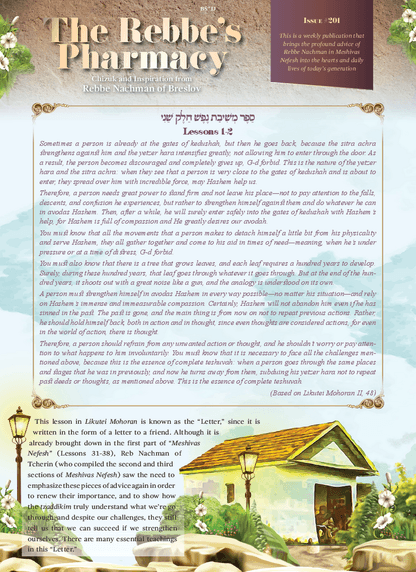
Sometimes a person is already at the gates of kedushah, but then he goes back, because the sitra achra strengthens against him and the yetzer hara intensifies greatly, not allowing him to enter through the door. As a result, the person becomes discouraged and completely gives up, G-d forbid. This is the nature of the yetzer hara and the sitra achra: when they see that a person is very close to the gates of kedushah and is about to enter, they spread over him with incredible force, may Hashem help us.

Therefore, a person needs great power to stand firm and not leave his place—not to pay attention to the falls, descents, and confusion he experiences, but rather to strengthen himself against them and do whatever he can in avodas Hashem. Then, after a while, he will surely enter safely into the gates of kedushah with Hashem’s help, for Hashem is full of compassion and He greatly desires our avodah.

You must know that all the movements that a person makes to detach himself a little bit from his physicality and serve Hashem, they all gather together and come to his aid in times of need—meaning, when he’s under pressure or at a time of distress, G-d forbid.

You must also know that there is a tree that grows leaves, and each leaf requires a hundred years to develop. Surely, during these hundred years, that leaf goes through whatever it goes through. But at the end of the hundred years, it shoots out with a great noise like a gun, and the analogy is understood on its own.

A person must strengthen himself in avodas Hashem in every way possible—no matter his situation—and rely on Hashem’s immense and immeasurable compassion. Certainly, Hashem will not abandon him even if he has sinned in the past. The past is gone, and the main thing is from now on not to repeat previous actions. Rather, he should hold himself back, both in action and in thought, since even thoughts are considered actions, for even in the world of action, there is thought.

Therefore, a person should refrain from any unwanted action or thought, and he shouldn’t worry or pay attention to what happens to him involuntarily. You must know that it is necessary to face all the challenges mentioned above, because this is the essence of complete teshuvah: when a person goes through the same places and stages that he was in previously, and now he turns away from them, subduing his yetzer hara not to repeat past deeds or thoughts, as mentioned above. This is the essence of complete teshuvah.

(Based on Likutei Mohoran II, 48)

PDF Preview