Shabbat Chazon and Tisha B'Av
The Jewish Weekly | July 17, 2026
Print This Article
View Original PDF

Shabbat Chazon and Tisha B'Av

The Jewish Weekly | July 12, 2026

The Shabbat before Tisha B'Av is referred to as Shabbat Chazon, when we read the Haftorah called, "The Vision of Yeshayahu". It is said that, on this Shabbat, every Jew is given a vision of the Third Bet HaMikdash, the Third Temple. This glimpse of the Third Bet HaMikdash causes us to long for it and the complete redemption.

Our Sages explain that on Tisha B'Av Moshiach is born. According to the Arizal, this takes place on the afternoon of Tisha B'Av. This does not refer to his actual birth, because Moshiach will not be an infant when he redeems our people, but to a strengthening of his influence.

For our Sages refer to a birthday as a day when mazalo gover, "the spiritual source of one's soul shines powerfully." On the day when Moshiach's spiritual source is powerfully revealed, there is a unique potential for the Redemption to come.

Always Awaiting Moshiach

The grandchild of the tzaddik Rabbi Levi Yitzchak of Berditchev was engaged to marry the grandchild of the Alter Rebbe (at the great wedding of Zhlobin).

When Rabbi Levi Yitzchak was shown the invitation indicating that the wedding would take place in Zhlobin, he tore it up and instructed that this be changed to: "The wedding, if it be G-d's will, will take place in the holy city of Jerusalem and in the Bet HaMikdash, may it be speedily rebuilt. If however, Moshiach will, G-d forbid, not yet be here, then the wedding will take place in Zhlobin."

At the time of the destruction of the Bet HaMikdash, our forefather Yitzchak asked Hashem, "perhaps the Jews will never merit returning." Hashem answered that there will come a generation that will await the geulah (redemption), and they will immediately be redeemed. Our Sages say that even if this is the only merit we will have, we are worthy of being redeemed.

This is the meaning of the words in the 15th blessing of the Amida prayer, "because we hope for your salvation all day." Before these words, at the beginning of this blessing, we ask Hashem to speedily send us Moshiach. And to the possible argument that we are undeserving, we say, "because we hope for your salvation all day," implying that as a reward for awaiting Moshiach, we deserve to be redeemed.

Everyone's Responsibility

Rabbi Mordechai Yaffeh (the Levush) writes that he had always wondered why Eicha, read in shul on Tishah B'Av, is not read from a megilla of parchment like Megillat Ester. He explains that since we are constantly waiting for these days to be transformed into days of joy and holidays, if we would write the megillah on parchment, it would give the impression that we are, G-d forbid, giving up hope.

The Rebbe emphasized that since today we have "passed all the deadlines," [for Moshiach's coming] it is now the responsibility of every individual, including children, to bring the redemption. Since every Jew has within him a spark of Moshiach, he can bring the redemption through his Torah and mitzvot. Just one action, speech or thought, can tip the scale and bring salvation for the entire world.

reprinted from The Weekly Farbrengen by Merkaz Anash, on-line at TheWeeklyFarbrengen.com
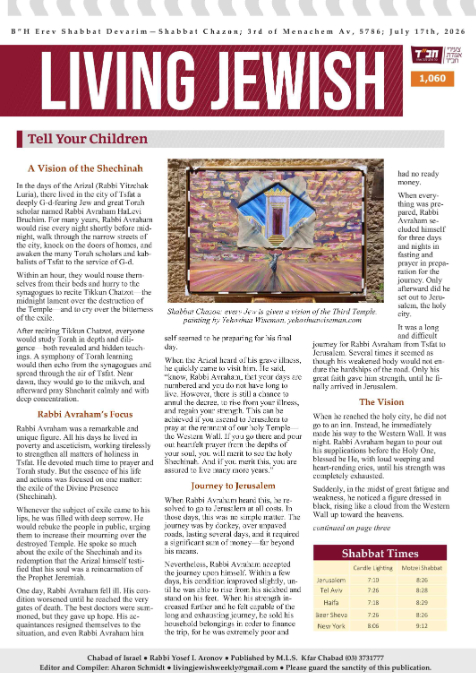
The Shabbat before Tisha B'Av is referred to as Shabbat Chazon, when we read the Haftorah called, "The Vision of Yeshayahu". It is said that, on this Shabbat, every Jew is given a vision of the Third Bet HaMikdash, the Third Temple. This glimpse of the Third Bet HaMikdash causes us to long for it and the complete redemption.

Our Sages explain that on Tisha B'Av Moshiach is born. According to the Arizal, this takes place on the afternoon of Tisha B'Av. This does not refer to his actual birth, because Moshiach will not be an infant when he redeems our people, but to a strengthening of his influence.

For our Sages refer to a birthday as a day when mazalo gover, "the spiritual source of one's soul shines powerfully." On the day when Moshiach's spiritual source is powerfully revealed, there is a unique potential for the Redemption to come.

Always Awaiting Moshiach

The grandchild of the tzaddik Rabbi Levi Yitzchak of Berditchev was engaged to marry the grandchild of the Alter Rebbe (at the great wedding of Zhlobin).

When Rabbi Levi Yitzchak was shown the invitation indicating that the wedding would take place in Zhlobin, he tore it up and instructed that this be changed to: "The wedding, if it be G-d's will, will take place in the holy city of Jerusalem and in the Bet HaMikdash, may it be speedily rebuilt. If however, Moshiach will, G-d forbid, not yet be here, then the wedding will take place in Zhlobin."

At the time of the destruction of the Bet HaMikdash, our forefather Yitzchak asked Hashem, "perhaps the Jews will never merit returning." Hashem answered that there will come a generation that will await the geulah (redemption), and they will immediately be redeemed. Our Sages say that even if this is the only merit we will have, we are worthy of being redeemed.

This is the meaning of the words in the 15th blessing of the Amida prayer, "because we hope for your salvation all day." Before these words, at the beginning of this blessing, we ask Hashem to speedily send us Moshiach. And to the possible argument that we are undeserving, we say, "because we hope for your salvation all day," implying that as a reward for awaiting Moshiach, we deserve to be redeemed.

Everyone's Responsibility

Rabbi Mordechai Yaffeh (the Levush) writes that he had always wondered why Eicha, read in shul on Tishah B'Av, is not read from a megilla of parchment like Megillat Ester. He explains that since we are constantly waiting for these days to be transformed into days of joy and holidays, if we would write the megillah on parchment, it would give the impression that we are, G-d forbid, giving up hope.

The Rebbe emphasized that since today we have "passed all the deadlines," [for Moshiach's coming] it is now the responsibility of every individual, including children, to bring the redemption. Since every Jew has within him a spark of Moshiach, he can bring the redemption through his Torah and mitzvot. Just one action, speech or thought, can tip the scale and bring salvation for the entire world.

reprinted from The Weekly Farbrengen by Merkaz Anash, on-line at TheWeeklyFarbrengen.com

PDF Preview