The Sin of the Spies and Moshes Perspective
Print This Article
View Original PDF

The Sin of the Spies and Moshes Perspective

Facebuker Shabbos Table Talk | December 31, 2025

The sin of the spies who frightened the Jewish People, and the Jews’ response, was the catalyst for the tragedies that took place on Tisha B’Av and all the suffering we’ve gone through during our long and often bitter exile. And yet, when Moshe heard the original request, he thought it was a good idea to send them. What was it about the plan that Moshe appreciated?

In a sense, it seemed that the Jews were excited to go into Eretz Yisrael, and they wanted scouts to go first so they could find the best and fastest way to conquer it. They wanted to know which paths were the straightest, and which cities might be a good place for them to settle the women and children as the men pressed on to capture the land. This is why they wanted spies; not to see if it was a good land, but to identify the ideal way of inheriting it.

Alas, the spies came back with a negative report, which undermined the desire of the people to conquer it. They didn’t explain how to conquer it, but instead argued it was unconquerable. The Jews listened to these arguments and began lamenting that they’d come to such a place where they would be unable to settle.

Moshe was wise and astute. Why did he not anticipate such a potential response? Especially since he knew Hashem wasn’t commanding that spies be sent and had only acquiesced to let Moshe send them on his own recognizance, how could the plan had gained favor in Moshe’s eyes?

The answer lies in Moshe’s recounting of the events. What swayed him was the people’s desire for, “which path shall we ascend upon?” This phrase is reminiscent of what Yisro told Moshe, “you shall let them know the path in which they should go,” (Shmos 18:20) which described Moshe teaching Klal Yisrael the Torah and how to live.

In his mind, the Jews were asking to be guided; to be given leaders to show them how to apply the laws of Hashem to their own lives. This was a great thing. However, when the spies came back, and they denigrated the land, they were not doing what Moshe expected them to. Worse, the Jewish People were unable to discern this, even though the negative spies were contradicted by Yehoshua and Kaleiv, so there was another way to see things.

They should have been able to identify the right approach and listened to those who promoted the position of Hashem, who would guide them in fulfilling His will. Instead, they chose to listen to the Satan and his minyan, bringing calamity upon millions of people throughout history.

The Haftorah of Shabbos Chazon this week ends with the promise that Hashem will restore our judges and advisors like in the beginning (when we listened to Moshe) and then we will reclaim our status as trusted followers of Hashem.
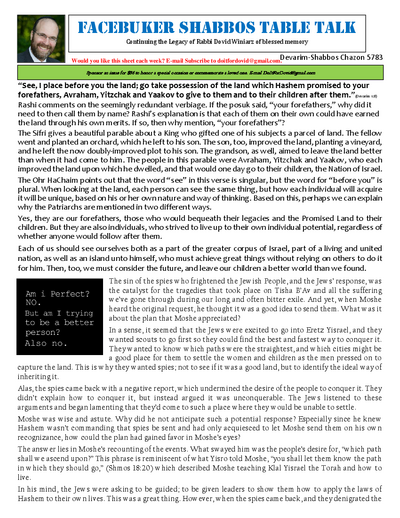

The sin of the spies who frightened the Jewish People, and the Jews’ response, was the catalyst for the tragedies that took place on Tisha B’Av and all the suffering we’ve gone through during our long and often bitter exile. And yet, when Moshe heard the original request, he thought it was a good idea to send them. What was it about the plan that Moshe appreciated?

In a sense, it seemed that the Jews were excited to go into Eretz Yisrael, and they wanted scouts to go first so they could find the best and fastest way to conquer it. They wanted to know which paths were the straightest, and which cities might be a good place for them to settle the women and children as the men pressed on to capture the land. This is why they wanted spies; not to see if it was a good land, but to identify the ideal way of inheriting it.

Alas, the spies came back with a negative report, which undermined the desire of the people to conquer it. They didn’t explain how to conquer it, but instead argued it was unconquerable. The Jews listened to these arguments and began lamenting that they’d come to such a place where they would be unable to settle.

Moshe was wise and astute. Why did he not anticipate such a potential response? Especially since he knew Hashem wasn’t commanding that spies be sent and had only acquiesced to let Moshe send them on his own recognizance, how could the plan had gained favor in Moshe’s eyes?

The answer lies in Moshe’s recounting of the events. What swayed him was the people’s desire for, “which path shall we ascend upon?” This phrase is reminiscent of what Yisro told Moshe, “you shall let them know the path in which they should go,” (Shmos 18:20) which described Moshe teaching Klal Yisrael the Torah and how to live.

In his mind, the Jews were asking to be guided; to be given leaders to show them how to apply the laws of Hashem to their own lives. This was a great thing. However, when the spies came back, and they denigrated the land, they were not doing what Moshe expected them to. Worse, the Jewish People were unable to discern this, even though the negative spies were contradicted by Yehoshua and Kaleiv, so there was another way to see things.

They should have been able to identify the right approach and listened to those who promoted the position of Hashem, who would guide them in fulfilling His will. Instead, they chose to listen to the Satan and his minyan, bringing calamity upon millions of people throughout history.

The Haftorah of Shabbos Chazon this week ends with the promise that Hashem will restore our judges and advisors like in the beginning (when we listened to Moshe) and then we will reclaim our status as trusted followers of Hashem.

PDF Preview