What Should Be Done with a Stone That Falls from the Kosel HaMaravi
למודי משה | July 15, 2026
Print This Article
View Original PDF

What Should Be Done with a Stone That Falls from the Kosel HaMaravi

למודי משה | August 04, 2024

Being that during the upcoming week we will be keeping the Mo’ed of Tisha B’Av, and if Moshiach doesn’t come we will have a day when we focus on the Churban Beis HaMikdash, I would like to discuss a shailah which is related to the closest thing we have today which resembles the Beis HaMikdash, and that is the “Kosel HaMaravi”.

Being Careful to Call the “Kosel HaMaravi”, “Kosel HaMaravi”, and Not Simply “Kosel”

The Maharil Diskin was very particular to refer to the “Kosel HaMaravi” as “Kosel HaMaravi” and not merely “Kosel”.

The Gemara in Shabbos (32a) teaches: R’ Yishmoel ben Elozor taught, due to two sins amei ha’aretz [ignoramuses] die: 1) על שקורין לארון הקודש ארנא Because – they refer to the Aron HaKodesh as “Aron”; 2) ועל שקורין בית הכנסת עם בית – Because they refer to a Beis HaKnesses, simply as a place of a public gathering (Rashi explains: It is a disgrace to refer to a Beis HaKnesses simply as a place where people gather).

We see from this Gemara that if one doesn’t designate a special name for the Aron HaKodesh, and one simply refers to it as an “Aron”, it is considered disgraceful. The Maharil Diskin understood that the same thing applies to the Kosel HaMaravi and it is considered disgraceful to refer to it simply as a “Kosel” [A Wall], therefore, one should give it a special name, and refer to it as “Kosel HaMaravi”. (Testimony from R’ Shmuel Yudelevitz, cited in the sefer, Meiloi Shel Shmuel, pg. 290)

To answer the minhag ha’oilam [widespread custom not to care about this] some suggest the following: We find in Chazal that they refer to the Beis HaMikdash as “Bayis” [House], and a Sefer Torah as “Sefer” and they weren’t worried about the disgrace. Perhaps, if everyone calls something a certain way it is not considered disgraceful to do so. However, if generally speaking something is referred to in an honorable manner, such as “Aron HaKodesh”, and then someone comes along and calls it simply “Aron”, then we consider it to be disgraceful. Perhaps we can answer that during the times of the Maharil Diskin everyone referred to the “Kosel HaMaravi” as “Kosel HaMaravi”, and if someone came along and shortened it and referred to it as just “Kosel”, they were acting disgracefully. However, nowadays when most people refer to it as simply “The Kosel”, perhaps it is no longer considered a disgrace (Igros U’Reshimos HaKoheles Ya’akov, Vol. 3, pg. 304). However, tzorich iyun if this is what was bothering the Maharil Diskin, and if he would agree that today the situation is different.

Perhaps we can also add: Nowadays people refer to the “Kosel HaMaravi” as “The Kosel” and not just “Kosel” and perhaps referring to it as “The Kosel” is considered giving it importance, and is better than simply saying “Kosel” which means “wall”.

The Incident

On Monday of Parshas Va’eschanan, the 11th of Av 5778, a piece of stone broke free from the eighteenth row of the Kosel HaMaravi and fell into the southern plaza known as “Ezras Yisrael.” According to experts the stone was from a row of stones that was built during the time of the Second Beis HaMikdash, during the Herodian era.

Over the years, many small pieces of stone have fallen from the Kosel HaMaravi, however, this was the first time (that we are aware of) that a large stone exceeding 400 kilograms broke free from the Kosel HaMaravi. The impact caused a crack in the floor below. Miraculously the incident didn’t cause any harm, and although there was a charedi woman standing very close by, nothing happened to her.

At the time this event raised a number of interesting halachic shailos: What should be done with the stone? Does this stone carry inherent kedushah? Does it require geniza? Must it be returned to its place? If it needs to be replaced, must it be done by a Jew, or may a non-Jew also return it? These shailos were taken in front of the gedolei Yisrael. Iy’H below we will try and discuss these shailos and bring what the poskim had to say about it at the time.
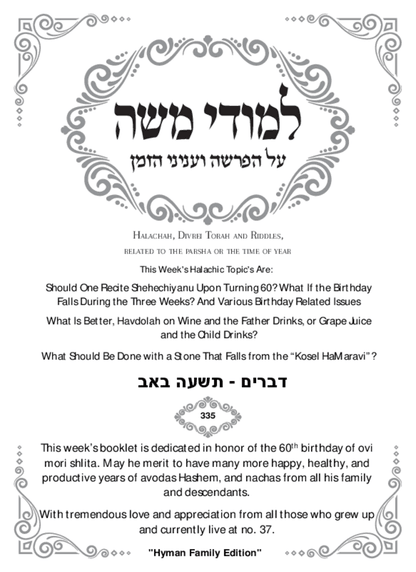
Being that during the upcoming week we will be keeping the Mo’ed of Tisha B’Av, and if Moshiach doesn’t come we will have a day when we focus on the Churban Beis HaMikdash, I would like to discuss a shailah which is related to the closest thing we have today which resembles the Beis HaMikdash, and that is the “Kosel HaMaravi”.

Being Careful to Call the “Kosel HaMaravi”, “Kosel HaMaravi”, and Not Simply “Kosel”

The Maharil Diskin was very particular to refer to the “Kosel HaMaravi” as “Kosel HaMaravi” and not merely “Kosel”.

The Gemara in Shabbos (32a) teaches: R’ Yishmoel ben Elozor taught, due to two sins amei ha’aretz [ignoramuses] die: 1) על שקורין לארון הקודש ארנא Because – they refer to the Aron HaKodesh as “Aron”; 2) ועל שקורין בית הכנסת עם בית – Because they refer to a Beis HaKnesses, simply as a place of a public gathering (Rashi explains: It is a disgrace to refer to a Beis HaKnesses simply as a place where people gather).

We see from this Gemara that if one doesn’t designate a special name for the Aron HaKodesh, and one simply refers to it as an “Aron”, it is considered disgraceful. The Maharil Diskin understood that the same thing applies to the Kosel HaMaravi and it is considered disgraceful to refer to it simply as a “Kosel” [A Wall], therefore, one should give it a special name, and refer to it as “Kosel HaMaravi”. (Testimony from R’ Shmuel Yudelevitz, cited in the sefer, Meiloi Shel Shmuel, pg. 290)

To answer the minhag ha’oilam [widespread custom not to care about this] some suggest the following: We find in Chazal that they refer to the Beis HaMikdash as “Bayis” [House], and a Sefer Torah as “Sefer” and they weren’t worried about the disgrace. Perhaps, if everyone calls something a certain way it is not considered disgraceful to do so. However, if generally speaking something is referred to in an honorable manner, such as “Aron HaKodesh”, and then someone comes along and calls it simply “Aron”, then we consider it to be disgraceful. Perhaps we can answer that during the times of the Maharil Diskin everyone referred to the “Kosel HaMaravi” as “Kosel HaMaravi”, and if someone came along and shortened it and referred to it as just “Kosel”, they were acting disgracefully. However, nowadays when most people refer to it as simply “The Kosel”, perhaps it is no longer considered a disgrace (Igros U’Reshimos HaKoheles Ya’akov, Vol. 3, pg. 304). However, tzorich iyun if this is what was bothering the Maharil Diskin, and if he would agree that today the situation is different.

Perhaps we can also add: Nowadays people refer to the “Kosel HaMaravi” as “The Kosel” and not just “Kosel” and perhaps referring to it as “The Kosel” is considered giving it importance, and is better than simply saying “Kosel” which means “wall”.

The Incident

On Monday of Parshas Va’eschanan, the 11th of Av 5778, a piece of stone broke free from the eighteenth row of the Kosel HaMaravi and fell into the southern plaza known as “Ezras Yisrael.” According to experts the stone was from a row of stones that was built during the time of the Second Beis HaMikdash, during the Herodian era.

Over the years, many small pieces of stone have fallen from the Kosel HaMaravi, however, this was the first time (that we are aware of) that a large stone exceeding 400 kilograms broke free from the Kosel HaMaravi. The impact caused a crack in the floor below. Miraculously the incident didn’t cause any harm, and although there was a charedi woman standing very close by, nothing happened to her.

At the time this event raised a number of interesting halachic shailos: What should be done with the stone? Does this stone carry inherent kedushah? Does it require geniza? Must it be returned to its place? If it needs to be replaced, must it be done by a Jew, or may a non-Jew also return it? These shailos were taken in front of the gedolei Yisrael. Iy’H below we will try and discuss these shailos and bring what the poskim had to say about it at the time.

PDF Preview