Likkutei Sichos ABSTRACT
Ben Chamesh L'Mikra | August 21, 2024
Parshas Ekev
- Being proud of one’s Judaism: A Jew hastens the end of exile, filling one’s service with vitality (warmth). Wandering through the vast desert is comparable to the current exile; the spiritual desert results from thinking about the secular world as big and important, while being cold to Torah and Mitzvos. (Chelek 2, Bamidbar Hagadol 8:15)
- Our physical desires limit us; our spiritual desires liberate us: Physical desires could not be satisfied by Mahn, which cultivated an inner appetite for spirituality after which can fulfill the physical & the spiritual. (Chelek 4, Lo Al Halachem Levado Yichyeh 8:3)
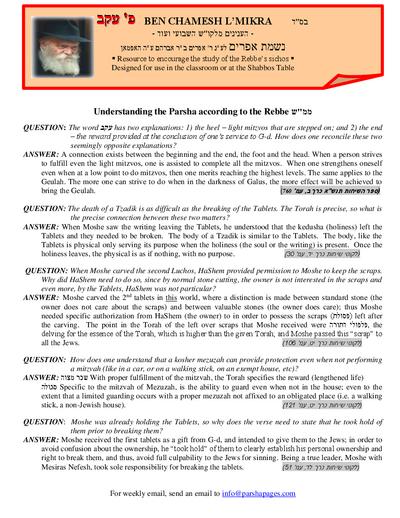
- When one fulfills Torah & Mitzvos with bitul that permeates, then it becomes enjoyment: Connection between two explanations of ՐԲ (trampled with a heel and ‘heel of Moshiach’). Preceding Moshiach, we should do Mitzvos with Kabalos Ol. (Chelek 9a, Ekev 7:12)
- Our avodah in Galus reaches to the Essence and thus we will receive comfort direct from HaShem: Parsha V’eschanan (the first paragraph of Shema) reflects life in Eretz Yisrael (revealed light ראיה). Parshas Ekev (the second paragraph of Shema) reflects life in Galus (hidden light שמיעה). (Chelek 9b, Uvechol Levavcha 11:13)
Comparison of Parshiyos and Shema
Avodahמלמעלה למטה (Top-down)מלמטה למעלה (Bottom-up)FunctionalIn Eretz Yisrael (ראיה - Sight)In Galus (שמיעה - Hearing)Haftorahנחמו נחמו (Comfort through Prophets)ציון עזבני (Comfort direct from HaShem)Shema Paragraph1st Paragraph2nd ParagraphScopeIncludes בכל מאודךDoes not include בכל מאודכםSequenceTorah then Mitzvos (ושננתם ... וקשרתם)Mitzvos then Torah (וקשרתם ... למדתם)ThemeCommands (Kabalos Ol)Reward & PunishmentWarningאזהרה ליחיד (Individual)אזהרה לציבור (Public)- The death of a Tzadik is as difficult as the breaking of the Tablets: The writing on the Tablets (the body), is nothing without the kedusha (the soul); thus, when the kedusha left the Tablets, nothing (significant) remained and Moshe could break them. So too with a Tzadik for the life of a Tzadik is not a physical life but a spiritual life. (Chelek 14a, 20 Menachem Av)
- We do not have the ability to create, except as HaShem’s agents to conquer the world: A woman is required to make the blessings on Torah, since her Torah study has independent value, a proper method for her to serve HaShem. (Chelek 14b, Ulimadetem Otam 11:19)
- When we transcend our self-imposed order, equally fervent in our performance of all commandments, then G-d too foregoes the "order" of natural events and abundantly provides us: Some recognize that all mitzvos are to be performed, no matter how inconsequential they may seem; yet they prioritize the order of their performance, delaying the performance of some mitzvos so that they are treated lightly - they cast their performance of these mitzvos "under their heels". Moshiach will come in the merit of the deeds which are performed in the last moments of exile. (Chelek 19a, Ekev 7:12)
- HaShem also gave to Moshe the ‘scraps’ of the Torah: פלפול, exuding effort into the essence of the Torah, which is higher than the given Torah; and Moshe passed this “scrap” to all the Jews. Moshe carved the 2nd tablets in this world, where a distinction is made between standard stone and valuable stones; thus Moshe needed specific authorization from HaShem to possess the scraps (פסולת) left after the carving. (Chelek 19c, Pesol Lecha 10:1)
- When doing Mitzvos one should strive to go beyond one’s limit: The blessing of rain is according to the needs of the land, which functions within nature; when we do beyond what is incumbent upon us, then G-d does likewise, providing unlimited blessing. (Chelek 19d, V’nasati Matar 11:14)
- The Mezuzah campaign involves the utmost effort to place a kosher mezuzah on the door of every Jewish home: With proper fulfillment of the mitzvah (מצוה שכר), the Torah specifies the reward (lengthened life). Specific to the mitzvah of Mezuzah (סגולה), is the ability to guard even when not in the house; even to the extent that a limited guarding occurs with a proper mezuzah not affixed to an obligated place (i.e. a walking stick, a non-Jewish house). (Chelek 19e, Mezuzos 11:20)
- Everything in the world belongs to HaShem and we need to make a blessing prior to benefiting: In Seder Birchas HaNehenim, the goal of the Alter Rebbe is to teach clear behavior in practical action. However, the goal of the Alter Rebbe in his Shulchan Aruch is to gather all the decisions of the Halacha. (Chelek 24a, Uverachta 8:10)
- Teshuva is the exception where one is allowed to bribe HaShem: G-d does not show favor, nor does He take a bribe (לא ישא). Rambam explains it refers to Shomer Mitzvos; Rashi explains it refers to an unrepentant sinner. Rashi negates the concept that an unrepentant sinner can benefit by giving one’s money in lieu of giving of one’s self. Rambam explains that one Mitzvah does not neutralize a sin. Teshuvah is the item in which one can bribe G-d; in the first moment of doing basic Teshuvah, G-d accepts this ‘bribe’ and forgives completely. (Chelek 24b & 32b, Lo Yisa 10:17)
- Unique spelling expresses the Divine quality of the Tablets: Moshe’s rebuke includes the loss of the Tablets; Rashi explains that the word written with missing letters (לחת and not לוחות) expresses the merit of the Tablets, that were miraculous writings from the fingers of G-d. (Chelek 29a, Luchos 9:11)
- Mezuzah brings to one an awareness of HaShem “outside”: In addition to the mitzvah itself, the mezuzah inherently produces a remembrance of G-d’s love when passing through the doorway; this arousal occurs even when not in “use” (not like Tefillin and Tzitzis). (Chelek 29b, Mezuzos 11:20)
- Being a true leader, Moshe with Mesiras Nefesh, took sole responsibility for breaking the tablets: Moshe received the first tablets as a gift from G-d; he “took hold” of the tables to clearly establish his personal ownership and right to break them, with the purpose of making atonement for the Jews. (Chelek 31a, Va’etpos Bishnei Haluchos 9:17)
- One should pray only with כובד ראש: פועל: the person prepares oneself properly before G-d; פעולה: the manner of how one prays (words, body, bowing); נפעל: to be acceptable to G-d, with proper intent. (Chelek 32c)
View The Full Article (PDF)