Bein Hazmanim in Halachah
Limuday Moshe | August 03, 2023
Print This Article
View Original PDF

Bein Hazmanim in Halachah

Limuday Moshe | December 31, 2025

One of the many wonderful things about being Jewish, is that every step of the way we are guided about how to conduct ourselves, and each and every special occasion has its own set of halachos. Bein hazmanim [summer vacation] is no different, and it comes with some unique halachos. This week I would like to take the opportunity to discuss some interesting halachos that come up primarily during bein hazmanim.

Going Away to a Place Without a Minyan

During bein hazmanim many people take the opportunity to go away, and some people even go to places where there is no minyan, and they end up missing tefillah b’tzibbur [praying with a quorum of ten people], as well as krias haTorah on Monday and Thursday. The Mishnah Berurah (90:29) rules, that if one is in a situation that if he davens in a minyan he will suffer a monetary loss, he may daven by himself at home. However, if one won’t suffer a monetary loss, however, he will cause himself not to gain (menias revech) he shouldn’t refrain from davening with a minyan. As there is a big difference from positively losing, and not from simply not gaining.

Based on the above, it would seem that going on vacation isn’t considered a monetary loss, and therefore, one should have to ensure that he goes to a place where there will be a minyan. However, R’ Shlomah Zalman Auerbach (Halichos Shlomah, Vol. 1, 5:4) rules, that if one needs the vacation for health reasons, parnosah [sustenance] or for a mitzvah purpose then one is allowed. However, one has to be honest with himself and know if he is actually going for one of the above reasons, or if he simply fancies a nice vacation.

The Shu”t Shevet HaLevi (6:21) writes, it’s obvious that if one travels for a pleasurable vacation to a place where there is no minyan, and he misses out on davening with a minyan, and misses out on kaddish, kedusha, borchu etc. he has committed an aveirah [sin]. The Shevet HaLevi then adds, that one can’t argue that the obligation to daven with a minyan is only in a place where there is one, as one is forbidden to put himself into a situation where he will be exempt from a mitzvah.

Some want to bring a proof, that even in a place where there is no minyan, there is still a chiyuv to daven b’tzibbur [with a minyan], as if not, how could R’ Eliezer free his slave Tovi to make up the minyan. If one frees his slave he transgresses an issur, so how could R’ Eliezer do it? It must be that there was a mitzvah to daven b’tzibbur. However, the Shevet HaLevi refutes such an argument, as the halachah is that if one is traveling he must go up to four mil (see Shulchan Aruch 109:15) to find a minyan, therefore, by Tovi as well, since there was a solution to free him, R’ Eliezer was obligated to. However, if one is in a place where there is no minyan, then there may in fact be no chiyuv for him to daven b’tzibbur.

Travelling Before Shacharis

When one sets out on his travels early in the morning, one must be careful not to set out before davening (see Shulchan Aruch 89:3). The Mishnah Berurah (s.k. 20) adds, that the above applies even if one will be able to daven before sof zman tefillah [final time for praying] with a tzibbur [congregation] after he arrives. The reason being, one isn’t supposed to take care of his own needs before davening, and traveling is considered taking care of one’s own needs. However, if one is travelling for a mitzvah purpose (see Mishnah Berurah 90:53) one is allowed. Nonetheless, even if one is travelling for a mitzvah purpose, he should make sure to recite birchas hashachar first (see Mishnah Berurah 90:53).

Based on the above, if one wants to travel to Yerusholayim to daven Shacharis by the Kosel HaMarovi, he may travel before davening, as it is considered a mitzvah, however, he should make sure to recite birchas hashachar before setting out.
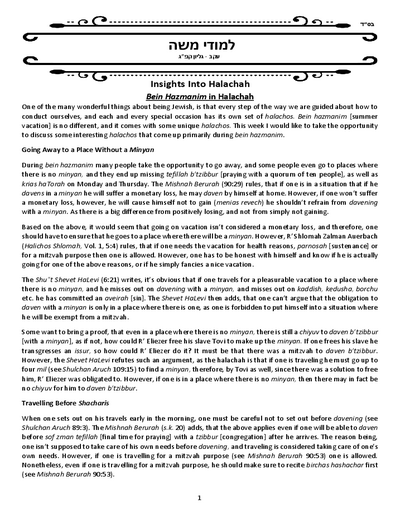
One of the many wonderful things about being Jewish, is that every step of the way we are guided about how to conduct ourselves, and each and every special occasion has its own set of halachos. Bein hazmanim [summer vacation] is no different, and it comes with some unique halachos. This week I would like to take the opportunity to discuss some interesting halachos that come up primarily during bein hazmanim.

Going Away to a Place Without a Minyan

During bein hazmanim many people take the opportunity to go away, and some people even go to places where there is no minyan, and they end up missing tefillah b’tzibbur [praying with a quorum of ten people], as well as krias haTorah on Monday and Thursday. The Mishnah Berurah (90:29) rules, that if one is in a situation that if he davens in a minyan he will suffer a monetary loss, he may daven by himself at home. However, if one won’t suffer a monetary loss, however, he will cause himself not to gain (menias revech) he shouldn’t refrain from davening with a minyan. As there is a big difference from positively losing, and not from simply not gaining.

Based on the above, it would seem that going on vacation isn’t considered a monetary loss, and therefore, one should have to ensure that he goes to a place where there will be a minyan. However, R’ Shlomah Zalman Auerbach (Halichos Shlomah, Vol. 1, 5:4) rules, that if one needs the vacation for health reasons, parnosah [sustenance] or for a mitzvah purpose then one is allowed. However, one has to be honest with himself and know if he is actually going for one of the above reasons, or if he simply fancies a nice vacation.

The Shu”t Shevet HaLevi (6:21) writes, it’s obvious that if one travels for a pleasurable vacation to a place where there is no minyan, and he misses out on davening with a minyan, and misses out on kaddish, kedusha, borchu etc. he has committed an aveirah [sin]. The Shevet HaLevi then adds, that one can’t argue that the obligation to daven with a minyan is only in a place where there is one, as one is forbidden to put himself into a situation where he will be exempt from a mitzvah.

Some want to bring a proof, that even in a place where there is no minyan, there is still a chiyuv to daven b’tzibbur [with a minyan], as if not, how could R’ Eliezer free his slave Tovi to make up the minyan. If one frees his slave he transgresses an issur, so how could R’ Eliezer do it? It must be that there was a mitzvah to daven b’tzibbur. However, the Shevet HaLevi refutes such an argument, as the halachah is that if one is traveling he must go up to four mil (see Shulchan Aruch 109:15) to find a minyan, therefore, by Tovi as well, since there was a solution to free him, R’ Eliezer was obligated to. However, if one is in a place where there is no minyan, then there may in fact be no chiyuv for him to daven b’tzibbur.

Travelling Before Shacharis

When one sets out on his travels early in the morning, one must be careful not to set out before davening (see Shulchan Aruch 89:3). The Mishnah Berurah (s.k. 20) adds, that the above applies even if one will be able to daven before sof zman tefillah [final time for praying] with a tzibbur [congregation] after he arrives. The reason being, one isn’t supposed to take care of his own needs before davening, and traveling is considered taking care of one’s own needs. However, if one is travelling for a mitzvah purpose (see Mishnah Berurah 90:53) one is allowed. Nonetheless, even if one is travelling for a mitzvah purpose, he should make sure to recite birchas hashachar first (see Mishnah Berurah 90:53).

Based on the above, if one wants to travel to Yerusholayim to daven Shacharis by the Kosel HaMarovi, he may travel before davening, as it is considered a mitzvah, however, he should make sure to recite birchas hashachar before setting out.

PDF Preview