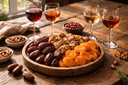
The Seven Special Species
דברים ח, ח אֶרֶץ חִטָּה וּשְׂ עֹרָּה וְׂגֶפֶן וּתְׂאֵנָּה וְׂרִ מּוֹן אֶרֶץ-זֵית שֶמֶן וּדְׂ בָּש :
מסכת ברכות דף מא/א
דא"ר חנן כל הפסוק כולו לשיעורין נאמר חטה דתנן הנכנס לבית המנוגע וכליו על כתפיו וסנדליו וטבעותיו בידיו הוא והן טמאין מיד היה לבוש כליו וסנדליו ברגליו וטבעותיו באצבעותיו הוא טמא מיד והן טהורין עד שישהא בכדי אכילת פרס פת חטין ולא פת שעורין מיסב ואוכלן בלפתן שעורה דתנן עצם כשעורה מטמא במגע ובמשא ואינו מטמא באהל גפן כדי רביעית יין לנזיר תאנה כגרוגרת להוצאת שבת רמון כדתנן כל כלי בעלי בתים דף מא/ב שיעורן כרמונים ארץ זית שמן אמר ר' יוסי ברבי חנינא ארץ שכל שיעוריה כזיתים כל שיעוריה סלקא דעתך והא איכא הנך דאמרן אלא ארץ שרוב שיעוריה כזיתים דבש ככותבת הגסה ביום הכפורים ואידך הני שיעורין בהדיא מי כתיבי אלא מדרבנן וקרא אסמכתא בעלמא
(R. Chanan): The entire verse alludes to Shi'urim (Halacha measurements):
- Wheat -- (Mishnah): If one enters Bayis ha'Menuga with clothes resting on his shoulder, and sandals and rings on his hands (not on the proper fingers), he and his clothes are Teme'im immediately; If he enters wearing his clothes, sandals and rings (on the proper fingers), he is Tamei immediately, his clothes, rings & sandals are Teme'im only after he tarries the time needed to eat a half a loaf of bread (the time to eat wheat bread (not barley), reclining, with an accompaniment on the bread).
- Barley -- a bone of a Mes at least the size of a barley kernel has Tum'as Maga (touching) and Tum'as Masa (moving), but not Tum'as Ohel;
- Grapes -- a Nazir is liable for [eating produce of vines] the quantity of a Revi'is of wine; (This is more than a Revi'is of water, for wine is thick -- when one fills a vessel above the brim with wine it does not spill out as soon as when it is filled with water. The difference depends on the dimensions of the vessel -- we must gauge the Revi'is according to a standard Revi'is vessel.)
- Figs -- one who transfers food (from Reshus ha'Yachid to Reshus ha'Rabim or vice-versa) the volume of a dried fig on Shabbos is liable;
- Pomegranates -- (Mishnah): If a [wooden] vessel of a Ba'al ha'Bayis (i.e., not a craftsman) has a hole the size of a pomegranate, it is Tahor.
- Olives -- (R. Yosi b'Rebbi Chanina): All the Shi'urim of Eretz Yisrael are a k'Zayis. Objection: This cannot be -- each of the other fruits is also a Shi'ur! Correction: Most of the Shi'urim of Eretz Yisrael are a k'Zayis (e.g., liability for eating forbidden fat, blood, Pigul, etc.).
- Dates -- one who eats the volume of a large date on Yom Kippur is liable.
Rav Yosef disagrees, for the Shi'urim are not written in the Torah -- they are mid'Rabanan (elsewhere, the Gemara says "a tradition from Moshe from Sinai"), the verse is merely an Asmachta.
This verse praises the Land of Israel that even in the law of heiter and issur, we learn the measurements from the special fruits of the Land (even though the real measurements are a learning from Moshe from Sinai – an oral tradition)
דברים ח,ח אֶרֶץ חִטָּה וּשְׂ עֹרָּה וְׂגֶפֶן וּתְׂאֵנָּה וְׂרִ מּוֹן אֶרֶץ-זֵית שֶמֶן וּדְׂ בָּש :
“A land of wheat, barley, grapes, figs and pomegranates, a land of olives which produce oil and dates which produce honey”
This verse also provides important direction in the law of proper sequence of beracha rishonah (blessing prior to eating a food item) Orach Chayim 211:
Since the Torah praises Eretz Yisrael as a land of these products, we deduce that these foods have more significance than other foods. And, we infer that the particular order in which the foods are listed indicates an order of importance within these foods
A food mentioned closed to the word Eretz in the above verse, has more preference. A food connected to the first word Eretz has an increased preference than a food connected to the word Eretz mentioned the second time in the verse.
Thus, the general order of importance of foods is as follows:
- When foods require different berachos, the more specific the blessing expresses greater praise to HaShem, determines its preference as first.
- A fruit from the “seven species” takes precedence over a fruit not from the “seven species”.
- Within the “seven species” the order is as follows:
i) wheat;
ii) barley;
iii) spelt (derivative of wheat);
iv) rye & oats (derivatives of barley); v) olives (next to the second Eretz);
v) dates (second word from second Eretz);
vi) grapes, raisins or wine (third word from first Eretz),
vii) figs (fourth word from first Eretz);
viii) pomegranates (fifth word from first Eretz). - Fruits and vegetables are governed by slightly different standards
THE PROPER SEQUENCE OF BEROCHOS
- HAMOTZEI on bread in order of preference: wheat, barley, spelt, rye, oat
- MEZONOS on cakes prior to cooked in order of preference: wheat, barley, spelt, rye, oat
- HAGOFEN on wine produced from grapes
- HAEITZ on one of the “seven species” in order of preference: olives, dates, grapes, figs, pomegranates
- HAEITZ on fruits or HAADAMA on vegetables
Two fruits or vegetables with the same beracha
a) “seven species”
b) Complete fruit
c) Species usually desired
d) Species desired now
A fruit and vegetable (different beracha)
a) complete fruit
b) species usually desired
c) “seven species”
d) HAEITZ before HAADAMA
6) SHEHAKOL: solid food takes precedence over a liquid
Please note many difficulties with these general rules (such as rice, shalem, local customs, etc.) Please consult halachic authorities for final decisions
Why does the verse list “Eretz” twice?
Tzlach states that if “Eretz” was listed once, then would assume the intention is a list of special items which receive preferential treatment when compared to all other foods. The second “Eretz” shows that even within the list of seven items also exists a prioritized order.
Related Articles